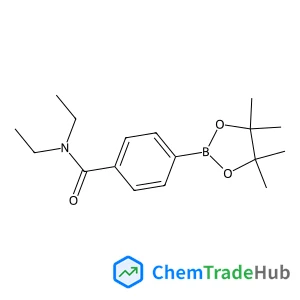
N,N-Diethyl-4-(4,4,5,5-tetramethyl-1,3,2-dioxaborolan-2-yl)benzamide
CAS番号:
325142-99-2
分子式:
C17H26BNO3
Chitin agglomerated scaffolds were produced and functionalized using green chemistry principles and clean technologies. This combination enabled the functionalization of chitin microparticles prepared by dissolution of the polymer in ionic liquids, followed by the application of a sol–gel method. Finally, the 3D constructs were moulded and dried by a supercritical assisted agglomeration method. Structural and morphological characterization was performed using scanning electron microscopy (SEM) and micro-computed tomography (μ-CT). An evaluation of the bioactive behavior of the matrices was done by immersing them in simulated body fluid (SBF) for up to 21 days. The potential use of such matrices as drug delivery systems was evaluated after the incorporation of dexamethasone into the matrices during drying in supercritical assisted agglomeration. The findings suggested that the morphological features such as porosity, interconnectivity and pore size distribution of the matrices can be tuned by changing the particle size, chitin concentration and the pressure applied during moulding. Chitin microspheres were modified by siloxane and silanol groups, providing a bioactive behavior; the apatite formation was shown to be dependent on the amount and arrangement of silanol groups. Furthermore, in vitro drug release studies showed that dexamethasone was sustainably released. All these findings suggest that this strategy is a feasible and advantageous process to obtain chitin-based 3D structures with both functional and structural characteristics that make them suitable for regenerative medicine applications.
Hideaki Kanayama, Te Ma, Satoru Tsuchikawa, Tetsuya Inagaki
DOI: 10.1039/C9AN01180C
Thomas P. Forbes, Jeffrey Lawrence, Jennifer R. Verkouteren, R. Michael Verkouteren
DOI: 10.1039/C9AN01771B
Abby S. Gelb, Rui Lai
DOI: 10.1039/C9AN00875F
Zoe M. Smith, Emily Kerr, Egan H. Doeven, Neil W. Barnett, Paul S. Donnelly, Stephen J. Haswell, Paul S. Francis
DOI: 10.1039/C6AN00141F
Yanli Zhou, Huijie Huangfu, Jie Yang, Hui Dong, Lantao liu, Maotian Xu
DOI: 10.1039/C9AN01600G
Ruixue Cui, Yongyan Wan, Guanfeng Ji, Zhiliang Liu
DOI: 10.1039/C9AN01204D
DOI: 10.1039/C9AN01078E
2-ヒドロキシ-5-ニトロベンジンブロモイドは特定の化学反応に適しているため、代替品は限られています。しかし、同様の構造を持つ2-ヒドロキシ-4-ニトロベンジン...
N-(2-ブロモフェニル)-1-チロール-3-オキソ-3-(ピペリジニル)プロペン-2-イル)ベンゼンアミドは有毒で、皮膚や粘膜に刺激を与える可能性があります。...
この化合物は、新規治療薬の開発に注目されています。市場では、その有効性と安全性が評価され、研究分野では、分子生物学と医薬化学の新たな発見が期待されています。
Succinimidyl-alanyl-phenylalanyl-prolyl-phenylalanine 4-nitroanilide は主に医薬品開発やポ...
メチル6-アミノ-5-クロロピリジン-2-カーボイル酸(CAS番号: 1256794-05-4)の使用には、GHS( Globally Harmonized S...
取り扱いには、耐薬品性の容器を使用し、通気性の良い場所で操作することを推奨します。漏れ時は、SDS(安全データシート)を参照して適切な措置を取ること。手洗いと洗...
(S)-3-ベンZYルピペリジン塩酸塩は、CAS番号1258940-00-9で表される化合物です。これは、(S)-3-苯基哌啶的盐酸盐であり、主に医薬品の原料と...
3,5-二甲基金剛胺は、主に医薬品の原料として使用され、また抗うつ薬や抗アルツハイマー薬の開発に利用されます。さらに、化粧品や食品添加物の製造でも重要な役割を果...
ビス(4-メチル-2-ペンチル)フェニルカルボン酸エステル (CAS番号: 1398066-13-1) の代替品には、ビス(2-エチルヘキシル)フェノールカルボ...

Green Chemistry provides a unique forum for the publication of innovative research on the development of alternative green and sustainable technologies. The scope of Green Chemistry is based on, but not limited to, the definition proposed by Anastas and Warner (Green Chemistry: Theory and Practice, P T Anastas and J C Warner, Oxford University Press, Oxford, 1998). Green chemistry is the utilisation of a set of principles that reduces or eliminates the use or generation of hazardous substances in the design, manufacture and application of chemical products. Green Chemistry is at the frontiers of this continuously-evolving interdisciplinary science and publishes research that attempts to reduce the environmental impact of the chemical enterprise by developing a technology base that is inherently non-toxic to living things and the environment. Submissions on all aspects of research relating to the endeavour are welcome. The journal publishes original and significant cutting-edge research that is likely to be of wide general appeal. To be published, work must present a significant advance in green chemistry. Papers must contain a comparison with existing methods and demonstrate advantages over those methods before publication can be considered. For more information please see this Editorial. Coverage includes the following, but is not limited to: Design (e.g. biomimicry, design for degradation/recycling/reduced toxicity…) Reagents & Feedstocks (e.g. renewables, CO2, solvents, auxiliary agents, waste utilization…) Synthesis (e.g. organic, inorganic, synthetic biology…) Catalysis (e.g. homogeneous, heterogeneous, enzyme, whole cell…) Process (e.g. process design, intensification, separations, recycling, efficiency…) Energy (e.g. renewable energy, fuels, photovoltaics, fuel cells, energy storage, energy carriers…) Applications (e.g. electronics, dyes, consumer products, coatings, pharmaceuticals, preservatives, building materials, chemicals for industry/agriculture/mining…) Impact (e.g. safety, metrics, LCA, sustainability, (eco)toxicology…) Green chemistry is, by definition, a continuously-evolving frontier. Therefore, the inclusion of a particular material or technology does not, of itself, guarantee that a paper is suitable for the journal. To be suitable, the novel advance should have the potential for reduced environmental impact relative to the state of the art. Green Chemistry does not normally deal with research associated with 'end-of-pipe' or remediation issues.