













Recent developments in the application of nanomaterials to understanding molecular level processes in cobalt catalysed Fischer–Tropsch synthesis
文献情報
出版日
2014-01-24
DOI
10.1039/C3CP55030C
インパクトファクター
3.676
著者
原文を見る
要旨
This perspective offers an overview of using nanomaterials for understanding cobalt catalysed Fischer–Tropsch chemistry. Nanomaterials now afford unprecedented control of size, shape and structure at the nanometre scale. This makes them invaluable tools for studying heterogeneous catalysis. The Fischer–Tropsch reaction, especially using cobalt based catalysts, is a linchpin in many processes for utilising other feedstocks (via gasification) that have been envisaged as short/medium term replacements for crude oil. The underlying chemistry has therefore garnered considerable renewed interest. The current state of the art in mechanistic understanding is summarised and the application of nanomaterials to developing this further is explored. Several specific questions, to which nanomaterials have already contributed answers, are addressed: how do nanomaterials contribute to our understanding of cobalt particle size effects, reducibility, and the effect of support porosity and how do precious metal promoters operate in cobalt catalysed Fischer–Tropsch chemistry? Future possible uses for nanomaterials in studying this field are also identified.
関連文献
Highly sensitive detection of cancer-related genes based on complete fluorescence restoration of a molecular beacon with a functional overhang
Feng Li, Ying-Ying Zhou, Ting Peng, Huo Xu, Rong-Bo Zhang, Hui Zhao, Zheng-yong Wang, Jian-Xin Lv, Zai-Sheng Wu, Zhi-Fa Shen
2016-05-11
Paper
DOI: 10.1039/C6AN00898D
Lateral flow fluorescent immunoassay based on isothermal amplification for rapid quantitative detection of Salmonella spp.
Linlin Zhuang, Jiansen Gong, Yongxin Ji, Peilong Tian, Fei Kong, Huiyuan Bai, Ning Gu, Yu Zhang
2020-01-17
Paper
DOI: 10.1039/C9AN02011J
A nanoplasmonic probe as a triple channel colorimetric sensor array for protein discrimination
Jinpeng Mao, Yuexiang Lu, Ning Chang, Jiaoe Yang, Jiacheng Yang, Sichun Zhang, Yueying Liu
2016-05-18
Communication
DOI: 10.1039/C6AN00302H
Photoelectrocatalytic analysis and electrocatalytic determination of hydroquinone by using a Cu2O–reduced graphene oxide nanocomposite modified rotating ring-disk electrode
Hong Xie, Kaiyue Duan, Muyin Xue, Yongling Du, Chunming Wang
2016-05-31
Paper
DOI: 10.1039/C6AN00545D
An array of individually addressable micro-needles for mapping pH distributions
Claudio Zuliani, Fu Siong Ng, Andrea Alenda, Amir Eftekhar, Nicholas S. Peters, Christofer Toumazou
2016-05-11
Paper
DOI: 10.1039/C6AN00639F
Retraction: Microelectrochemical cell arrays for whole-cell currents recording through ion channel proteins based on trans-electroporation approach
Jan C. Behrends, Jürgen Rühe
2020-01-31
Retraction
DOI: 10.1039/D0AN90011G
A high-sensitive sensor with HEPES-enhanced electrochemiluminescence of benzo[3]uril for Fe3+ and its application in human serum
Yao Lei, Fei Qiu, Jian-Mei Yang, Mao Liu, Qing-Mei Ge, Hang Cong, Zhu Tao
2019-12-27
Paper
DOI: 10.1039/C9AN02156F
Study of the intracellular nanoparticle-based radiosensitization mechanisms in F98 glioma cells treated with charged particle therapy through synchrotron-based infrared microspectroscopy
I. Martínez-Rovira, S. Brons, I. Yousef
2020-01-29
Paper
DOI: 10.1039/C9AN02350J
Real-time neurochemical measurement of dynamic metabolic events during cardiac arrest and resuscitation in a porcine model
Sally A. N. Gowers, Isabelle C. Samper, De-Shaine R. K. Murray, Georgia K. Smith, Sarah Jeyaprakash, Michelle L. Rogers, Michael Karlsson, Markus Harboe Olsen, Kirsten Møller, Martyn G. Boutelle
2020-01-24
Paper
DOI: 10.1039/C9AN01950B
Employment of electrostatic interactions for amperometric detection of carbon nanoparticles in a FIA system
D. Ogończyk, M. Opallo
2016-04-29
Paper
DOI: 10.1039/C6AN00752J
こちらもおすすめ
化合物よくある質問
2,3-スチオエポキシマドルを取り扱う際の実験室安全事項は何ですか?
取り扱いにはPPE(プロテクティブ・パーソナル・エイド)が必要で、防ぐ手袋と保護眼鏡を着用してください。ドラフトチャンバーの使用を推奨します。漏洩した場合は、適...
4267-80-52,3-Thioepoxy Madol
53981-25-22-Amino-6-fluorophen...
化合物よくある質問
BOC-S-3-アミニ-4-(4-メチオキシベンチル)-ブタン酸の代替品はありますか?
この化合物の代替品としては、BOC保護基を有さないアミノ酸やその他の保護基化合物が考えられます。また、メチオキシ基を有しない他の芳香族アミノ酸も代替品として挙げ...
126800-59-7(3S)-4-(4-Methoxyphe...
化合物よくある質問
Methyl 2-(chloromethyl)-3-nitrobenzoate(1218910-61-2)の代替品はありますか?
Methyl 2-(chloromethyl)-3-nitrobenzoate(1218910-61-2)の代替品としては、化学組成を変えることで効果を達成する...
1218910-61-2Methyl 2-(chlorometh...
化合物よくある質問
(2R)-2-アミノ-N-ベンジル-3-ヒドロキシプロパナミドを含む廃棄物はどのように処理すべきですか?
(2R)-2-アミノ-N-ベンジル-3-ヒドロキシプロパナミドを含む廃棄物は、適切な廃棄物管理ガイドラインに基づき処理する必要があります。まず、廃棄物を適切に収...
175481-39-7(2R)-2-amino-N-benzy...
化合物よくある質問
6,7-二氢-咪唑並[1,2-a]ピリドイン-8(5h)-酮はどのように合成されますか?
6,7-二氢-咪唑並[1,2-a]ピリドイン-8(5h)-酮は、2-ブロモフェニルアセトインとリン酸ハロゲン化物を反応させることで合成できます。この反応は高温で...
457949-09-66,7-Dihydroimidazo[1...
化合物よくある質問
エチル(3R)-3-ピロリジニル酢酸水和塩とは何ですか?
エチル(3R)-3-ピロリジニル酢酸水和塩は、CAS番号1332459-32-1の化合物で、(R)-乙基2-(ピロリジン-3-基)酢酸塩水和塩と呼ばれます。この...
1332459-32-1Ethyl (3R)-3-pyrroli...
化合物よくある質問
(2S)-{[(2-メチルエチルオキシ]カルボニル}アミノ)[2-(トリアフルオロメチルフェニル]エチカシック酸の物理化学的性質は何ですか?
(2S)-{[(2-メチルエチルオキシ]カルボニル}アミノ)[2-(トリアフルオロメチルフェニル]エチカシック酸のCAS番号は1203454-45-8です。この...
1203454-45-8(2S)-({[(2-Methyl-2-...
化合物よくある質問
2-ブロモ-1-(2-メチル-2-プロパニル)-4-ニトロベンゼンはどのように保存すればよいですか?
2-ブロモ-1-(2-メチル-2-プロパニル)-4-ニトロベンゼンは、直射日光を避けて暗所で、室温(約15℃〜25℃)、乾燥した場所に保存する必要があります。ま...
6310-17-42-Bromo-1-(2-methyl-...
化合物よくある質問
1-[(4-硝基フェニル)スルホニル]-1H-1,2,4-三唑の市場動向や研究トレンドはどうですか?
市場動向としては、1-[(4-硝基フェニル)スルホニル]-1H-1,2,4-三唑は主に農業用除草剤や合成化学製品の原料として利用されています。研究トレンドとして...
57777-84-11-[(4-Nitrophenyl)su...
掲載誌
Physical Chemistry Chemical Physics

CiteScore:
5.5
自己引用率:
10.3%
年間論文数:
3036
Physical Chemistry Chemical Physics (PCCP) is an international journal co-owned by 19 physical chemistry and physics societies from around the world. This journal publishes original, cutting-edge research in physical chemistry, chemical physics and biophysical chemistry. To be suitable for publication in PCCP, articles must include significant innovation and/or insight into physical chemistry; this is the most important criterion that reviewers and Editors will judge against when evaluating submissions. The journal has a broad scope and welcomes contributions spanning experiment, theory, computation and data science. Topical coverage includes spectroscopy, dynamics, kinetics, statistical mechanics, thermodynamics, electrochemistry, catalysis, surface science, quantum mechanics, quantum computing and machine learning. Interdisciplinary research areas such as polymers and soft matter, materials, nanoscience, energy, surfaces/interfaces, and biophysical chemistry are welcomed if they demonstrate significant innovation and/or insight into physical chemistry. Joined experimental/theoretical studies are particularly appreciated when complementary and based on up-to-date approaches.
おすすめ化合物

![6,6-Dimethylbicyclo[3.1.1]hept-2-ene-2-carbaldehyde structure](https://static.chemtradehub.com/structs/564/564-94-3-e746.webp "6,6-Dimethylbicyclo[3.1.1]hept-2-ene-2-carbaldehyde structure")
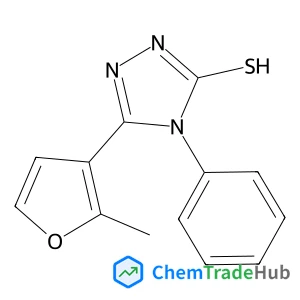
5-(2-Methyl-3-furyl)-4-phenyl-2,4-dihydro-3H-1,2,4-triazole-3-thione
CAS番号:
346464-59-3
分子式:
C13H11N3OS

おすすめサプライヤー





免責事項
このページに表示される学術雑誌情報は、参考および研究目的のみを目的としています。当社は雑誌出版社とは提携しておらず、投稿の取り扱いも行っておりません。出版に関するお問い合わせは、各雑誌出版社に直接ご連絡ください。
表示されている情報に誤りがある場合は、support@chemtradehub.com までご連絡ください。迅速に確認し、対応いたします。