












Photofragmentation spectroscopy of cold protonated aromatic amines in the gas phase
文献情報
出版日
2014-01-20
DOI
10.1039/C3CP54736A
インパクトファクター
3.676
著者
Géraldine Féraud, Claude Dedonder-Lardeux, Gilles Grégoire, Satchin Soorkia, Christophe Jouvet
原文を見る
要旨
The electronic spectra of cold protonated aromatic amines: anilineH+ C6H5–NH3+, benzylamineH+ C6H5–CH2–NH3+ and phenylethylamineH+ C6H5–(CH2)2–NH3+ have been investigated experimentally in a large spectral domain and are compared to those of their hydroxyl homologues. In the low energy region, the electronic spectra are similar to their neutral analogues, which reveals the ππ* character of their first excited state. A second transition is observed from 0.4 to 1 eV above the origin band, which is assigned to the excitation of the πσ* state. In these protonated amine molecules, there is a competition between different fragmentation channels, some being specific to UV excitation i.e., not observed in low-energy collision induced dissociation experiments. Besides, for one amine a drastic change in the fragmentation branching ratio is observed within a very short energy range that reveals the complex excited state dynamics and fragmentation processes. The experimental observations can be rationalized using a simple qualitative model, the ππ*–πσ* model [A. L. Sobolewski, W. Domcke, C. Dedonder-Lardeux and C. Jouvet, Phys. Chem. Chem. Phys., 2002, 4, 1093–1100], which predicts that the excited state dynamics is controlled by the crossing between the ππ* excited state and a πσ* state repulsive along the XH (X being O or N) coordinate.
おすすめジャーナル
関連文献
Simple phenylpropanoids: recent advances in biological activities, biosynthetic pathways, and microbial production
Zhanpin Zhu, Ruibing Chen
2023-10-09
Review Article
DOI: 10.1039/D3NP00012E
Tumor microenvironment-responsive degradable silica nanoparticles: design principles and precision theranostic applications
Kaiyuan Tang, Zilu Liu, Zhijing Zhang, Shufan Duan, Hui Wang, Hui Yang, Dongliang Yang, Wenpei Fan
2023-11-29
Review Article
DOI: 10.1039/D3NH00388D
Dual carbon engineering enabling 1T/2H MoS2 with ultrastable potassium ion storage performance
Rong Hu, Yanqi Tong, Jinling Yin, Junxiong Wu, Jing Zhao, Dianxue Cao, Guiling Wang, Kai Zhu
2023-12-20
Communication
DOI: 10.1039/D3NH00404J
Active sites of NO selective catalytic reduction over V2O5–WO3/TiO2
Dongrun Xu, Weiye Qu, Junhong Liu, Junxiao Chen, Xue Fang, Liwei Chen, Xi Liu, Yaxin Chen
2023-10-26
Paper
DOI: 10.1039/D3TA05525F
Boosting the in-plane thermal conductivity of nanofibrillated cellulose films: alignment engineering of cross-linked AlN whiskers
Mengyang Niu, Zheng Zhao, Baokai Wang, Chang Yu, Mengyi Li, Jiajun Hu, Lifeng Zhu, Xu Hao, Shiqin Wan, Ming Yue, Weiwei Xuan, Qipeng Lu, Wenbin Cao, Kexin Chen, Qi Wang
2023-10-04
Paper
DOI: 10.1039/D3TA04770A
A solely biobased strain sensor with an ultra-precision response via a surface graphitization strategy
Zhihao Yang, Ying Yuan, Bin Wang, Xiaojun Shen, Xiluan Wang, Tong-Qi Yuan
2023-11-02
Paper
DOI: 10.1039/D3TA04872A
Chemistry and bioactivity of lindenane sesquiterpenoids and their oligomers
Jun Luo, Danyang Zhang, Pengfei Tang, Nan Wang, Shuai Zhao, Lingyi Kong
2023-10-04
Review Article
DOI: 10.1039/D3NP00022B
Microelectromechanical system for in situ quantitative testing of tension–compression asymmetry in nanostructures
Yuheng Huang, Kuibo Yin, Binghui Li, Anqi Zheng, Bozhi Wu, Litao Sun, Meng Nie
2023-11-21
Communication
DOI: 10.1039/D3NH00407D
Porous Ga0.25Li6.25La3Zr2O12 frameworks by gelcasting–reaction sintering for high-performance hybrid quasi-solid lithium metal batteries
Ying Zhou, Ying Tian, Wen Wang, Yu Zhou
2023-09-29
Paper
DOI: 10.1039/D3TA04638A
Mechanical disassembly of human picobirnavirus like particles indicates that cargo retention is tuned by the RNA–coat protein interaction
Javier M. Rodríguez
2023-10-05
Communication
DOI: 10.1039/D3NH00195D
こちらもおすすめ
化合物よくある質問
2,3-スチオエポキシマドルを取り扱う際の実験室安全事項は何ですか?
取り扱いにはPPE(プロテクティブ・パーソナル・エイド)が必要で、防ぐ手袋と保護眼鏡を着用してください。ドラフトチャンバーの使用を推奨します。漏洩した場合は、適...
4267-80-52,3-Thioepoxy Madol
53981-25-22-Amino-6-fluorophen...
化合物よくある質問
BOC-S-3-アミニ-4-(4-メチオキシベンチル)-ブタン酸の代替品はありますか?
この化合物の代替品としては、BOC保護基を有さないアミノ酸やその他の保護基化合物が考えられます。また、メチオキシ基を有しない他の芳香族アミノ酸も代替品として挙げ...
126800-59-7(3S)-4-(4-Methoxyphe...
化合物よくある質問
Methyl 2-(chloromethyl)-3-nitrobenzoate(1218910-61-2)の代替品はありますか?
Methyl 2-(chloromethyl)-3-nitrobenzoate(1218910-61-2)の代替品としては、化学組成を変えることで効果を達成する...
1218910-61-2Methyl 2-(chlorometh...
化合物よくある質問
(2R)-2-アミノ-N-ベンジル-3-ヒドロキシプロパナミドを含む廃棄物はどのように処理すべきですか?
(2R)-2-アミノ-N-ベンジル-3-ヒドロキシプロパナミドを含む廃棄物は、適切な廃棄物管理ガイドラインに基づき処理する必要があります。まず、廃棄物を適切に収...
175481-39-7(2R)-2-amino-N-benzy...
化合物よくある質問
6,7-二氢-咪唑並[1,2-a]ピリドイン-8(5h)-酮はどのように合成されますか?
6,7-二氢-咪唑並[1,2-a]ピリドイン-8(5h)-酮は、2-ブロモフェニルアセトインとリン酸ハロゲン化物を反応させることで合成できます。この反応は高温で...
457949-09-66,7-Dihydroimidazo[1...
化合物よくある質問
エチル(3R)-3-ピロリジニル酢酸水和塩とは何ですか?
エチル(3R)-3-ピロリジニル酢酸水和塩は、CAS番号1332459-32-1の化合物で、(R)-乙基2-(ピロリジン-3-基)酢酸塩水和塩と呼ばれます。この...
1332459-32-1Ethyl (3R)-3-pyrroli...
化合物よくある質問
(2S)-{[(2-メチルエチルオキシ]カルボニル}アミノ)[2-(トリアフルオロメチルフェニル]エチカシック酸の物理化学的性質は何ですか?
(2S)-{[(2-メチルエチルオキシ]カルボニル}アミノ)[2-(トリアフルオロメチルフェニル]エチカシック酸のCAS番号は1203454-45-8です。この...
1203454-45-8(2S)-({[(2-Methyl-2-...
化合物よくある質問
2-ブロモ-1-(2-メチル-2-プロパニル)-4-ニトロベンゼンはどのように保存すればよいですか?
2-ブロモ-1-(2-メチル-2-プロパニル)-4-ニトロベンゼンは、直射日光を避けて暗所で、室温(約15℃〜25℃)、乾燥した場所に保存する必要があります。ま...
6310-17-42-Bromo-1-(2-methyl-...
化合物よくある質問
1-[(4-硝基フェニル)スルホニル]-1H-1,2,4-三唑の市場動向や研究トレンドはどうですか?
市場動向としては、1-[(4-硝基フェニル)スルホニル]-1H-1,2,4-三唑は主に農業用除草剤や合成化学製品の原料として利用されています。研究トレンドとして...
57777-84-11-[(4-Nitrophenyl)su...
掲載誌
Physical Chemistry Chemical Physics

CiteScore:
5.5
自己引用率:
10.3%
年間論文数:
3036
Physical Chemistry Chemical Physics (PCCP) is an international journal co-owned by 19 physical chemistry and physics societies from around the world. This journal publishes original, cutting-edge research in physical chemistry, chemical physics and biophysical chemistry. To be suitable for publication in PCCP, articles must include significant innovation and/or insight into physical chemistry; this is the most important criterion that reviewers and Editors will judge against when evaluating submissions. The journal has a broad scope and welcomes contributions spanning experiment, theory, computation and data science. Topical coverage includes spectroscopy, dynamics, kinetics, statistical mechanics, thermodynamics, electrochemistry, catalysis, surface science, quantum mechanics, quantum computing and machine learning. Interdisciplinary research areas such as polymers and soft matter, materials, nanoscience, energy, surfaces/interfaces, and biophysical chemistry are welcomed if they demonstrate significant innovation and/or insight into physical chemistry. Joined experimental/theoretical studies are particularly appreciated when complementary and based on up-to-date approaches.
おすすめ化合物
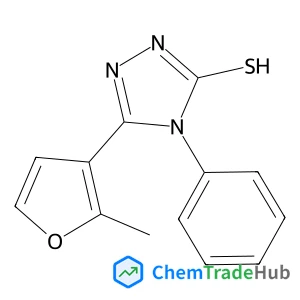
5-(2-Methyl-3-furyl)-4-phenyl-2,4-dihydro-3H-1,2,4-triazole-3-thione
CAS番号:
346464-59-3
分子式:
C13H11N3OS
おすすめサプライヤー



免責事項
このページに表示される学術雑誌情報は、参考および研究目的のみを目的としています。当社は雑誌出版社とは提携しておらず、投稿の取り扱いも行っておりません。出版に関するお問い合わせは、各雑誌出版社に直接ご連絡ください。
表示されている情報に誤りがある場合は、support@chemtradehub.com までご連絡ください。迅速に確認し、対応いたします。