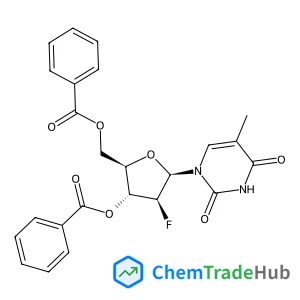
1-(3',5'-Di-O-benzoyl-2'-deoxy-2'-fluoro-b-D-arabinofuranosyl)thymine
CAS番号:
97614-47-6
分子式:
C24H21FN2O7
Sylvain R. A. Marque, Didier Siri
The Intramolecular Proton Transfer (IPT) in alkoxyamines is one of the main factors determining the process of Nitroxide Mediated Polymerization (NMP). Recently, we proposed an experimental approach to study IPT and applied it to a series of alkoxyamines. It was found that IPT dramatically depends on the structure of the alkoxyamine, but it was not clear which factors are significant for IPT (M. V. Edeleva et al., J. Polym. Sci., Part A: Polym. Chem. 2009, 47, 6579–6595). To understand the mechanism and the factors determining the IPT process, in this article we investigate the geometrical parameters and thermokinetics of this reaction using the BMK/6-311++G(3df,3pd)//B3LYP/6-31+G(d,p) method. It was found that the thermokinetics and geometrical parameters of the transition state (TS) for IPT do not depend on the alkoxyamine structure. The only factor which determines the occurrence of IPT is the position of the TS energy level of the C–ON bond homolysis.
Manuel Montenegro, Mireia Garcia-Viloca, José M. Lluch, Àngels González-Lafont
DOI: 10.1039/C0CP01062F
DOI: 10.1039/C0CP01745K
Masao Gohdo, Tadashi Takamasu, Masanobu Wakasa
DOI: 10.1039/C0CP00077A
Yaroslava Lykhach, Thorsten Staudt, Nataliya Tsud, Tomáš Skála, Kevin Charles Prince, Vladimír Matolín
DOI: 10.1039/C0CP00345J
Mario Ishizaki, Hideki Tanaka, Kenichiro Koga
DOI: 10.1039/C0CP01767A
Jacek Kłos, Majdi Hochlaf
DOI: 10.1039/C004945J
Kenneth Ruud
DOI: 10.1039/C0CP01149E
Piotr S. Żuchowski, Michał Hapka, Marcin Modrzejewski, Małgorzata M. Szczęśniak, Grzegorz Chałasiński
DOI: 10.1039/C0CP00626B
Mohammad S. Yalfani, Sandra Contreras, Jordi Llorca, Montserrat Dominguez, Jesus E. Sueiras, Francesc Medina
DOI: 10.1039/C0CP01157F
Weijia Zhou, Hong Liu, Jiyang Wang, Duo Liu, Guojun Du, Shujuan Han, Jianjian Lin, Ruijun Wang
DOI: 10.1039/C0CP00734J
オステニ二甲磺酸塩は、GHS分類に基づき corrosive 物質として分類されます。REACH規則では、該当物質の登録が要求される可能性があります。また、FD...
環丁基肼盐酸盐は毒性があり、吸入や皮膚接触は有害です。使用時の安全対策として、密閉システムを使用し、適切な排気設備を備えた場所で作業することが推奨されます。
N-(4-パリドン基ソニルフェニル)硫代イソシアネートは高毒性で、皮膚や吸入による毒性があります。取り扱う際は防毒マスク、保護用手袋、保護眼鏡などのPPEを着用...
CAS番号3416-18-0の5-ヒドロキシ-1,3-ジヒドロ-2H-インドン-2-酮は、結晶性の白色粉末です。分子量は228.25であり、 aqueous m...
O-苄基-D-丝氨醇は、D-アミノ酸とベンゼン環の経由で合成されます。触媒としてジメチルアミノピリジンが使用され、選択性は高いです。一般的な収率は約90%です。
ナトリウム3-ヒドロキシbutano酸は、CAS番号13613-65-5で登録されている化合物です。この化合物は、(3R)-3-ヒドロキシbutano酸とナトリ...
CAS番号603-37-2の1-(二苯甲基)-4-甲基ベンゼンは、結晶性の固体で、分子量は244.28であり、水中的には微溶です。この化合物は有機反応において中...
ネアミン塩酸塩の分子量は321.19であり、結晶性の白色粉末です。この化合物は水に溶けやすく、pHが低くなると不溶性になります。反応活性は高く、水溶液中の酸化還...
偶氮二甲酰二哌啶は、医薬品、染料、高 Então 剤、触媒、溶媒、量論試薬など、様々な分野で使用されています。特に、高 Enough 反応において、グリコール酸...

Physical Chemistry Chemical Physics (PCCP) is an international journal co-owned by 19 physical chemistry and physics societies from around the world. This journal publishes original, cutting-edge research in physical chemistry, chemical physics and biophysical chemistry. To be suitable for publication in PCCP, articles must include significant innovation and/or insight into physical chemistry; this is the most important criterion that reviewers and Editors will judge against when evaluating submissions. The journal has a broad scope and welcomes contributions spanning experiment, theory, computation and data science. Topical coverage includes spectroscopy, dynamics, kinetics, statistical mechanics, thermodynamics, electrochemistry, catalysis, surface science, quantum mechanics, quantum computing and machine learning. Interdisciplinary research areas such as polymers and soft matter, materials, nanoscience, energy, surfaces/interfaces, and biophysical chemistry are welcomed if they demonstrate significant innovation and/or insight into physical chemistry. Joined experimental/theoretical studies are particularly appreciated when complementary and based on up-to-date approaches.