


The optical activity of β,γ-enones in ground and excited states using circular dichroism and circularly polarized luminescence
文献情報
出版日
2010-10-29
DOI
10.1039/C0CP01149E
インパクトファクター
3.676
著者
Kenneth Ruud
原文を見る
要旨
The circularly polarized luminescence (CPL) and electronic circular dichroism (CD) spectroscopic parameters corresponding to the n ← π* and n → π* transitions, respectively, have been calculated for selected β,γ-enones using density functional theory. For the smallest β,γ-enone, (1R,4R)-bicyclo[2.2.1]hept-5-en-2-one (norbornenone), coupled-cluster calculations have also been carried out. The excited-state potential energy surface for three of the five enones studied reveals two minima with different CO⋯CC dihedral angles, and with rotatory strengths of opposite sign. The relative energies of the minima determine the sign of the CPL intensity, which may be the same or opposite as in the CD spectrum, in agreement with experimental data. The results obtained in this first computational study of CPL demonstrate its usefulness as an indicator of excited-state structures of chiral species.
おすすめジャーナル

Synthetic Communications

European Journal of Medicinal Chemistry

Journal of Dispersion Science and Technology

Annual Review of Public Health

Bulletin of Materials Science

Pharmaceutical Chemistry Journal

Journal of Natural Products

Crystal Research and Technology

Pharmacology & Therapeutics

Bioorganic Chemistry
関連文献
Gated molecular baskets
Keith Hermann, Yian Ruan, Alex M. Hardin, Christopher M. Hadad, Jovica D. Badjić
2014-06-13
Review Article
DOI: 10.1039/C4CS00140K
Biomimetic electro-oxidation of alkyl sulfides from exfoliated molybdenum disulfide nanosheets
Lahcene Maachou, Kun Qi, Eddy Petit, Zhaodan Qin, Yang Zhang, Didier Cot, Valérie Flaud, Corine Reibel, Heba El-Maghrbi, Lei Li, Philippe Miele, Daniel Kaplan, Manish Chhowalla, Nicolas Onofrio, Damien Voiry
2020-11-10
Paper
DOI: 10.1039/D0TA09045J
Self-produced bubble-template synthesis of La2O3:Yb/Er@Au hollow spheres with markedly enhanced luminescence and release properties
Ruichan Lv, Guixin Yang, Yunlu Dai, Shili Gai, Fei He, Piaoping Yang
2014-07-07
Paper
DOI: 10.1039/C4CE01063A
Effects of substrate temperature on the crystallization process and properties of mixed-ion perovskite layers
Chen Zhao, Deng Li, Heng Guo, Feiyi Liao, Wei Cao, Xiaobin Niu, Yiying Zhao
2019-01-08
Paper
DOI: 10.1039/C8TA10170A
Water-induced room-temperature transformation of straight Ge/Si core/shell nanowires into circular silica nanotubes
Byeong Geun Kim, Byung-Sung Kim, Dongmok Whang, Heon-Jin Choi, Soon-Mok Choi, Won-Seon Seo, Seong-Min Jeong
2015-07-07
Paper
DOI: 10.1039/C5CE00974J
Splitting growth of novel CuO straw sheaves and their improved photocatalytic activity due to exposed active {110} facets and crystallinity
Yunxuan Zhao, Huaxia Shi, Mingdong Chen, Fei Teng
2014-01-10
Paper
DOI: 10.1039/C3CE42271B
Proton delivery through a dynamic 3D H-bond network constructed from dense hydroxyls for advanced ion-selective membranes
Lei Hu, Li Gao, Wenji Zheng, Yan Dai, Ce Hao, Xuemei Wu
2019-05-24
Paper
DOI: 10.1039/C9TA04423J
Historical corner. Analytical spectroscopy: the beginnings and the Scottish connection
Other
DOI: 10.1039/JA9860100100
こちらもおすすめ
化合物よくある質問
オステニ二甲磺酸塩に適用される法規ガイドラインは何ですか?
オステニ二甲磺酸塩は、GHS分類に基づき corrosive 物質として分類されます。REACH規則では、該当物質の登録が要求される可能性があります。また、FD...
2070014-82-1N-(2-{[2-(Dimethylam...
化合物よくある質問
環丁基肼盐酸盐は安全ですか?
環丁基肼盐酸盐は毒性があり、吸入や皮膚接触は有害です。使用時の安全対策として、密閉システムを使用し、適切な排気設備を備えた場所で作業することが推奨されます。
1156980-49-2Cyclobutylhydrazine ...
化合物よくある質問
N-(4-パリドン基ソニルフェニル)硫代イソシアネートを取り扱う際の実験室安全事項は何ですか?
N-(4-パリドン基ソニルフェニル)硫代イソシアネートは高毒性で、皮膚や吸入による毒性があります。取り扱う際は防毒マスク、保護用手袋、保護眼鏡などのPPEを着用...
7356-55-01-[(4-Isothiocyanato...
化合物よくある質問
5-ヒドロキシ-1,3-ジヒドロ-2H-インドン-2-酮の物理化学的性質は何ですか?
CAS番号3416-18-0の5-ヒドロキシ-1,3-ジヒドロ-2H-インドン-2-酮は、結晶性の白色粉末です。分子量は228.25であり、 aqueous m...
3416-18-05-Hydroxy-1,3-dihydr...
化合物よくある質問
O-苄基-D-丝氨醇はどのように合成されますか?
O-苄基-D-丝氨醇は、D-アミノ酸とベンゼン環の経由で合成されます。触媒としてジメチルアミノピリジンが使用され、選択性は高いです。一般的な収率は約90%です。
58577-88-1(s)-2-Amino-3-benzyl...
化合物よくある質問
ナトリウム3-ヒドロキシbutano酸とは何ですか?
ナトリウム3-ヒドロキシbutano酸は、CAS番号13613-65-5で登録されている化合物です。この化合物は、(3R)-3-ヒドロキシbutano酸とナトリ...
13613-65-5sodium;(3R)-3-hydrox...
化合物よくある質問
1-(二苯甲基)-4-甲基ベンゼンの物理化学的性質は何ですか?
CAS番号603-37-2の1-(二苯甲基)-4-甲基ベンゼンは、結晶性の固体で、分子量は244.28であり、水中的には微溶です。この化合物は有機反応において中...
603-37-21-(Diphenylmethyl)-4...
化合物よくある質問
ネアミン塩酸塩の物理化学的性質は何ですか?
ネアミン塩酸塩の分子量は321.19であり、結晶性の白色粉末です。この化合物は水に溶けやすく、pHが低くなると不溶性になります。反応活性は高く、水溶液中の酸化還...
15446-43-2NEAMINE HYDROCHLORID...
化合物よくある質問
偶氮二甲酰二哌啶の主な用途は何ですか?
偶氮二甲酰二哌啶は、医薬品、染料、高 Então 剤、触媒、溶媒、量論試薬など、様々な分野で使用されています。特に、高 Enough 反応において、グリコール酸...
10465-81-3(E)-1,2-Diazenediylb...
664969-54-44-[(2E)-3-Phenyl-2-p...
掲載誌
Physical Chemistry Chemical Physics

CiteScore:
5.5
自己引用率:
10.3%
年間論文数:
3036
Physical Chemistry Chemical Physics (PCCP) is an international journal co-owned by 19 physical chemistry and physics societies from around the world. This journal publishes original, cutting-edge research in physical chemistry, chemical physics and biophysical chemistry. To be suitable for publication in PCCP, articles must include significant innovation and/or insight into physical chemistry; this is the most important criterion that reviewers and Editors will judge against when evaluating submissions. The journal has a broad scope and welcomes contributions spanning experiment, theory, computation and data science. Topical coverage includes spectroscopy, dynamics, kinetics, statistical mechanics, thermodynamics, electrochemistry, catalysis, surface science, quantum mechanics, quantum computing and machine learning. Interdisciplinary research areas such as polymers and soft matter, materials, nanoscience, energy, surfaces/interfaces, and biophysical chemistry are welcomed if they demonstrate significant innovation and/or insight into physical chemistry. Joined experimental/theoretical studies are particularly appreciated when complementary and based on up-to-date approaches.
おすすめ化合物
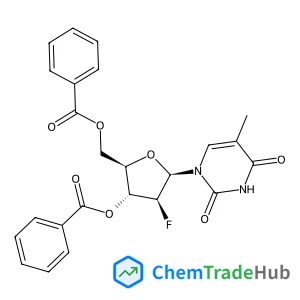
1-(3',5'-Di-O-benzoyl-2'-deoxy-2'-fluoro-b-D-arabinofuranosyl)thymine
CAS番号:
97614-47-6
分子式:
C24H21FN2O7
おすすめサプライヤー




免責事項
このページに表示される学術雑誌情報は、参考および研究目的のみを目的としています。当社は雑誌出版社とは提携しておらず、投稿の取り扱いも行っておりません。出版に関するお問い合わせは、各雑誌出版社に直接ご連絡ください。
表示されている情報に誤りがある場合は、support@chemtradehub.com までご連絡ください。迅速に確認し、対応いたします。