













Monte Carlo simulation and free energies of mixed oxidenanoparticles
文献情報
出版日
2013-03-20
DOI
10.1039/C3CP50388G
インパクトファクター
3.676
著者
John A. Purton, Stephen C. Parker, Neil L. Allan
原文を見る
要旨
A Monte Carlo Exchange technique is used to study the thermodynamic properties of MgO–MnO nanoparticles ranging in size from 1728 to 21 952 ions. The solubility of Mg2+ is much greater in MnO than the reverse, reflecting the difference in size between the two cations. The solubility, for a given temperature, diminishes with nanoparticle size. As the Mn concentration is progressively increased the Mn2+ ions occupy the corners, edges and then surface sites of the nanoparticle before entering subsurface layers. We do not observe any pronounced ordering of the cations within the body of the nanoparticles themselves. The enthalpies of forming ternary nanoparticles from particles of MgO and MnO of the same size vary with the size of the nanoparticle and become more positive for a given concentration as the particle size increases. Free energies of mixing of the two end-member nanoparticles have been determined using the semigrand ensemble. The consolute temperature (the temperature above which there is complete miscibility) increases non-linearly with the size of the nanoparticle by approximately 70% over the size range considered.
関連文献
Fluorescence identification of arthropathic calcium pyrophosphate single crystals using alizarin red S and a xanthene dipicolylamine ZnII complex
Waralee Srinarawat, Ruedee Hemstapat, Tulyapruek Tawonsawatruk, Nisa Patikarnmonthon, Itaru Hamachi, Akio Ojida, Jirarut Wongkongkatep
2022-09-20
Paper
DOI: 10.1039/D2AN01257J
Specific detection of fusion transcripts based on a duplex-specific nuclease and isothermal exponential amplification reaction
Fengxia Su, Tian Li, Xiaofei He, Zhengping Li
2022-11-02
Paper
DOI: 10.1039/D2AN01665F
Detection ofdrug-induced cellular changes using confocal Raman spectroscopy on patterned single-cell biosensors
Ryan Buckmaster, Fareid Asphahani, Myo Thein, Jian Xu, Miqin Zhang
2009-04-30
Paper
DOI: 10.1039/B900420C
Slab waveguide-based particle plasmon resonance optofluidic biosensor for rapid and label-free detection
Devesh Barshilia, Akhil Chandrakanth Komaram, Pin-Chuan Chen
2022-08-18
Paper
DOI: 10.1039/D2AN01092E
Rapid detection and classification of hongmu by atmospheric pressure ionization mass spectrometry
Dehua Yu
2022-09-08
Paper
DOI: 10.1039/D2AN01169G
Correction of axial chromatic aberrations in confocal Raman microspectroscopic measurements of a single microbial spore
Peter Lasch, Antje Hermelink, Dieter Naumann
2009-03-23
Paper
DOI: 10.1039/B822553B
Phenotypic heterogeneity within microbial populations at the single-cell level investigated by confocal Raman microspectroscopy
Antje Hermelink, Angelika Brauer, Peter Lasch, Dieter Naumann
2009-03-25
Paper
DOI: 10.1039/B822574E
Analysis of breast cancer by small angle X-ray scattering (SAXS)
André Luiz Coelho Conceição, Marcelo Antoniassi, Martin Eduardo Poletti
2009-04-06
Paper
DOI: 10.1039/B821434D
こちらもおすすめ
化合物よくある質問
2-ブロモ-9,9-ジフェニル-9H-フルオレンの主な用途は何ですか?
2-溴-9,9-二苯基芴は、医薬品、工業材料、有機合成の研究分野で応用されます。特に、レーザー材料や機能性ポリマーの合成に使用されることがあります。また、蛍光色...
474918-32-62-Bromo-9,9-diphenyl...
化合物よくある質問
四氯化铱の市場動向や研究トレンドはどうですか?
四氯化铱の市場は研究開発分野で注目されており、特にナノ技術や金属有機框架(MOFs)の分野での需要が増加傾向にあります。価格は安定しており、中国や韓国での生産が...
207399-11-9Tetrachloroiridium h...
882-06-44-Nitrocinnamic acid
化合物よくある質問
1-(4-溴-3-氟苯基)-2-氯乙酮を含む廃棄物はどのように処理すべきですか?
1-(4-溴-3-氟苯基)-2-氯乙酮 (CAS番号: 1260857-14-4) の廃棄物は専門的な廃棄処理が必要です。まず、廃棄物は密閉された容器に収集し、...
1260857-14-41-(4-Bromo-3-fluorop...
化合物よくある質問
苦参酚Kとは何ですか?
苦参酚Kは、CAS番号101236-49-1を持つ化合物で、主に天然由来の生薬から抽出されます。この化合物は、抗炎症作用や抗癌作用を持つことが報告されています。
101236-49-1Kushenol K
化合物よくある質問
POTASSIUM (1-(TERTBUTOXYCARBONYL)AZETIDIN-3-YL)TRIFLUOROBORATE を含む廃棄物はどのように処理すべきですか?
POTASSIUM (1-(TERTBUTOXYCARBONYL)AZETIDIN-3-YL)TRIFLUOROBORATE を含む廃棄物は、まず安全なエント...
1430219-73-0Potassium (1-(tert-b...
化合物よくある質問
4-庚基-4’-联苯羧酸の市場動向や研究トレンドはどうですか?
4-庚基-4’-聯苯羧酸は、特殊化学品や合成化学の分野で用いられる化学物質ですが、市場動向としては、研究開発の進展とともに需要が増加しています。また、環境配慮型...
58573-94-74'-Heptyl-4-biphenyl...
化合物よくある質問
6-ブロモ-3-メトキシ-1-フェニル-1H-インドゾールを含む廃棄物はどのように処理すべきですか?
6-ブロモ-3-メトキシ-1-フェニル-1H-インドゾールを含む廃棄物は、適切な化学廃棄処理が必要です。通常、廃棄物は密閉容器に収集され、専門の廃棄処理業者に引...
1332527-03-36-Bromo-3-methoxy-1-...
化合物よくある質問
4,4-二甲基-2-吡咯烷酮はどの業界で使用されていますか?
4,4-二甲基-2-吡咯烷酮は医薬、ポリマー、センサー、半導体などの業界で広く使用されています。特に溶媒としての性能が高く評価されています。
66899-02-34,4-dimethylpyrrolid...
51312-42-6Sodium Phosphotungst...
掲載誌
Physical Chemistry Chemical Physics

CiteScore:
5.5
自己引用率:
10.3%
年間論文数:
3036
Physical Chemistry Chemical Physics (PCCP) is an international journal co-owned by 19 physical chemistry and physics societies from around the world. This journal publishes original, cutting-edge research in physical chemistry, chemical physics and biophysical chemistry. To be suitable for publication in PCCP, articles must include significant innovation and/or insight into physical chemistry; this is the most important criterion that reviewers and Editors will judge against when evaluating submissions. The journal has a broad scope and welcomes contributions spanning experiment, theory, computation and data science. Topical coverage includes spectroscopy, dynamics, kinetics, statistical mechanics, thermodynamics, electrochemistry, catalysis, surface science, quantum mechanics, quantum computing and machine learning. Interdisciplinary research areas such as polymers and soft matter, materials, nanoscience, energy, surfaces/interfaces, and biophysical chemistry are welcomed if they demonstrate significant innovation and/or insight into physical chemistry. Joined experimental/theoretical studies are particularly appreciated when complementary and based on up-to-date approaches.
おすすめ化合物
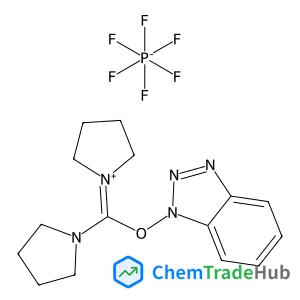
(1H-Benzotriazol-1-yloxy)(di-1-pyrrolidinyl)methylium hexafluorophosphate
CAS番号:
105379-24-6
分子式:
C15H21F6N5OP
おすすめサプライヤー


免責事項
このページに表示される学術雑誌情報は、参考および研究目的のみを目的としています。当社は雑誌出版社とは提携しておらず、投稿の取り扱いも行っておりません。出版に関するお問い合わせは、各雑誌出版社に直接ご連絡ください。
表示されている情報に誤りがある場合は、support@chemtradehub.com までご連絡ください。迅速に確認し、対応いたします。