












![N-[4-(Cyanoethynyl)phenyl]-16-oxo-4,7,10,13-tetraoxa-17-azahenicos-1-yn-21-amide structure](https://static.chemtradehub.com/structs/218/2183440-36-8-68cb.webp "N-[4-(Cyanoethynyl)phenyl]-16-oxo-4,7,10,13-tetraoxa-17-azahenicos-1-yn-21-amide structure")
Structural characterization of small Xe clusters using their 5s correlation satellite electron spectrum
文献情報
出版日
2013-05-08
DOI
10.1039/C3CP50249J
インパクトファクター
3.676
著者
Minna Patanen, Christophe Nicolas, Xiao-Jing Liu, Oksana Travnikova, Catalin Miron
原文を見る
要旨
The Xe 5s photoelectron spectrum and 5p4nl correlation satellites have been studied in small Xe clusters of an average size of about 15 atoms. The satellite structures are interpreted with the help of the atomic Xe lines. Transition energy shifts between the atomic and the corner/edge/face/bulk components in clusters are divided into polarization screening and exchange interaction energy. Interestingly enough, the ratios between corner/edge/face/bulk polarization screening and exchange interaction energies are found to reflect the ratios of the coordination numbers of corner/edge/face/bulk atoms in these small icosahedral cluster structures.
関連文献
CO2 capture and activation by superbase/polyethylene glycol and its subsequent conversion
Zhen-Zhen Yang, Liang-Nian He, Ya-Nan Zhao, Bin Li, Bing Yu
2011-08-25
Communication
DOI: 10.1039/C1EE02156G
Unraveling the structural and morphological stability of oxygen vacancy engineered leaf-templated CaTiO3 towards photocatalytic H2 evolution and N2 fixation reactions
Ashish Kumar, Manish Kumar, Vempuluru Navakoteswara Rao, Muthukonda Venkatakrishnan Shankar, Saswata Bhattacharya, Venkata Krishnan
2021-08-02
Paper
DOI: 10.1039/D1TA04180K
A kinetically well-matched full-carbon sodium-ion capacitor
Kangyu Zou, Peng Cai, Cheng Liu, Jiayang Li, Xu Gao, Laiqiang Xu, Guoqiang Zou, Hongshuai Hou, Zuming Liu, Xiaobo Ji
2019-05-13
Paper
DOI: 10.1039/C9TA03797G
Function-oriented synthesis of two-dimensional (2D) covalent organic frameworks – from 3D solids to 2D sheets
Xing Li, Priya Yadav, Kian Ping Loh
2020-06-03
Review Article
DOI: 10.1039/D0CS00236D
Anion-induced self-assembly of positively charged polycyclic aromatic hydrocarbons towards nanostructures with controllable two-dimensional morphologies
Chongqing Yang, Dongqing Wu, Wuxue Zhao, Weizhen Ye, Zhixiao Xu, Fan Zhang
2016-01-04
Communication
DOI: 10.1039/C5CE02171E
Depolymerization of lignocellulosic biomass to fuel precursors: maximizing carbon efficiency by combining hydrolysis with pyrolysis
Jungho Jae, Geoffrey A. Tompsett, Yu-Chuan Lin, Torren R. Carlson, Jiacheng Shen, Taiying Zhang, Bin Yang, Charles E. Wyman, W. Curtis Conner, George W. Huber
2010-02-12
Paper
DOI: 10.1039/B924621P
Near-critical water, a cleaner solvent for the synthesis of a metal–organic framework
Ilich A. Ibarra, Peter A. Bayliss, Eduardo Pérez, Sihai Yang, Alexander J. Blake, Harriott Nowell, David R. Allan, Martyn Poliakoff, Martin Schröder
2011-11-14
Paper
DOI: 10.1039/C1GC15726D
Podoviridae bacteriophage for the biocontrol of Pseudomonas aeruginosa in rainwater
Brandon Reyneke, Sehaam Khan, Pilar Fernández-Ibáñez, Wesaal Khan
2019-11-13
Paper
DOI: 10.1039/C9EW00896A
Conjugated polymers with controllable interfacial order and energetics enable tunable heterojunctions in organic and colloidal quantum dot photovoltaics
Ahmad R. Kirmani, Xinzheng Lan, Joshua Carpenter, Annabel Rong-Hui Chew, Muhammad R. Niazi, Oleksandr Voznyy, Guy Olivier Ngongang Ndjawa, Alberto Salleo, Harald Ade, Edward H. Sargent
2021-12-24
Paper
DOI: 10.1039/D1TA09544G
こちらもおすすめ
化合物よくある質問
オステニ二甲磺酸塩に適用される法規ガイドラインは何ですか?
オステニ二甲磺酸塩は、GHS分類に基づき corrosive 物質として分類されます。REACH規則では、該当物質の登録が要求される可能性があります。また、FD...
2070014-82-1N-(2-{[2-(Dimethylam...
化合物よくある質問
環丁基肼盐酸盐は安全ですか?
環丁基肼盐酸盐は毒性があり、吸入や皮膚接触は有害です。使用時の安全対策として、密閉システムを使用し、適切な排気設備を備えた場所で作業することが推奨されます。
1156980-49-2Cyclobutylhydrazine ...
化合物よくある質問
N-(4-パリドン基ソニルフェニル)硫代イソシアネートを取り扱う際の実験室安全事項は何ですか?
N-(4-パリドン基ソニルフェニル)硫代イソシアネートは高毒性で、皮膚や吸入による毒性があります。取り扱う際は防毒マスク、保護用手袋、保護眼鏡などのPPEを着用...
7356-55-01-[(4-Isothiocyanato...
化合物よくある質問
5-ヒドロキシ-1,3-ジヒドロ-2H-インドン-2-酮の物理化学的性質は何ですか?
CAS番号3416-18-0の5-ヒドロキシ-1,3-ジヒドロ-2H-インドン-2-酮は、結晶性の白色粉末です。分子量は228.25であり、 aqueous m...
3416-18-05-Hydroxy-1,3-dihydr...
化合物よくある質問
O-苄基-D-丝氨醇はどのように合成されますか?
O-苄基-D-丝氨醇は、D-アミノ酸とベンゼン環の経由で合成されます。触媒としてジメチルアミノピリジンが使用され、選択性は高いです。一般的な収率は約90%です。
58577-88-1(s)-2-Amino-3-benzyl...
化合物よくある質問
ナトリウム3-ヒドロキシbutano酸とは何ですか?
ナトリウム3-ヒドロキシbutano酸は、CAS番号13613-65-5で登録されている化合物です。この化合物は、(3R)-3-ヒドロキシbutano酸とナトリ...
13613-65-5sodium;(3R)-3-hydrox...
化合物よくある質問
1-(二苯甲基)-4-甲基ベンゼンの物理化学的性質は何ですか?
CAS番号603-37-2の1-(二苯甲基)-4-甲基ベンゼンは、結晶性の固体で、分子量は244.28であり、水中的には微溶です。この化合物は有機反応において中...
603-37-21-(Diphenylmethyl)-4...
化合物よくある質問
ネアミン塩酸塩の物理化学的性質は何ですか?
ネアミン塩酸塩の分子量は321.19であり、結晶性の白色粉末です。この化合物は水に溶けやすく、pHが低くなると不溶性になります。反応活性は高く、水溶液中の酸化還...
15446-43-2NEAMINE HYDROCHLORID...
化合物よくある質問
偶氮二甲酰二哌啶の主な用途は何ですか?
偶氮二甲酰二哌啶は、医薬品、染料、高 Então 剤、触媒、溶媒、量論試薬など、様々な分野で使用されています。特に、高 Enough 反応において、グリコール酸...
10465-81-3(E)-1,2-Diazenediylb...
664969-54-44-[(2E)-3-Phenyl-2-p...
掲載誌
Physical Chemistry Chemical Physics

CiteScore:
5.5
自己引用率:
10.3%
年間論文数:
3036
Physical Chemistry Chemical Physics (PCCP) is an international journal co-owned by 19 physical chemistry and physics societies from around the world. This journal publishes original, cutting-edge research in physical chemistry, chemical physics and biophysical chemistry. To be suitable for publication in PCCP, articles must include significant innovation and/or insight into physical chemistry; this is the most important criterion that reviewers and Editors will judge against when evaluating submissions. The journal has a broad scope and welcomes contributions spanning experiment, theory, computation and data science. Topical coverage includes spectroscopy, dynamics, kinetics, statistical mechanics, thermodynamics, electrochemistry, catalysis, surface science, quantum mechanics, quantum computing and machine learning. Interdisciplinary research areas such as polymers and soft matter, materials, nanoscience, energy, surfaces/interfaces, and biophysical chemistry are welcomed if they demonstrate significant innovation and/or insight into physical chemistry. Joined experimental/theoretical studies are particularly appreciated when complementary and based on up-to-date approaches.
おすすめ化合物
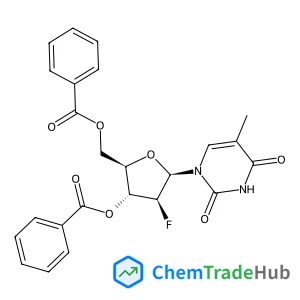
1-(3',5'-Di-O-benzoyl-2'-deoxy-2'-fluoro-b-D-arabinofuranosyl)thymine
CAS番号:
97614-47-6
分子式:
C24H21FN2O7
おすすめサプライヤー




免責事項
このページに表示される学術雑誌情報は、参考および研究目的のみを目的としています。当社は雑誌出版社とは提携しておらず、投稿の取り扱いも行っておりません。出版に関するお問い合わせは、各雑誌出版社に直接ご連絡ください。
表示されている情報に誤りがある場合は、support@chemtradehub.com までご連絡ください。迅速に確認し、対応いたします。