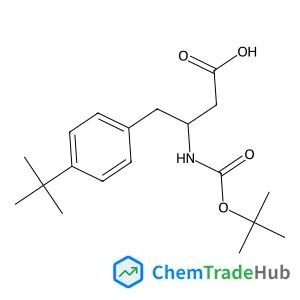
(S)-3-((tert-Butoxycarbonyl)amino)-4-(4-(tert-butyl)phenyl)butanoic acid
CAS番号:
403661-85-8
分子式:
C19H29NO4
Martin Schulz, Jane Inglis, Johannes G. Vos
Resonance Raman microspectroscopy is used to investigate dye-sensitized NiOx nanoparticle films to be used as photocathodes in tandem dye-sensitized solar cells. It is shown that rR microspectroscopy has potential for applications in quality assurance in such systems and also in integrated dye-sensitized solar cell modules. Here, ruthenium dye-sensitized NiOx nanoparticle layers were produced both as single and double NiOx films using a one or two-step deposition process, respectively. The distribution of the sensitizer on the surfaces was investigated by rR microspectroscopy. The chemical images obtained from rR microspectroscopy yield complementary information to bright field microscope pictures and provide detailed insight into the sensitization pattern e.g. in the vicinity of surface vacancies and other inhomogeneities. Furthermore, based on the mapping results the dye desorption kinetics upon addition of water has been analysed. Desorption on the single NiOx film is faster and more efficient than on the double film. These changes are attributed to binding sites on the NiOx surface that are passivated with regard to water penetration. This passivation is introduced by the second synthesis step in building the second film of NiOx on the glass substrate. Both findings highlight the potential of rR microspectroscopy for quality assurance of dye-sensitized solar cell electrodes.
Lianyue Wang, Jun Li, Ying Lv, Yi Zhang, Shuang Gao
DOI: 10.1039/C3GC42075B
Hong Liu, Zhong Yuan Lu
DOI: 10.1039/C3GC41506F
Xiu-Jie Yang, Bin Chen, Li-Qiang Zheng, Li-Zhu Wu
DOI: 10.1039/C3GC42042F
Duy D. Do Pham, Geoffrey F. Kelso, Yuanzhong Yang, Milton T. W. Hearn
DOI: 10.1039/C3GC41972J
R. B. Nasir Baig, Mallikarjuna N. Nadagouda, Rajender S. Varma
DOI: 10.1039/C3GC42004C
Radka Chaloupkova
DOI: 10.1039/C4GC00117F
Arno Behr, Andreas J. Vorholt, Karoline A. Ostrowski, Thomas Seidensticker
DOI: 10.1039/C3GC41960F
Evan A. Davey, Esteban E. Ureña-Benavides
DOI: 10.1039/C3GC42302F
Noppadon Sathitsuksanoh, Kevin M. Holtman, Daniel J. Yelle, Trevor Morgan, Vitalie Stavila, Jeffrey Pelton
DOI: 10.1039/C3GC42295J
4-アミノフェノール酸ナトリウム水和物は、CAS番号206557-08-6の化合物で、4-アミノフェノールとナトリウムが結合した塩と水和物です。この化合物は、白...
この化合物は特定の合成プロセスに使用される可能性がありますが、代替品として、他の类似的な化合物、例えばMethyl 3-methyl-N-{[(2-methyl...
4-Boc-2-哌嗪甲酸は、薬品開発や合成化学分野で広く使用されており、その需要は継続的に推移しています。特に、新薬開発における合成化学分野での需要が高まってい...
4,4'-二羟甲基联苯のCAS番号は1667-12-5です。この化合物は白色の結晶粉末で、分子量は154.20です。水にわずかに溶けますが、アルコールや有機溶媒...
5-甲硫基戊腈は医薬品産業で使用される可能性があります。また、ポリマー合成の触媒として、センサー製造の一部として、半導体製造のプロセス改善に使用される可能性があ...
この化合物は、1-abieta-8,11,13-trien-19-イルと6'-メトキシシンコナナン-9-基を含有する窒素含有化合物から合成されます。一般的な合成...
6-ブロモベンジジミダゾール-2-カルビルデオキシドは、避光・乾燥した容器(密閉容器)で-20℃~4℃の低温で保存してください。高温や直射日光、湿気は避けてくだ...
621-65-8のCAS番号を持つBoc-N-甲基氨甲环酸は、化学式C7H13NO5を有する化合物です。この化合物は白色の結晶性粉末で、吸湿性があります。
乙基三氟硼酸钾は、トリフLUオール酸カリウムとエチルブロミドを反応させて合成されます。この反応は高い選択性と収率を持ち、触媒を用いることで効率的に進行します。
2-フロウロ-5-クロロ-4-アミノフェノールは、直射日光を避けて冷却された暗所で保存し、密閉容器に保管してください。温度は常温か低温が適しています。

Physical Chemistry Chemical Physics (PCCP) is an international journal co-owned by 19 physical chemistry and physics societies from around the world. This journal publishes original, cutting-edge research in physical chemistry, chemical physics and biophysical chemistry. To be suitable for publication in PCCP, articles must include significant innovation and/or insight into physical chemistry; this is the most important criterion that reviewers and Editors will judge against when evaluating submissions. The journal has a broad scope and welcomes contributions spanning experiment, theory, computation and data science. Topical coverage includes spectroscopy, dynamics, kinetics, statistical mechanics, thermodynamics, electrochemistry, catalysis, surface science, quantum mechanics, quantum computing and machine learning. Interdisciplinary research areas such as polymers and soft matter, materials, nanoscience, energy, surfaces/interfaces, and biophysical chemistry are welcomed if they demonstrate significant innovation and/or insight into physical chemistry. Joined experimental/theoretical studies are particularly appreciated when complementary and based on up-to-date approaches.