


Factors governing the growth mode of carbon nanotubes on carbon-based substrates
文献情報
出版日
2012-09-04
DOI
10.1039/C2CP42566A
インパクトファクター
3.676
著者
Kyoung Ju Kim, Woong-Ryeol Yu, Ji Ho Youk, Jinyong Lee
原文を見る
要旨
The formation of carbon nanotubes (CNTs) through precipitated carbons emerging from supersaturated metal catalysts is an established mechanism for their growth during the CVD process. Here, the CNT growth mode is determined by the interaction between the substrate and the catalyst nanoparticle, e.g., the tip-growth mode for the weak adhesion between them and the base-growth mode for the strong adhesion case. With microscopic evidence, this study reports another factor that governs the growth mode of CNTs on carbon-based substrates. Catalyst nanoparticles after only sputtering and annealing processes before the chemical vapor deposition (CVD) process are fully or partially wrapped with some graphitic layers, which are formed by carbons escaping from the carbon substrate. The formation of the wrapping graphitic layers is initiated by catalyst atoms diffusing into the carbon substrate during the catalyst sputtering process. The diffused catalyst atoms later coalesce into the nanoparticles, during which carbon atoms escape from the carbon substrate, forming the graphitic layers which wrap around the catalyst nanoparticles for energy minimization. Then, the carbon atoms generated from the catalytic reactions during the CVD process interact with the carbons in the graphitic layers wrapped around the catalyst nanoparticles, bringing about clear tip-growth of CNTs on carbon-based substrates and a stable interface (carbon–carbon bonding) between CNTs and carbon-based substrates.
おすすめジャーナル

Pharmacological Reviews

Science Progress

Proceedings of the National Academy of Sciences of the United States of America

Nature

European Journal of Wood and Wood Products

Organic Preparations and Procedures International

Russian Chemical Reviews

Israel Journal of Chemistry

Journal of Heterocyclic Chemistry

Kinetics and Catalysis
関連文献
A PDMS membrane with high pervaporation performance for the separation of furfural and its potential in industrial application
Fan Qin, Shufeng Li, Peiyong Qin, M. Nazmul Karim, Tianwei Tan
2013-11-05
Paper
DOI: 10.1039/C3GC41867G
Solvents for sustainable chemical processes
Evan A. Davey, Esteban E. Ureña-Benavides
2013-12-20
Critical Review
DOI: 10.1039/C3GC42302F
Efficient and selective nitrile hydration reactions in water catalyzed by an unexpected dimethylsulfinyl anion generated in situ from CsOH and DMSO‡
Haonan Chen, Wujie Dai, Yi Chen, Qing Xu, Jianhui Chen, Yajuan Zhao, Mingde Ye
2014-01-02
Communication
DOI: 10.1039/C3GC42310G
Synthesis of soluble core cross-linked polystyrene star polymer by application of acrylate-nitrile oxide ‘click chemistry’ using metal-free reagents
Rakesh Banerjee, Saikat Maiti, Dibakar Dhara
2013-11-04
Paper
DOI: 10.1039/C3GC41722K
Acceleration of Suzuki coupling reactions by abundant and non-toxic salt particles
Binbin Zhang, Jinliang Song, Huizhen Liu, Jinghua Shi, Jun Ma, Honglei Fan, Weitao Wang, Peng Zhang, Buxing Han
2013-10-23
Paper
DOI: 10.1039/C3GC42088D
Comparison of catalysis by haloalkane dehalogenases in aqueous solutions of deep eutectic and organic solvents
Radka Chaloupkova
2014-02-12
Paper
DOI: 10.1039/C4GC00117F
Carbonylation in microflow: close encounters of CO and reactive species
Takahide Fukuyama, Takenori Totoki, Ilhyong Ryu
2013-12-13
Critical Review
DOI: 10.1039/C3GC41789A
Synthesis of a morphology controllable Fe3O4 nanoparticle/hydrogel magnetic nanocomposite inspired by magnetotactic bacteria and its application in H2O2 detection
Yang Gao, Zhao Wei, Fei Li, Zhi Mao Yang, Yong Mei Chen, Miklos Zrinyi, Yoshihito Osada
2013-10-11
Paper
DOI: 10.1039/C3GC41535J
Water at elevated temperatures (WET): reactant, catalyst, and solvent in the selective hydrolysis of protecting groups
Wilmarie Medina-Ramos, Mike A. Mojica, Elizabeth D. Cope, Ryan J. Hart
2014-02-04
Paper
DOI: 10.1039/C3GC42569J
Aerobic oxidation of biomass derived 5-hydroxymethylfurfural into 5-hydroxymethyl-2-furancarboxylic acid catalyzed by a montmorillonite K-10 clay immobilized molybdenum acetylacetonate complex
Zehui Zhang, Bing Liu, Kangle Lv, Jie Sun, Kejan Deng
2014-03-25
Paper
DOI: 10.1039/C4GC00062E
こちらもおすすめ
化合物よくある質問
4-アミノフェノール酸ナトリウム水和物とは何ですか?
4-アミノフェノール酸ナトリウム水和物は、CAS番号206557-08-6の化合物で、4-アミノフェノールとナトリウムが結合した塩と水和物です。この化合物は、白...
206557-08-64-Aminobenzoic acid ...
化合物よくある質問
Methyl 3-methyl-N-{[(2-methyl-2-propanyl)oxy]carbonyl}-L-histidinateの代替品はありますか?
この化合物は特定の合成プロセスに使用される可能性がありますが、代替品として、他の类似的な化合物、例えばMethyl 3-methyl-N-{[(2-methyl...
72212-51-2Methyl 3-methyl-N-{[...
化合物よくある質問
4-Boc-2-哌嗪甲酸の市場動向や研究トレンドはどうですか?
4-Boc-2-哌嗪甲酸は、薬品開発や合成化学分野で広く使用されており、その需要は継続的に推移しています。特に、新薬開発における合成化学分野での需要が高まってい...
192330-11-3(2R)-4-[(tert-butoxy...
化合物よくある質問
4,4'-二羟甲基联苯の物理化学的性質は何ですか?
4,4'-二羟甲基联苯のCAS番号は1667-12-5です。この化合物は白色の結晶粉末で、分子量は154.20です。水にわずかに溶けますが、アルコールや有機溶媒...
1667-12-54,4'-Biphenyldiyldim...
化合物よくある質問
5-甲硫基戊腈はどの業界で使用されていますか?
5-甲硫基戊腈は医薬品産業で使用される可能性があります。また、ポリマー合成の触媒として、センサー製造の一部として、半導体製造のプロセス改善に使用される可能性があ...
59121-25-45-(Methylsulfanyl)pe...
化合物よくある質問
CAS番号1311961-50-8の化合物はどのように合成されますか?
この化合物は、1-abieta-8,11,13-trien-19-イルと6'-メトキシシンコナナン-9-基を含有する窒素含有化合物から合成されます。一般的な合成...
1311961-50-81-Abieta-8,11,13-tri...
化合物よくある質問
6-ブロモベンジジミダゾール-2-カルビルデオキシドはどのように保存すればよいですか?
6-ブロモベンジジミダゾール-2-カルビルデオキシドは、避光・乾燥した容器(密閉容器)で-20℃~4℃の低温で保存してください。高温や直射日光、湿気は避けてくだ...
885280-26-25-Bromo-1H-benzimida...
化合物よくある質問
Boc-N-甲基氨甲环酸とは何ですか?
621-65-8のCAS番号を持つBoc-N-甲基氨甲环酸は、化学式C7H13NO5を有する化合物です。この化合物は白色の結晶性粉末で、吸湿性があります。
621-65-83-Hydroxy-1,2-propan...
化合物よくある質問
乙基三氟硼酸钾はどのように合成されますか?
乙基三氟硼酸钾は、トリフLUオール酸カリウムとエチルブロミドを反応させて合成されます。この反応は高い選択性と収率を持ち、触媒を用いることで効率的に進行します。
882871-21-8Potassium ethyltrifl...
化合物よくある質問
2-フロウロ-5-クロロ-4-アミノフェノールはどのように保存すればよいですか?
2-フロウロ-5-クロロ-4-アミノフェノールは、直射日光を避けて冷却された暗所で保存し、密閉容器に保管してください。温度は常温か低温が適しています。
847872-10-04-Amino-5-chloro-2-f...
掲載誌
Physical Chemistry Chemical Physics

CiteScore:
5.5
自己引用率:
10.3%
年間論文数:
3036
Physical Chemistry Chemical Physics (PCCP) is an international journal co-owned by 19 physical chemistry and physics societies from around the world. This journal publishes original, cutting-edge research in physical chemistry, chemical physics and biophysical chemistry. To be suitable for publication in PCCP, articles must include significant innovation and/or insight into physical chemistry; this is the most important criterion that reviewers and Editors will judge against when evaluating submissions. The journal has a broad scope and welcomes contributions spanning experiment, theory, computation and data science. Topical coverage includes spectroscopy, dynamics, kinetics, statistical mechanics, thermodynamics, electrochemistry, catalysis, surface science, quantum mechanics, quantum computing and machine learning. Interdisciplinary research areas such as polymers and soft matter, materials, nanoscience, energy, surfaces/interfaces, and biophysical chemistry are welcomed if they demonstrate significant innovation and/or insight into physical chemistry. Joined experimental/theoretical studies are particularly appreciated when complementary and based on up-to-date approaches.
おすすめ化合物
![2-[(5Z,8Z,11Z,14Z)-5,8,11,14-Icosatetraen-1-yloxy]-1,3-propanediol structure](https://static.chemtradehub.com/structs/222/222723-55-9-0348.webp "2-[(5Z,8Z,11Z,14Z)-5,8,11,14-Icosatetraen-1-yloxy]-1,3-propanediol structure")
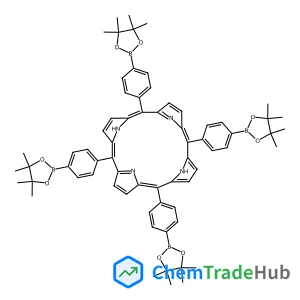
5,10,15,20-tetrakis(4-boronic acid pinacol ester phenyl) porphyrin
CAS番号:
1332748-00-1
分子式:
C68H74B4N4O8
おすすめサプライヤー





免責事項
このページに表示される学術雑誌情報は、参考および研究目的のみを目的としています。当社は雑誌出版社とは提携しておらず、投稿の取り扱いも行っておりません。出版に関するお問い合わせは、各雑誌出版社に直接ご連絡ください。
表示されている情報に誤りがある場合は、support@chemtradehub.com までご連絡ください。迅速に確認し、対応いたします。