












Ion-specific effect on dynamics of polyelectrolyte chains
文献情報
出版日
2012-03-21
DOI
10.1039/C2CP40077D
インパクトファクター
3.676
著者
Zhenli Luo, Xiaoyan Wang
原文を見る
要旨
The sedimentation of quaternized poly(4-vinyl pyridine) (QP4VP) or poly(N-methyl 4-vinyl pyridine iodide) in aqueous solution has been investigated by using an analytical ultracentrifuge (AUC) via sedimentation velocity (SV). When NaI is introduced, either the sedimentation coefficient (s) or apparent molar mass (Mw) of QP4VP increases with NaI concentration because the polyelectrolyte chains aggregate or even form precipitates due to hydrophobic interaction. Upon addition of NaCl, either s or Mw exhibits a maximum as NaCl concentration increases. The sedimentation in NaBr solution falls in between. Besides, the diffusion coefficient (D) shows a minimum as the added salt concentration increases when either of the salts is added. Isothermal titration calorimetry (ITC) measurements show that the enthalpy change increases from NaI over NaBr to NaCl when each of them is mixed with QP4VP, revealing that the order of the strength of the anion–pyridinium interaction is I− > Br− > Cl−. When I− ions are added, they only screen the electrostatic interaction and no counterion competition happens. Upon addition of Cl− or Br− ions, the original counterions (I−) win the competition at low Cl− or Br− concentration, so that the added anions only screen the electrostatic interaction. When the concentration of Cl− or Br− ions is high enough, they replace I− ions to interact with the polyelectrolyte chains due to osmotic pressure. The present study demonstrates that the complex dynamics of the polyelectrolyte is greatly influenced by the ion-specific effect.
関連文献
Copper nanoclusters on specific-primer PCR fragments with magnetic capture for the label-free fluorescent sensing of the T315I single nucleotide variant in the BCR–ABL1 gene
Ke-Peng Lai, Yu-Chen Su, Bo-Siang Fu, Kung-Hung Lin, Hwang-Shang Kou
2022-11-17
Paper
DOI: 10.1039/D2AN01433E
Glucose oxidase-encapsulated liposomes for amplified autofluorescence-free immunoassay of a prostate-specific antigen with photoluminescence of CePO4:Tb nanocrystals
Xiwen Jiang, Cuiyuan Pan, Qiaowen Wang, Zipeng Yin, Xiao Han
2022-11-07
Paper
DOI: 10.1039/D2AN01689C
Analysis of breast cancer by small angle X-ray scattering (SAXS)
André Luiz Coelho Conceição, Marcelo Antoniassi, Martin Eduardo Poletti
2009-04-06
Paper
DOI: 10.1039/B821434D
Quantitative assessment of intracellular/extracellular dimethyl sulfoxide concentrations during freezing with low-temperature confocal Raman micro-spectroscopy
Taijie Zhan, Wenya Niu, Mengdong Cui, Hengxin Han, Ding Wang, Yi Xu
2022-10-19
Paper
DOI: 10.1039/D2AN01288J
Implementing reactive secondary electrospray ionization based on gas–droplet reactions for VOC analysis
Quan Yu, Jing Gao, Xiaohua Yu, Jianbo Shi, Lin Lin, Xiaohao Wang
2022-09-22
Paper
DOI: 10.1039/D2AN01422J
Adenosine detection by using gold nanoparticles and designed aptamer sequences
Fan Li, Juan Zhang, Xuni Cao, Lihua Wang, Di Li, Shiping Song, Bangce Ye, Chunhai Fan
2009-04-02
Paper
DOI: 10.1039/B900900K
Association between ageing, brain chemistry and white matter volume revealed with complementary MRI and FTIR brain imaging
Juliette Phillips, Elizabeth Harrild, Rebecca J. Tidy, Lincoln Codd, Kirsty Richardson, Liesl Celliers
2022-11-02
Communication
DOI: 10.1039/D2AN01271E
Preparation and application of chitosan-based fluorescent probes
Shenghua Lv, Shan Liang, Jingjing Zuo, Shanshan Zhang, Dequan Wei
2022-09-17
Minireview
DOI: 10.1039/D2AN01070D
こちらもおすすめ
化合物よくある質問
2-ブロモ-9,9-ジフェニル-9H-フルオレンの主な用途は何ですか?
2-溴-9,9-二苯基芴は、医薬品、工業材料、有機合成の研究分野で応用されます。特に、レーザー材料や機能性ポリマーの合成に使用されることがあります。また、蛍光色...
474918-32-62-Bromo-9,9-diphenyl...
化合物よくある質問
四氯化铱の市場動向や研究トレンドはどうですか?
四氯化铱の市場は研究開発分野で注目されており、特にナノ技術や金属有機框架(MOFs)の分野での需要が増加傾向にあります。価格は安定しており、中国や韓国での生産が...
207399-11-9Tetrachloroiridium h...
882-06-44-Nitrocinnamic acid
化合物よくある質問
1-(4-溴-3-氟苯基)-2-氯乙酮を含む廃棄物はどのように処理すべきですか?
1-(4-溴-3-氟苯基)-2-氯乙酮 (CAS番号: 1260857-14-4) の廃棄物は専門的な廃棄処理が必要です。まず、廃棄物は密閉された容器に収集し、...
1260857-14-41-(4-Bromo-3-fluorop...
化合物よくある質問
苦参酚Kとは何ですか?
苦参酚Kは、CAS番号101236-49-1を持つ化合物で、主に天然由来の生薬から抽出されます。この化合物は、抗炎症作用や抗癌作用を持つことが報告されています。
101236-49-1Kushenol K
化合物よくある質問
POTASSIUM (1-(TERTBUTOXYCARBONYL)AZETIDIN-3-YL)TRIFLUOROBORATE を含む廃棄物はどのように処理すべきですか?
POTASSIUM (1-(TERTBUTOXYCARBONYL)AZETIDIN-3-YL)TRIFLUOROBORATE を含む廃棄物は、まず安全なエント...
1430219-73-0Potassium (1-(tert-b...
化合物よくある質問
4-庚基-4’-联苯羧酸の市場動向や研究トレンドはどうですか?
4-庚基-4’-聯苯羧酸は、特殊化学品や合成化学の分野で用いられる化学物質ですが、市場動向としては、研究開発の進展とともに需要が増加しています。また、環境配慮型...
58573-94-74'-Heptyl-4-biphenyl...
化合物よくある質問
6-ブロモ-3-メトキシ-1-フェニル-1H-インドゾールを含む廃棄物はどのように処理すべきですか?
6-ブロモ-3-メトキシ-1-フェニル-1H-インドゾールを含む廃棄物は、適切な化学廃棄処理が必要です。通常、廃棄物は密閉容器に収集され、専門の廃棄処理業者に引...
1332527-03-36-Bromo-3-methoxy-1-...
化合物よくある質問
4,4-二甲基-2-吡咯烷酮はどの業界で使用されていますか?
4,4-二甲基-2-吡咯烷酮は医薬、ポリマー、センサー、半導体などの業界で広く使用されています。特に溶媒としての性能が高く評価されています。
66899-02-34,4-dimethylpyrrolid...
51312-42-6Sodium Phosphotungst...
掲載誌
Physical Chemistry Chemical Physics

CiteScore:
5.5
自己引用率:
10.3%
年間論文数:
3036
Physical Chemistry Chemical Physics (PCCP) is an international journal co-owned by 19 physical chemistry and physics societies from around the world. This journal publishes original, cutting-edge research in physical chemistry, chemical physics and biophysical chemistry. To be suitable for publication in PCCP, articles must include significant innovation and/or insight into physical chemistry; this is the most important criterion that reviewers and Editors will judge against when evaluating submissions. The journal has a broad scope and welcomes contributions spanning experiment, theory, computation and data science. Topical coverage includes spectroscopy, dynamics, kinetics, statistical mechanics, thermodynamics, electrochemistry, catalysis, surface science, quantum mechanics, quantum computing and machine learning. Interdisciplinary research areas such as polymers and soft matter, materials, nanoscience, energy, surfaces/interfaces, and biophysical chemistry are welcomed if they demonstrate significant innovation and/or insight into physical chemistry. Joined experimental/theoretical studies are particularly appreciated when complementary and based on up-to-date approaches.
おすすめ化合物
![5-Acetyl-2,3-dihydrobenzo[b]furan structure](https://static.chemtradehub.com/structs/908/90843-31-5-eea4.webp "5-Acetyl-2,3-dihydrobenzo[b]furan structure")
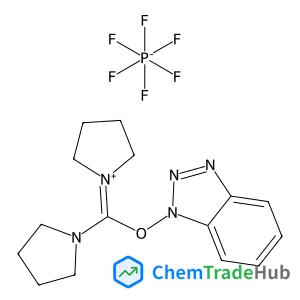
(1H-Benzotriazol-1-yloxy)(di-1-pyrrolidinyl)methylium hexafluorophosphate
CAS番号:
105379-24-6
分子式:
C15H21F6N5OP
おすすめサプライヤー





免責事項
このページに表示される学術雑誌情報は、参考および研究目的のみを目的としています。当社は雑誌出版社とは提携しておらず、投稿の取り扱いも行っておりません。出版に関するお問い合わせは、各雑誌出版社に直接ご連絡ください。
表示されている情報に誤りがある場合は、support@chemtradehub.com までご連絡ください。迅速に確認し、対応いたします。