


![5-Methoxy-1H-pyrrolo[3,2-b]pyridine structure](https://static.chemtradehub.com/structs/172/17288-40-3-a8d1.webp "5-Methoxy-1H-pyrrolo[3,2-b]pyridine structure")
Bis(phosphinimino)methanide borohydride complexes of the rare-earth elements as initiators for the polymerization of methyl methacrylate: combined experimental and computational investigations
文献情報
出版日
2011-05-24
DOI
10.1039/C1PY00133G
インパクトファクター
5.582
著者
Sophie M. Guillaume, Pierre Brignou, Nicolas Susperregui, Laurent Maron, Magdalena Kuzdrowska, Peter W. Roesky
原文を見る
要旨
Rare earth borohydride complexes are known as efficient initiators for the polymerization of both apolar and polar monomers. Significant contribution of the phosphiniminomethanide ligand on the reactivity of group 3 derivatives was previously established in the polymerization of ε-caprolactone. Investigations of the capability of bis(phosphinimino)methanide rare earth metal bisborohydrides, [{CH(PPh2NSiMe3)2}La(BH4)2(THF)] (1) and [{CH(PPh2NSiMe3)2}Ln(BH4)2] (Ln = Y (2), Lu (3)) to polymerize methyl methacrylate (MMA) both experimentally and computationally, are reported here. All three metallic compounds allowed the preparation of PMMA at room temperature. However, the overall performances of 1–3 remain quite poor based on experimental observations. DFT investigations on the insertion of the first two MMA molecules revealed that the incoming of the first MMA molecule was the most important step regardless of the nature of the metal center. The nucleophilic attack of MMA leads to the formation of a first adduct B followed by the unprecedented trapping of the liberated BH3 group by the nitrogen of the phosphiniminomethanide ligand to afford the active enolate species C. The unique significant role played by the phosphiniminomethanide ligand has thus been clearly unveiled and evidenced computationally. This whole first insertion of the MMA process is both kinetically and thermodynamically favorable. Trapping of the BH3 by the ancillary ligand appeared to make the second MMA insertion more energetically favorable than the first one, especially for lanthanum. The ketoenolate thus formed, Prod., is thermodynamically and kinetically favorable. In the case of yttrium, steric considerations, in addition to energetically comparable first and second MMA insertions, support the experimentally observed difficulty to polymerize MMA. DFT calculations closely corroborate experimental findings.
おすすめジャーナル

New Journal of Chemistry

Russian Journal of Bioorganic Chemistry

Russian Journal of Applied Chemistry

Journal of Saudi Chemical Society

Russian Chemical Bulletin

Organic Process Research & Development

Russian Journal of Coordination Chemistry

Journal of Natural Medicines

Current Opinion in Colloid & Interface Science

Nature Medicine
関連文献
Strong enrichment of atmospherically relevant organic ions at the aqueous interface: the role of ion pairing and cooperative effects
Victor Ekholm, Nicklas Bjärnhall Prytz, Marie-Madeleine Walz, Josephina Werner, Gunnar Öhrwall, Jan-Erik Rubensson, Olle Björneholm
2018-10-12
Paper
DOI: 10.1039/C8CP04525A
Precise estimation of transfer free energies for ionic species between similar media
Carmen Esposito, Andreas Vitalis
2018-10-17
Paper
DOI: 10.1039/C8CP05331F
Topologically close-packed characteristic of amorphous tantalum
Zhizhou Wu, Lin Lang, Aibing Yu, Quan Xie, Rangsu Liu
2018-10-18
Paper
DOI: 10.1039/C8CP05897K
Monte Carlo simulation on the dynamics of a semi-flexible polymer in the presence of nanoparticles
Yi Peng, Huan Zhang, Xiao-Wei Huang, Jian-Hua Huang, Meng-Bo Luo
2018-09-26
Paper
DOI: 10.1039/C8CP05136D
Theoretical analysis of crystallization by homogeneous nucleation of water droplets
Kyoko K. Tanaka, Yuki Kimura
2019-01-05
Paper
DOI: 10.1039/C8CP06650G
Isotope effect on hydrogen bond symmetrization in hydrogen and deuterium fluoride crystals by molecular dynamics simulation
Hichem Dammak, Fabien Brieuc, Grégory Geneste, Marc Torrent, Marc Hayoun
2019-01-21
Paper
DOI: 10.1039/C8CP06949B
Direct observation of atomic step edges on the rutile TiO2(110)-(1 × 1) surface using atomic force microscopy
Huan Fei Wen, Masato Miyazaki, Quanzhen Zhang, Yuuki Adachi, Yan Jun Li, Yasuhiro Sugawara
2018-10-18
Paper
DOI: 10.1039/C8CP06156D
Difference in the micro-dynamics mechanism between aromatic nylon and aliphatic nylon during water absorption: spectroscopic evidence
Liyang Jia, Gehong Su, Qiang Yuan, Xueqian Zhang, Tao Zhou
2018-10-03
Paper
DOI: 10.1039/C8CP05432K
こちらもおすすめ
化合物よくある質問
間溴苯甲酰腈の市場動向や研究トレンドはどうですか?
間 brom 苯甲酰腈は、合成化学や薬物化学において重要な Intermediate として使用されています。市場動向としては、その合成性と機能性により、研究開...
24999-51-7(3-Bromophenyl)(oxo)...
287966-62-5Desulfo Glucoraphani...
化合物よくある質問
Methyl 2-amino-5-(trifluoromethyl)benzoateに適用される法規ガイドラインは何ですか?
CAS番号117324-58-0の塩酸メチル2アミノ-5-トリフルオロメチルベンゼートは、GHS分類により腐食性物質と判定されます。REACH規則では、製造、販...
117324-58-0Methyl 2-amino-5-(tr...
化合物よくある質問
3-ブロモ-1,3,4,5-四水化-2H-1-ベンザアゼピン-2-オンは安全ですか?
毒性があるため、適切な安全対策が必須です。皮膚や粘膜への刺激性が強く、吸入や誤飲により健康被害を引き起こす可能性があります。取扱時にはガスマスクや手袋、眼鏡を使...
86499-96-93-Bromo-1,3,4,5-tetr...
化合物よくある質問
三氟甲基ピリジン-2-甲アミン塩酸塩は安全ですか?
三氟甲基ピリジン-2-甲アミン塩酸塩は安全性に注意が必要です。毒性は低レベルですが、直接的接触や吸入は避けるべきです。適切な手袋や防塵マスクを着用し、密閉された...
871826-12-9(5-(Trifluoromethyl)...
化合物よくある質問
1-エチル-4-(4-硝基フェニル)ピペリジンは安全ですか?
1-エチル-4-(4-硝基フェニル)ピペリジンは有毒であり、取扱には注意が必要です。保管や作業中に手袋を着用し、目や皮膚に接触しないように注意する必要があります...
115619-00-61-Ethyl-4-(4-nitroph...
化合物よくある質問
1,1-ジメトキシプロパン-2-オンは安全ですか?
1,1-ジメトキシプロパン-2-オンは一般的に低毒性ですが、皮膚や目への刺激性があるため、取扱いには注意が必要です。蒸気や液体の吸入には有害な可能性があり、適切...
6342-56-91,1-dimethoxypropan-...
化合物よくある質問
コバルト(II) 3,3'-{[(1S,2S)-1,2-ジメチルフENCYCLICALE-1,2-エチエンジイル]ビス[ニトロリルメチルイリデン]}ビス[4-オキソ-2-ペンテン-2-olate]について「に適用される法規ガイドラインは何ですか?
この化合物はCAS番号259259-80-8に対応しています。GHS分類では、毒性、燃焼性、反応性、炎症性を考慮に入れ、適切な危険性分類が行われます。REACH...
259259-80-8Cobalt(2+) (2E,2'E)-...
化合物よくある質問
「カーバミル酸, N-[8-[[2-[[2-(2,6-ジオキソ-3-ピペリジニル)-2,3-ジオキソ-1,3-ジヒドロ-1H-イソイソインドール-4-イルオキシ]アセチル]アミノ]オクチル]-1,1-ジメチレチルエステル」はどのように保存すればよいですか?
この化合物は、冷却庫で-20℃の温度、乾燥した容器に保管し、直日光から保護する必要があります。湿度の高い環境や高温は避けてください。
1950635-34-32-Methyl-2-propanyl ...
1433975-21-3FMoc-D-4-Aph(tBu-CbM...
掲載誌
Polymer Chemistry

CiteScore:
8.6
自己引用率:
7.3%
年間論文数:
457
Polymer Chemistry welcomes submissions in all areas of polymer science that have a strong focus on macromolecular chemistry. Manuscripts may cover a broad range of fields, yet no direct application focus is required.
おすすめ化合物
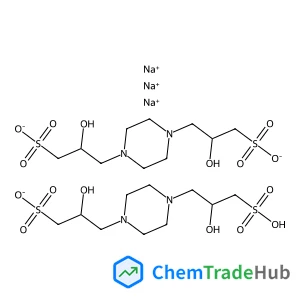
3,3'-(Piperazine-1,4-diyl)bis(2-hydroxypropane-1-sulfonic acid) Sodium Salt
CAS番号:
108321-08-0
分子式:
C20H41N4Na3O16S4
![(3R)-3-(3-Fluorophenyl)-3-({[(2-methyl-2-propanyl)oxy]carbonyl}amino)propanoic acid structure](https://static.chemtradehub.com/structs/500/500789-04-8-20dd.webp "(3R)-3-(3-Fluorophenyl)-3-({[(2-methyl-2-propanyl)oxy]carbonyl}amino)propanoic acid structure")
![(1R,3S,5R)-2-{[(2-Methyl-2-propanyl)oxy]carbonyl}-2-azabicyclo[3.1.0]hexane-3-carboxylic acid structure](https://static.chemtradehub.com/structs/197/197142-34-0-6a44.webp "(1R,3S,5R)-2-{[(2-Methyl-2-propanyl)oxy]carbonyl}-2-azabicyclo[3.1.0]hexane-3-carboxylic acid structure")
![1,1'-[(E)-1,2-Ethenediyl]bis(4-bromobenzene) structure](https://static.chemtradehub.com/structs/188/18869-30-2-c907.webp "1,1'-[(E)-1,2-Ethenediyl]bis(4-bromobenzene) structure")
おすすめサプライヤー





免責事項
このページに表示される学術雑誌情報は、参考および研究目的のみを目的としています。当社は雑誌出版社とは提携しておらず、投稿の取り扱いも行っておりません。出版に関するお問い合わせは、各雑誌出版社に直接ご連絡ください。
表示されている情報に誤りがある場合は、support@chemtradehub.com までご連絡ください。迅速に確認し、対応いたします。