












Synergistic enhanced photocatalytic and photothermal activity of Au@TiO2 nanopellets against human epithelial carcinoma cells
文献情報
出版日
2011-10-20
DOI
10.1039/C1CP22683E
インパクトファクター
3.676
著者
Md. Abdulla-Al-Mamun, Yoshihumi Kusumoto, Tohfatul Zannat, Md. Shariful Islam
原文を見る
要旨
The photocatalytic and plasmonic photothermal cancer cell-killing activity of the metallic Au-capped TiO2 (Au@TiO2) composite colloidal nanopellets has been investigated on HeLa cells under UV-visible (350–600 nm) light irradiation. The Au@TiO2 composite nanopellets with the uniform Au-capped TiO2 structure were successfully synthesized by simple reduction of HAuCl4 on the surface of TiO2 nanoparticles. The morphological structure and surface properties of Au@TiO2 were characterized by using UV-visible absorption spectroscopy, TEM, SEM, XPS, EDX and XRD analyses. The formation of hydroxyl radicals (˙OH) was confirmed by photoluminescence (PL) spectra. The photocatalytic and photothermal cell-killing activity of the Au@TiO2 nanopellets was found to vary with the molar ratio of Au to TiO2. The direct involvement of the metal particles in mediating the electron transfer from the photoexcited TiO2 under the band gap excitation is considered to carry out the efficient photocatalytic reaction on the cells. The plasmonic absorption spectra of Au@TiO2 suspensions were also measured for the evaluation of photothermal cell killing. The charge separation, the interfacial charge-transfer and photothermal activity promoted the photocatalytic–photothermal cancer-cell killing more than TiO2 alone. The cytotoxic effect of Au@TiO2 nanopellets with low concentration of gold (TiO2 : Au molar ratio > 1 : 1) was found to be 100%, whereas that of the commercial TiO2 (P25) was ca. 50%. The comparative study of the cell viability using Au alone and TiO2 alone revealed that the synergistic effect of photocatalytic hydroxyl radical formation and Au-plasmonic photothermal heat generation plays a vital role in the cancer cell killing. A plausible mechanism was also proposed for photocatalytic cancer cell killing based on the obtained results.
関連文献
Applications of N′-monofunctionalised TsDPEN derivatives in asymmetric catalysis
Jonathan Barrios-Rivera, Yingjian Xu, Martin Wills
2019-01-04
Review Article
DOI: 10.1039/C8OB02889C
Chemiluminescence molecular probe with a linear chain reaction amplification mechanism
Samer Gnaim, Doron Shabat
2019-01-21
Communication
DOI: 10.1039/C8OB03042A
Design, synthesis and glycosidase inhibition studies of novel triazole fused iminocyclitol-δ-lactams
Venkatesan Santhanam, Pradeep Pant, B. Jayaram, Namakkal G. Ramesh
2019-01-03
Paper
DOI: 10.1039/C8OB03084G
Rh-Catalyzed nitrene alkyne metathesis/formal C–N bond insertion cascade: synthesis of 3-iminoindolines
Kemiao Hong, Su Zhou, Wenhao Hu
2020-04-08
Research Article
DOI: 10.1039/D0QO00294A
Aryltrifluoromethylative cyclization of unactivated alkenes by the use of PhICF3Cl under catalyst-free conditions
Jia Guo, Cong Xu, Xiaowei Liu
2019-01-24
Paper
DOI: 10.1039/C8OB03189D
Palladium-catalyzed double carbonylation of propargyl amines and aryl halides to access 1-aroyl-3-aryl-1,5-dihydro-2H-pyrrol-2-ones
Jun Ying, Zhengjie Le, Zhi-Peng Bao
2020-03-24
Research Article
DOI: 10.1039/D0QO00007H
Tricarabrols A–C, three anti-inflammatory sesquiterpene lactone trimers featuring a methylene-tethered linkage from Carpesium faberi
Xuelan Wen, Chang-Qiang Ke, Tian Zhang, Ligen Lin, Sheng Yao, Jason D. Goodpaster, Chunping Tang
2020-04-22
Research Article
DOI: 10.1039/D0QO00093K
Palladium-catalyzed enantioselective [5 + 4] annulation of ortho-quinone methides and vinylethylene carbonates
Chao Xia, Dong-Chao Wang, Gui-Rong Qu
2020-05-08
Research Article
DOI: 10.1039/D0QO00128G
Iron-catalyzed asymmetric intramolecular cyclopropanation reactions using chiral tetramethyl-1,1′-spirobiindane-based bisoxazoline (TMSI-BOX) ligands
Haorui Gu, Shaoying Huang, Xufeng Lin
2019-01-09
Paper
DOI: 10.1039/C8OB03065K
こちらもおすすめ
化合物よくある質問
環戊烷-1,3-二甲酸甲酯はどのように合成されますか?
環戊烷-1,3-二甲酸甲酯は、環戊烷と塩酸によるヒンデンブルク反応を経由して合成されます。この反応では、環戊烷が塩酸と作用し、1,3-ジカルボキシ基が導入されま...
2435-36-1Dimethyl 1,3-cyclope...
化合物よくある質問
4-メトキシ-1,2,3-スチアゼ-3,5-ジオンとは何ですか?
4-メトキシ-1,2,3-スチアゼ-3,5-ジオンは、CAS番号107843-77-6の化合物で、(E)-ベンジル3-(3,4-ジヒドロキシフェニル) acry...
107843-77-6(E)-Benzyl 3-(3,4-di...
化合物よくある質問
プロスタグランジンA2について「に適用される法規ガイドラインは何ですか?'
プロスタグランジンA2 (CAS番号: 41691-92-3) は、化学物質の安全管理に関する規制として、GHS (危険物質の国際的ハザード分類・ラベル付けシス...
41691-92-316,16-DIMETHYL PROST...
化合物よくある質問
4-アミノ-1-ナフタレン sulfonic 酸についての物理化学的性質は何ですか?
4-アミノ-1-ナフタレン sulfonic 酸のCAS番号は84-86-6です。この化合物は結晶性で、分子量は212.15 g/molです。アルコールや水など...
84-86-64-Amino-1-naphthalen...
化合物よくある質問
N-GlcNAc-生物素を取り扱う際の実験室安全事項は何ですか?
N-GlcNAc-生物素は吸収性があり、皮膚や目への接触を避けることが重要です。PPE(個体保護具)は使用し、ドラフトチャンバーは必要に応じて使用します。漏洩時...
1272755-69-72-Acetamido-2-deoxy-...
化合物よくある質問
3-アミノメチルフローラノピペリジン-1-カルボニル酸テルブチルエステルとは何ですか?
CAS番号1209781-11-2の3-アミノメチルフローラノピペリジン-1-カルボニル酸テルブチルエステルは、有機化合物の一種で、化学式はC10H17FNO3...
1209781-11-22-Methyl-2-propanyl ...
化合物よくある質問
6-溴-1-甲基-1H-ベンゾ[d][1,2,3]三氮唑はどのように合成されますか?
6- bromo-1-methyl-1H-benzotriazoleは、ブロモフリオリンと1-メチル-1H-ベンゾ[d][1,2,3]三氮唑の反応により合成され...
944718-32-56-Bromo-1-methyl-1H-...
化合物よくある質問
4-硫代尿苷はどのように合成されますか?
4-硫代尿苷は、尿素とD-リボシルヒドロキシアルデヒドを用いてスルホン化反応を経て合成されます。通常は塩酸ヒドロキシチオニルスルホン酸などの触媒を使用し、選択性...
6741-73-71-(4-thio-beta-D-rib...
化合物よくある質問
ブレインナトリユリックペプチド32ラットとは何ですか?
ブレインナトリユリックペプチド32ラット(CAS番号: 133448-20-1)は、心臓で作られるホルモンの一つで、心不全の診断や予後評価に使用されます。
133448-20-1Brain Natriuretic Pe...
化合物よくある質問
1-(3-氮杂啶)-4-羟基哌啶双盐酸盐の物理化学的性質は何ですか?
CAS番号810680-60-5の1-(3-氮杂啶)-4-羟基哌啶双盐酸盐は、白色の結晶性粉末である。分子量は360.84 g/molで、水に溶けやすい。反応活...
810680-60-51-(3-Azetidinyl)-4-p...
掲載誌
Physical Chemistry Chemical Physics

CiteScore:
5.5
自己引用率:
10.3%
年間論文数:
3036
Physical Chemistry Chemical Physics (PCCP) is an international journal co-owned by 19 physical chemistry and physics societies from around the world. This journal publishes original, cutting-edge research in physical chemistry, chemical physics and biophysical chemistry. To be suitable for publication in PCCP, articles must include significant innovation and/or insight into physical chemistry; this is the most important criterion that reviewers and Editors will judge against when evaluating submissions. The journal has a broad scope and welcomes contributions spanning experiment, theory, computation and data science. Topical coverage includes spectroscopy, dynamics, kinetics, statistical mechanics, thermodynamics, electrochemistry, catalysis, surface science, quantum mechanics, quantum computing and machine learning. Interdisciplinary research areas such as polymers and soft matter, materials, nanoscience, energy, surfaces/interfaces, and biophysical chemistry are welcomed if they demonstrate significant innovation and/or insight into physical chemistry. Joined experimental/theoretical studies are particularly appreciated when complementary and based on up-to-date approaches.
おすすめ化合物
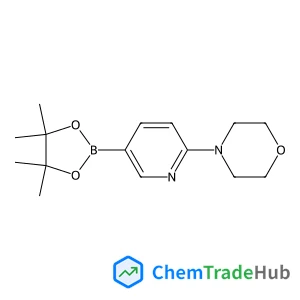
4-(5-(4,4,5,5-tetramethyl-1,3,2-dioxaborolan-2-yl)pyridin-2-yl)morpholine
CAS番号:
485799-04-0
分子式:
C15H23BN2O3
おすすめサプライヤー



免責事項
このページに表示される学術雑誌情報は、参考および研究目的のみを目的としています。当社は雑誌出版社とは提携しておらず、投稿の取り扱いも行っておりません。出版に関するお問い合わせは、各雑誌出版社に直接ご連絡ください。
表示されている情報に誤りがある場合は、support@chemtradehub.com までご連絡ください。迅速に確認し、対応いたします。