












Supramolecular complexes of single walled carbon nanotubes with conjugated polymers‡
文献情報
出版日
2010-10-29
DOI
10.1039/C0PY00286K
インパクトファクター
5.582
著者
Patigul Imin, Fuyong Cheng, Alex Adronov
原文を見る
要旨
We have synthesized a series of conjugated polymers, including poly[(2,7-(9,9-dioctylfluorene)-alt-2,7-(9,9-didodecylfluorene)] (PF), poly[(2,7-(9,9-dioctylfluorene)-alt-2,5-(3-dodecylthiophene)] (PFT), and poly(3-dodecylthiophene) (PT). Non-covalent functionalization of single walled carbon nanotubes (SWNTs) with these polymers can impart good solubility to nanotubes in a number of organic solvents, including THF, dichlorobenzene, chloroform, and toluene. Solution and solid-state characterization of the resulting polymer–SWNT composites are described, including UV-Vis absorption and Raman spectroscopy. It was found that the UV-Vis absorption maximum of the polymers was red-shifted in their corresponding composites due to the planarization of the polymer backbone following adsorption upon the SWNT surface. Polymer–SWNT complexes also exhibited good solution stability at elevated temperature in THF and dichlorobenzene, with no significant SWNT sedimentation observed at elevated temperatures. Both UV-Vis absorption and Raman spectroscopy results indicated that the interaction of PT with the nanotubes was different from those of PF and PFT, suggesting that the choice of aromatic ring in the polymer structures plays an important role in the supramolecular complex formation with carbon nanotubes.
関連文献
Spectroscopic characterisation of centropolyindanes
Stewart F. Parker, Lisha Zhong, Marco Harig, Dietmar Kuck
2019-02-04
Paper
DOI: 10.1039/C8CP07311B
Experimental and theoretical investigation of long-wavelength fluorescence emission in push–pull benzazoles: intramolecular proton transfer or charge transfer in the excited state?
Guilherme Wiethaus, Josene Maria Toldo, Fabiano da Silveira Santos, Rodrigo da Costa Duarte, Paulo Fernando Bruno Gonçalves, Fabiano Severo Rodembusch
2019-01-28
Paper
DOI: 10.1039/C8CP05186K
Fundamental limitations of the time-dependent Stokes shift for investigating protein hydration dynamics
Esther Heid
2019-02-01
Paper
DOI: 10.1039/C8CP07623E
Coarse-grained molecular dynamics simulation of the interface behaviour and self-assembly of CTAB cationic surfactants
Sílvia Illa-Tuset, David C. Malaspina, Jordi Faraudo
2018-09-25
Paper
DOI: 10.1039/C8CP04505D
Strained hydrogen bonding in imidazole trimer: a combined infrared, Raman, and theory study
Thomas Forsting, Julia Zischang, Martin A. Suhm, Marco Eckhoff, Benjamin Schröder, Ricardo A. Mata
2019-02-25
Paper
DOI: 10.1039/C9CP00399A
Interface Schottky barrier in Hf2NT2/MSSe (T = F, O, OH; M = Mo, W) heterostructures
Tao Jing, Dongmei Liang, Jinxin Hao, Mingsen Deng, Shaohong Cai
2019-02-19
Paper
DOI: 10.1039/C9CP00028C
Reconsideration of the relaxational and vibrational line shapes of liquid water based on ultrabroadband dielectric spectroscopy
Keiichiro Shiraga, Takashi Arikawa, Yuichi Ogawa
2018-10-08
Paper
DOI: 10.1039/C8CP04778B
Effect of intermediate phases on the optical properties of PbI2-rich CH3NH3PbI3 organic–inorganic hybrid perovskite
Alonso W. P. Sanches, Marco A. T. da Silva, Neusmar J. A. Cordeiro, Alexandre Urbano, Sidney A. Lourenço
2019-02-11
Paper
DOI: 10.1039/C8CP06916F
こちらもおすすめ
化合物よくある質問
3-(2-オキサプロピル)ベンzoic酸はどのように合成されますか?
3-(2-オキサプロピル)ベンzoic酸は、ベンzoic酸とプロパノ酸をヒドロキシム化合物として反応させて生成します。具体的には、ベンzoic酸とプロパノ酸を反...
205927-63-53-(2-Oxopropyl)benzo...
114873-01-73-Fluoro-N-{[(2-meth...
化合物よくある質問
4-メチル-4-ピペリジニル-1-ピロリドイン甲酸の主な用途は何ですか?
4-メチル-4-ピペリジニル-1-ピロリドイン甲酸は、主に医薬品の合成材料や研究用物質として使用されます。さらに、一部の薬理学的研究にも応用されています。
885523-47-7(4-Methyl-4-piperidi...
化合物よくある質問
Biotin-PEG3-oxyamine HCl塩について、適切な化合物名称に適用される法規ガイドラインは何ですか?
Biotin-PEG3-oxyamine HCl塩は、GHS( Globally Harmonized System of Classification and...
1786206-22-1Biotin-PEG3-oxyamine...
化合物よくある質問
N-(4-イソチオシアネートフェニル)-2-メトキシアリニンはどのように合成されますか?
N-(4-イソチオシアネートフェニル)-2-メトキシアリニンは、4-イソチオシアノフェノールと2-メトキシアリニルアミンのアミニド反応を用いて合成されます。この...
915919-57-2N-(4-Isothiocyanatop...
化合物よくある質問
金粉蕨亭2'-O-葡萄糖甙の主な用途は何ですか?
金粉蕨亭2'-O-葡萄糖甙は主に薬理研究や医薬品製造に使用され、抗炎症作用や抗がん作用などがあります。また、その構造や性質から、合成化学や化学生理学の研究にも用...
76947-60-92-(7-Hydroxy-2,2,4,6...
化合物よくある質問
2-(2-ニトロフェニル)酢酸ヒドライドの物理化学的性質は何ですか?
2-(2-ニトロフェニル)酢酸ヒドライドのCAS番号は114953-81-0です。この化合物は白色結晶性粉末で、分子量は244.12です。水溶性は限られており、...
114953-81-02-(2-Nitrophenyl)ace...
化合物よくある質問
5-(ヒドロキシメチル)-2-チオキソ-2,3-ジヒドロピリミジン-4(1H)-オンを取り扱う際の実験室安全事項は何ですか?
この化合物は高活性のため、取り扱いには注意が必要です。PPE(個人保護具)としてゴーグル、ガントリー、および防滴シールドを着用することが推奨されます。ドラフトチ...
93185-31-05-(Hydroxymethyl)-2-...
化合物よくある質問
11-脱氢血栓烷 b2の市場動向や研究トレンドはどうですか?
11-脱氢血栓烷 b2は、血栓溶解・抗凝固作用に関する研究で注目を集めています。特に心血管疾患の治療法開発において、市場の需要が高まっています。研究トレンドとし...
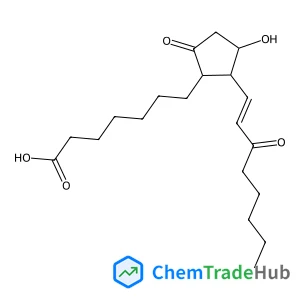
67910-12-77-{(2R,3S,4S)-4-Hydr...
化合物よくある質問
3,3-二甲基哌啶-4-酮はどのように保存すればよいですか?
3,3-二甲基哌啶-4-酮は避光、常温、乾燥した場所で保存してください。容器は密閉し、遠くから火源を離して保管することを確認してください。
150668-82-93,3-Dimethyl-4-piper...
掲載誌
Polymer Chemistry

CiteScore:
8.6
自己引用率:
7.3%
年間論文数:
457
Polymer Chemistry welcomes submissions in all areas of polymer science that have a strong focus on macromolecular chemistry. Manuscripts may cover a broad range of fields, yet no direct application focus is required.
おすすめ化合物
おすすめサプライヤー



免責事項
このページに表示される学術雑誌情報は、参考および研究目的のみを目的としています。当社は雑誌出版社とは提携しておらず、投稿の取り扱いも行っておりません。出版に関するお問い合わせは、各雑誌出版社に直接ご連絡ください。
表示されている情報に誤りがある場合は、support@chemtradehub.com までご連絡ください。迅速に確認し、対応いたします。