












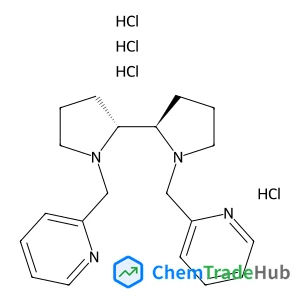
(2R,2'R)-1,1'-Bis(2-pyridinylmethyl)-2,2'-bipyrrolidine tetrahydrochloride
CAS番号:
1228077-88-0
分子式:
C20H30Cl4N4
F. Marinetti, F. A. Gianturco
Quantum Monte Carlo (QMC) stochastic calculations are carried out for a series of mixed rare gas clusters containing He and Ne which further include one H2O molecule as a single dopant. The ab initio potentials employed in the calculations, and the structural details provided by the QMC results, clearly reveal that the differences in the interaction forces which exist between the two solvent adatoms and the molecular solute are causing strongly competing environments that generate preferential shell structuring when surrounding the water molecule. The different behaviour of the two solvents, and the energetics of mixing, are analyzed in detail for small aggregates and for larger mixtures, revealing structural effects which originate from the different networking between solvent adatoms.
Yijun Yang, Dai-Ming Tang, Chao Zhang, Yihui Zhang, Qifeng Liang, Shimou Chen, Qunhong Weng, Min Zhou, Yanming Xue, Jiangwei Liu, Jinghua Wu, Qiu Hong Cui, Chao Lian, Guolin Hou, Fangli Yuan, Xi Wang
DOI: 10.1039/C7EE00329C
Lei Kang, Jinpeng Li, Jinsong Zeng, Wenhua Gao, Jun Xu, Zheng Cheng, Kefu Chen, Bin Wang
DOI: 10.1039/C9TA04815D
Kangyu Zou, Peng Cai, Cheng Liu, Jiayang Li, Xu Gao, Laiqiang Xu, Guoqiang Zou, Hongshuai Hou, Zuming Liu, Xiaobo Ji
DOI: 10.1039/C9TA03797G
Guijun Li, Wing-Cheung Law, Kang Cheung Chan
DOI: 10.1039/C8GC01347K
Benedicte Lebeau, Plinio Innocenzi
DOI: 10.1039/C0CS00106F
Pingping Liang, Xiaochen Dong
DOI: 10.1039/C8SC04123G
DOI: 10.1039/JA9860100100
Jiu Wang, Pawan Kumar, Heng Zhao, Md Golam Kibria, Jinguang Hu
DOI: 10.1039/D1GC02307A
オステニ二甲磺酸塩は、GHS分類に基づき corrosive 物質として分類されます。REACH規則では、該当物質の登録が要求される可能性があります。また、FD...
環丁基肼盐酸盐は毒性があり、吸入や皮膚接触は有害です。使用時の安全対策として、密閉システムを使用し、適切な排気設備を備えた場所で作業することが推奨されます。
N-(4-パリドン基ソニルフェニル)硫代イソシアネートは高毒性で、皮膚や吸入による毒性があります。取り扱う際は防毒マスク、保護用手袋、保護眼鏡などのPPEを着用...
CAS番号3416-18-0の5-ヒドロキシ-1,3-ジヒドロ-2H-インドン-2-酮は、結晶性の白色粉末です。分子量は228.25であり、 aqueous m...
O-苄基-D-丝氨醇は、D-アミノ酸とベンゼン環の経由で合成されます。触媒としてジメチルアミノピリジンが使用され、選択性は高いです。一般的な収率は約90%です。
ナトリウム3-ヒドロキシbutano酸は、CAS番号13613-65-5で登録されている化合物です。この化合物は、(3R)-3-ヒドロキシbutano酸とナトリ...
CAS番号603-37-2の1-(二苯甲基)-4-甲基ベンゼンは、結晶性の固体で、分子量は244.28であり、水中的には微溶です。この化合物は有機反応において中...
ネアミン塩酸塩の分子量は321.19であり、結晶性の白色粉末です。この化合物は水に溶けやすく、pHが低くなると不溶性になります。反応活性は高く、水溶液中の酸化還...
偶氮二甲酰二哌啶は、医薬品、染料、高 Então 剤、触媒、溶媒、量論試薬など、様々な分野で使用されています。特に、高 Enough 反応において、グリコール酸...

Physical Chemistry Chemical Physics (PCCP) is an international journal co-owned by 19 physical chemistry and physics societies from around the world. This journal publishes original, cutting-edge research in physical chemistry, chemical physics and biophysical chemistry. To be suitable for publication in PCCP, articles must include significant innovation and/or insight into physical chemistry; this is the most important criterion that reviewers and Editors will judge against when evaluating submissions. The journal has a broad scope and welcomes contributions spanning experiment, theory, computation and data science. Topical coverage includes spectroscopy, dynamics, kinetics, statistical mechanics, thermodynamics, electrochemistry, catalysis, surface science, quantum mechanics, quantum computing and machine learning. Interdisciplinary research areas such as polymers and soft matter, materials, nanoscience, energy, surfaces/interfaces, and biophysical chemistry are welcomed if they demonstrate significant innovation and/or insight into physical chemistry. Joined experimental/theoretical studies are particularly appreciated when complementary and based on up-to-date approaches.
![4,4-Difluoro-2-methyl-1-{[(2-methyl-2-propanyl)oxy]carbonyl}-L-proline structure](https://static.chemtradehub.com/structs/119/1194032-23-9-f426.webp "4,4-Difluoro-2-methyl-1-{[(2-methyl-2-propanyl)oxy]carbonyl}-L-proline structure")




