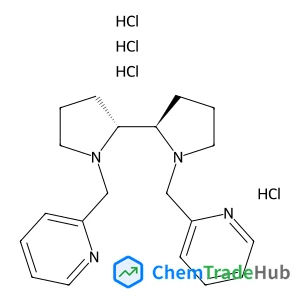
(2R,2'R)-1,1'-Bis(2-pyridinylmethyl)-2,2'-bipyrrolidine tetrahydrochloride
CAS番号:
1228077-88-0
分子式:
C20H30Cl4N4
Huihui Kong, Xing Song, Xiaoqing Liu, Hongming Wang
Large area chiral supramolecular self-assembly of rubrene has been achieved on Au(111) surface at room temperature. The basic building block of such self-assembled layers consists of two double-layered Y-shape supramolecular structures containing eight twisted rubrene molecules. Chirality is maintained and transferred from the bottom layer to the top layer in the successive molecular layers for up to five layers. Such chiral multilayers can be potential candidates in enantioselective catalysis and chiral separations.
Evgeny A. Uslamin, Nikolay A. Kosinov, Evgeny A. Pidko, Emiel J. M. Hensen
DOI: 10.1039/C8GC01528G
S. H. Jensen, C. Graves, M. Mogensen, C. Wendel, R. Braun, G. Hughes, Z. Gao, S. A. Barnett
DOI: 10.1039/C6EE90064J
Wenchao Wan, Shiqian Wei, Jingguo Li, Carlos A. Triana, Ying Zhou, Greta R. Patzke
DOI: 10.1039/C9TA03213D
Lei Hu, Li Gao, Wenji Zheng, Yan Dai, Ce Hao, Xuemei Wu
DOI: 10.1039/C9TA04423J
Wentan Liu, Jie Ke, Chuan He
DOI: 10.1039/D1SC02614C
Pushparathinam Gopinath, Venkatachalam Ramkumar, Kannoth Manheri Muraleedharan
DOI: 10.1039/C4CE01938E
Alexandra Popescu, Martin P. Bellmann, Daniel Vizman
DOI: 10.1039/D0CE01377C
Shougo Higashi, Takashi Tachikawa, Keiichiro Oh-ishi, Keisuke Shigetoh, Kensuke Takechi, Atsushi Beniya
DOI: 10.1039/D0TA07707K
オステニ二甲磺酸塩は、GHS分類に基づき corrosive 物質として分類されます。REACH規則では、該当物質の登録が要求される可能性があります。また、FD...
環丁基肼盐酸盐は毒性があり、吸入や皮膚接触は有害です。使用時の安全対策として、密閉システムを使用し、適切な排気設備を備えた場所で作業することが推奨されます。
N-(4-パリドン基ソニルフェニル)硫代イソシアネートは高毒性で、皮膚や吸入による毒性があります。取り扱う際は防毒マスク、保護用手袋、保護眼鏡などのPPEを着用...
CAS番号3416-18-0の5-ヒドロキシ-1,3-ジヒドロ-2H-インドン-2-酮は、結晶性の白色粉末です。分子量は228.25であり、 aqueous m...
O-苄基-D-丝氨醇は、D-アミノ酸とベンゼン環の経由で合成されます。触媒としてジメチルアミノピリジンが使用され、選択性は高いです。一般的な収率は約90%です。
ナトリウム3-ヒドロキシbutano酸は、CAS番号13613-65-5で登録されている化合物です。この化合物は、(3R)-3-ヒドロキシbutano酸とナトリ...
CAS番号603-37-2の1-(二苯甲基)-4-甲基ベンゼンは、結晶性の固体で、分子量は244.28であり、水中的には微溶です。この化合物は有機反応において中...
ネアミン塩酸塩の分子量は321.19であり、結晶性の白色粉末です。この化合物は水に溶けやすく、pHが低くなると不溶性になります。反応活性は高く、水溶液中の酸化還...
偶氮二甲酰二哌啶は、医薬品、染料、高 Então 剤、触媒、溶媒、量論試薬など、様々な分野で使用されています。特に、高 Enough 反応において、グリコール酸...

Physical Chemistry Chemical Physics (PCCP) is an international journal co-owned by 19 physical chemistry and physics societies from around the world. This journal publishes original, cutting-edge research in physical chemistry, chemical physics and biophysical chemistry. To be suitable for publication in PCCP, articles must include significant innovation and/or insight into physical chemistry; this is the most important criterion that reviewers and Editors will judge against when evaluating submissions. The journal has a broad scope and welcomes contributions spanning experiment, theory, computation and data science. Topical coverage includes spectroscopy, dynamics, kinetics, statistical mechanics, thermodynamics, electrochemistry, catalysis, surface science, quantum mechanics, quantum computing and machine learning. Interdisciplinary research areas such as polymers and soft matter, materials, nanoscience, energy, surfaces/interfaces, and biophysical chemistry are welcomed if they demonstrate significant innovation and/or insight into physical chemistry. Joined experimental/theoretical studies are particularly appreciated when complementary and based on up-to-date approaches.
![4,4-Difluoro-2-methyl-1-{[(2-methyl-2-propanyl)oxy]carbonyl}-L-proline structure](https://static.chemtradehub.com/structs/119/1194032-23-9-f426.webp "4,4-Difluoro-2-methyl-1-{[(2-methyl-2-propanyl)oxy]carbonyl}-L-proline structure")