



Zeolitic polyoxometalates metal organic frameworks (Z-POMOF) with imidazole ligands and ε-Keggin ions as building blocks; computational evaluation of hypothetical polymorphs and a synthesis approach
文献情報
出版日
2010-06-30
DOI
10.1039/C004234J
インパクトファクター
3.676
著者
L. Marleny Rodriguez Albelo, A. Rabdel Ruiz-Salvador, Dewi W. Lewis, Ariel Gómez, Pierre Mialane, Jérome Marrot, Anne Dolbecq, Alvaro Sampieri, Caroline Mellot-Draznieks
原文を見る
要旨
We investigate here a new family of zeolitic Metal Organic Frameworks (MOFs) based on imidazole (im) as the ligand and ε-type Keggin PolyOxoMetalates (POMs) as building units. The POM used in this study is the ε-{PMo12O40} Keggin isomer capped by four Zn(II) ions (noted ε-Zn) in tetrahedral coordination. We describe here our methods to first construct and then evaluate the stability of hypothetical 3-D POMOFs possessing a tetrahedral network, typified by dense silica polymorphs and zeotypes and referred here to as Z-POMOFs. We use the analogy between the connectivity of silicon ion in dense minerals or zeolites and the ε-Zn, using imidazolate ligands to mimic the role of oxygen atoms in zeolites. Handling the ε-Keggin and imidazole as the constitutive building-blocks, a selection of 40 polymorphs were constructed and their relative stabilities computed. Among these Z-POMOFs, the cristobalite-like and zni-structure were identified as the most stable candidates. In parallel, we have attempted to synthesize Z-POMOF structures with ε-Zn POMs, synthesized in situ under hydrothermal conditions, and imidazole ligands. We present our first experimental result, the extended material [NBu4][PMoV8MoVI4O37(OH)3Zn4(im)(Him)], named ε(im)2. The structure of the hybrid framework is built by the connection of dimerized ε-Zn POMs to imidazole ligands in two directions. The obtaining of the first POMOF based on imidazole ligand is an encouraging step towards the synthesis of a new family of POMOFs.
おすすめジャーナル

Russian Chemical Reviews

Journal of Heterocyclic Chemistry

Journal of Organometallic Chemistry

Journal of Catalysis

Organic Preparations and Procedures International

Nature

Helvetica Chimica Acta

Pharmacological Reviews

Israel Journal of Chemistry

Proceedings of the National Academy of Sciences of the United States of America
関連文献
Gas-phase structure of 1,8-bis[(trimethylsilyl)ethynyl]anthracene: cog-wheel-type vs. independent internal rotation and influence of dispersion interactions
Arseniy A. Otlyotov, Jan-Hendrik Lamm, Sebastian Blomeyer, Norbert W. Mitzel, Vladimir V. Rybkin, Yuriy A. Zhabanov, Natalya V. Tverdova, Nina I. Giricheva, Georgiy V. Girichev
2017-05-02
Paper
DOI: 10.1039/C7CP01781B
Phonons spreading from laser-heated gold nanoparticle array accelerate diffusion of excitons in an underlying polythiophene thin film
David Rais, Miroslav Menšík, Bartosz Paruzel, Dharmalingam Kurunthu, Jiří Pfleger
2017-03-24
Paper
DOI: 10.1039/C7CP00286F
Thermal mismatch strain induced disorder of Y2Mo3O12 and its effect on thermal expansion of Y2Mo3O12/Al composites
Chang Zhou, Qiang Zhang, Saiyue Liu, Bingcheng Luo, Eongyu Yi, Enke Tian, Guowu Li, Longtu Li, Gaohui Wu
2017-04-13
Paper
DOI: 10.1039/C7CP00676D
Identifying electrochemical effects in a thermal–electrochemical co-driven system for CO2 capture
Guang X. Liu, Yun S. Yu, Ying T. Hong, Geoff G. X. Wang
2017-04-25
Paper
DOI: 10.1039/C7CP01035D
Impact of lipid composition and photosensitizer hydrophobicity on the efficiency of light-triggered liposomal release
Julien Massiot, Ali Makky, Florent Di Meo, David Chapron, Véronique Rosilio
2017-04-04
Paper
DOI: 10.1039/C7CP00983F
Molecular organization in the twist–bend nematic phase by resonant X-ray scattering at the Se K-edge and by SAXS, WAXS and GIXRD
W. D. Stevenson, Z. Ahmed, X. B. Zeng, C. Welch, G. H. Mehl
2017-05-03
Communication
DOI: 10.1039/C7CP01404J
Emission behaviours of novel V- and X-shaped fluorophores in response to pH and force stimuli
Hong-Yu Fu, Ning Xu, Yi-Min Pan, Xiao-Lin Lu, Min Xia
2017-04-06
Paper
DOI: 10.1039/C7CP01281K
Phase diagram of water–methane by first-principles thermodynamics: discovery of MH-IV and MH-V hydrates
Xiaoxiao Cao, Yingying Huang, Xue Jiang, Yan Su, Jijun Zhao
2017-05-17
Paper
DOI: 10.1039/C7CP01147D
pH-Dependent absorption spectrum of a protein: a minimal electrostatic model of Anabaena sensory rhodopsin
Michael Stenrup, Elisa Pieri, Vincent Ledentu, Nicolas Ferré
2017-05-03
Paper
DOI: 10.1039/C7CP00991G
The importance of transport property studies for battery electrolytes: revisiting the transport properties of lithium–N-methyl-N-propylpyrrolidinium bis(fluorosulfonyl)imide mixtures
Thomas Rüther, Mitsuhiro Kanakubo, Adam S. Best, Kenneth R. Harris
2017-03-31
Paper
DOI: 10.1039/C7CP01272A
こちらもおすすめ
化合物よくある質問
2-メトキシ-4-(メチルスルフィニル)アミンの主な用途は何ですか?
2-メトキシ-4-(メチルスルフィニル)アミンは、主に医薬品および農薬の製造に使用されます。また、合成化学の一部として研究用材料としても利用されます。
41608-73-52-Methoxy-4-(methyls...
118684-13-24-(Bromomethyl)-3-me...
化合物よくある質問
4,6-二氯-N-甲基ピラミジンアミンの代替品はありますか?
代替品としては、4,6-二クロロピラミジンアミンや他のピラミジン系化合物が考えられます。ただし、目的と用途によって最適な代替品は異なります。
10397-15-64,6-Dichloro-N-methy...
化合物よくある質問
6-氯-4-甲基-1H-吲哚を含む廃棄物はどのように処理すべきですか?
6-氯-4-甲基-1H-吲哚の廃棄物は、適切な容器に収集し、密閉して保管します。温度は常温、湿度は低く、直射日光を避けて保管することを推奨します。廃棄処理は専門...
885520-84-36-chloro-4-methyl-1H...
化合物よくある質問
2-フローユロ-4-(トリフルオロメチル)ベンゾイドについて「に適用される法規ガイドラインは何ですか」
2-フローユロ-4-(トリフルオロメチル)ベンゾイドのCAS番号は207974-08-1です。この化合物はGHS分類で毒性物質と有害な反応物質として分類されます...
207974-08-1[2-Fluoro-4-(trifluo...
化合物よくある質問
4-ニトロフェニルN-[(ベンゼルオキシルカーボンイル]グリシングリシングリシン酸はどのように保存すればよいですか?
4-ニトロフェニルN-[(ベンゼルオキシルカーボンイル]グリシングリシングリシン酸は、室温で暗所に保管し、乾燥した環境で保存することを推奨します。容器は密閉性の...
19811-64-44-Nitrophenyl N-[(be...
化合物よくある質問
イソデスロラタドリンの代替品はありますか?
イソデスロラタドリンの代替品としては、デスロラタドリンや他の抗ヒスタミン薬が挙げられます。具体的には、デスロラタドリン、ラセカミド、フェルタドリンなどが、症状や...
183198-49-4Iso Desloratadine
化合物よくある質問
5-甲氧基-1,2,3,4-四氢异喹啉盐酸盐はどのように合成されますか?
5-甲氧基-1,2,3,4-四氢异喹啉盐酸盐の一般的な合成方法は、メタノール中で5-メトキシ-1,2,3,4-四ヒュドロイソキシンを塩酸で塩化します。この反応で...
103030-69-95-Methoxy-1,2,3,4-te...
化合物よくある質問
4-アミノ-5-メトキシ-2-トルエンサルホニック酸についての法規ガイドラインは何ですか?
CAS番号6471-78-9の4-アミノ-5-メトキシ-2-トルエンサルホニック酸は、GHS分類では corrosive(腐食性)と識別されます。EUのREAC...
6471-78-94-Amino-5-Methoxy-2-...
化合物よくある質問
甲基孕酮を取り扱う際の実験室安全事項は何ですか?
甲基孕酮の取り扱いは、PPE(個人保護具)の使用が必要な重要な安全事項を伴います。防塵マスク、ゴーグル、手袋を着用することが推奨されます。ドラフトチャンバーを使...
204063-33-22-[(Diphenylmethyl)a...
掲載誌
Physical Chemistry Chemical Physics

CiteScore:
5.5
自己引用率:
10.3%
年間論文数:
3036
Physical Chemistry Chemical Physics (PCCP) is an international journal co-owned by 19 physical chemistry and physics societies from around the world. This journal publishes original, cutting-edge research in physical chemistry, chemical physics and biophysical chemistry. To be suitable for publication in PCCP, articles must include significant innovation and/or insight into physical chemistry; this is the most important criterion that reviewers and Editors will judge against when evaluating submissions. The journal has a broad scope and welcomes contributions spanning experiment, theory, computation and data science. Topical coverage includes spectroscopy, dynamics, kinetics, statistical mechanics, thermodynamics, electrochemistry, catalysis, surface science, quantum mechanics, quantum computing and machine learning. Interdisciplinary research areas such as polymers and soft matter, materials, nanoscience, energy, surfaces/interfaces, and biophysical chemistry are welcomed if they demonstrate significant innovation and/or insight into physical chemistry. Joined experimental/theoretical studies are particularly appreciated when complementary and based on up-to-date approaches.
おすすめ化合物
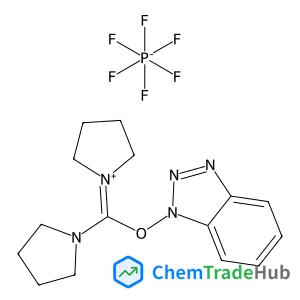
(1H-Benzotriazol-1-yloxy)(di-1-pyrrolidinyl)methylium hexafluorophosphate
CAS番号:
105379-24-6
分子式:
C15H21F6N5OP
おすすめサプライヤー






免責事項
このページに表示される学術雑誌情報は、参考および研究目的のみを目的としています。当社は雑誌出版社とは提携しておらず、投稿の取り扱いも行っておりません。出版に関するお問い合わせは、各雑誌出版社に直接ご連絡ください。
表示されている情報に誤りがある場合は、support@chemtradehub.com までご連絡ください。迅速に確認し、対応いたします。