


Reduction of electron deficient guanine radical species in plasmidDNA by tyrosine derivatives
文献情報
出版日
2010-03-24
DOI
10.1039/B922749K
インパクトファクター
3.876
著者
Mandi Tsoi, Trinh T. Do, Vicky J. Tang, Joseph A. Aguilera, Jamie R. Milligan
原文を見る
要旨
Guanine bases are the most easily oxidized sites in DNA and therefore electron deficient guanine radical species are major intermediates in the direct effect of ionizing radiation (ionization of the DNA itself) on DNA as a consequence of hole migration to guanine. As a model for this process we have used gamma-irradiation in the presence of thiocyanate ions to generate single electron oxidized guanine radicals in a plasmid target in aqueous solution. The stable species formed from these radicals can be detected and quantified by the formation of strand breaks in the plasmid after a post-irradiation incubation using a suitable enzyme. If a tyrosine derivative is also present during irradiation, the production of guanine oxidation products is decreased by electron transfer from tyrosine to the intermediate guanyl radical species. By using cationic tyrosine containing ligands we are able to observe this process when the tyrosine is electrostatically bound to the plasmid. The driving force dependence of this reaction was determined by comparing the reactivity of tyrosine with its 3-nitro analog. The results imply that the electron transfer reaction is coupled to a proton transfer. The experimental conditions used in this model system provide a reasonable approximation to those involved in the radioprotection of DNA by tightly bound proteins in chromatin.
おすすめジャーナル

Pure and Applied Chemistry

Proceedings of the National Academy of Sciences of the United States of America

Fibre Chemistry

Planta Medica

Pharmacological Reviews

Kinetics and Catalysis

Journal of Physics and Chemistry of Solids

Israel Journal of Chemistry

Helvetica Chimica Acta

European Journal of Wood and Wood Products
関連文献
Graphene film doped with silver nanoparticles: self-assembly formation, structural characterizations, antibacterial ability, and biocompatibility
Panpan Zhang, Haixia Wang, Wei Xu, Yang Li, Qing Li, Gang Wei, Zhiqiang Su
2015-04-28
Paper
DOI: 10.1039/C5BM00058K
The influence of ammonium salts on the precipitation of nickel by ammonia
Paper
DOI: 10.1039/AN8992400202
Insights into the scalability of catalytic upgrading of biomass pyrolysis vapors using micro and bench-scale reactors
Andreas Eschenbacher, Alireza Saraeian, Brent H. Shanks, Peter Arendt Jensen, Ulrik Birk Henriksen, Jesper Ahrenfeldt, Anker Degn Jensen
2020-05-15
Paper
DOI: 10.1039/D0SE00303D
Hyperbranched PEG-based supramolecular nanoparticles for acid-responsive targeted drug delivery
Xiaofei Chen, Xuemei Yao, Chunran Wang, Li Chen, Xuesi Chen
2015-05-13
Paper
DOI: 10.1039/C5BM00061K
Synthesis and electrochemical performance of Co1−xNixS QDs as electrode materials for high performance supercapacitors
Mingyan Chuai, Hongpeng Zhang, Yu Tong, Kewei Zhang, Mingzhe Zhang
2020-04-24
Paper
DOI: 10.1039/D0SE00366B
Progress in Ce0.8Gd0.2O2−δ protective layers for improving the CO2 stability of Ba0.5Sr0.5Co0.8Fe0.2O3−δ O2-transport membranes
Cecilia Solís, María Balaguer, Julio Garcia-Fayos, Elena Palafox, José M. Serra
2020-05-14
Paper
DOI: 10.1039/D0SE00324G
Fluorinated oligothiophene donors for high-performance nonfullerene small-molecule organic solar cells
Yuying Chang, Cenqi Yan, Qianguang Yang, Zhipeng Kan, Ranbir Singh, Manish Kumar, Gang Li, Shirong Lu, Tainan Duan
2020-04-07
Communication
DOI: 10.1039/D0SE00335B
こちらもおすすめ
化合物よくある質問
環戊烷-1,3-二甲酸甲酯はどのように合成されますか?
環戊烷-1,3-二甲酸甲酯は、環戊烷と塩酸によるヒンデンブルク反応を経由して合成されます。この反応では、環戊烷が塩酸と作用し、1,3-ジカルボキシ基が導入されま...
2435-36-1Dimethyl 1,3-cyclope...
化合物よくある質問
4-メトキシ-1,2,3-スチアゼ-3,5-ジオンとは何ですか?
4-メトキシ-1,2,3-スチアゼ-3,5-ジオンは、CAS番号107843-77-6の化合物で、(E)-ベンジル3-(3,4-ジヒドロキシフェニル) acry...
107843-77-6(E)-Benzyl 3-(3,4-di...
化合物よくある質問
プロスタグランジンA2について「に適用される法規ガイドラインは何ですか?'
プロスタグランジンA2 (CAS番号: 41691-92-3) は、化学物質の安全管理に関する規制として、GHS (危険物質の国際的ハザード分類・ラベル付けシス...
41691-92-316,16-DIMETHYL PROST...
化合物よくある質問
4-アミノ-1-ナフタレン sulfonic 酸についての物理化学的性質は何ですか?
4-アミノ-1-ナフタレン sulfonic 酸のCAS番号は84-86-6です。この化合物は結晶性で、分子量は212.15 g/molです。アルコールや水など...
84-86-64-Amino-1-naphthalen...
化合物よくある質問
N-GlcNAc-生物素を取り扱う際の実験室安全事項は何ですか?
N-GlcNAc-生物素は吸収性があり、皮膚や目への接触を避けることが重要です。PPE(個体保護具)は使用し、ドラフトチャンバーは必要に応じて使用します。漏洩時...
1272755-69-72-Acetamido-2-deoxy-...
化合物よくある質問
3-アミノメチルフローラノピペリジン-1-カルボニル酸テルブチルエステルとは何ですか?
CAS番号1209781-11-2の3-アミノメチルフローラノピペリジン-1-カルボニル酸テルブチルエステルは、有機化合物の一種で、化学式はC10H17FNO3...
1209781-11-22-Methyl-2-propanyl ...
化合物よくある質問
6-溴-1-甲基-1H-ベンゾ[d][1,2,3]三氮唑はどのように合成されますか?
6- bromo-1-methyl-1H-benzotriazoleは、ブロモフリオリンと1-メチル-1H-ベンゾ[d][1,2,3]三氮唑の反応により合成され...
944718-32-56-Bromo-1-methyl-1H-...
化合物よくある質問
4-硫代尿苷はどのように合成されますか?
4-硫代尿苷は、尿素とD-リボシルヒドロキシアルデヒドを用いてスルホン化反応を経て合成されます。通常は塩酸ヒドロキシチオニルスルホン酸などの触媒を使用し、選択性...
6741-73-71-(4-thio-beta-D-rib...
化合物よくある質問
ブレインナトリユリックペプチド32ラットとは何ですか?
ブレインナトリユリックペプチド32ラット(CAS番号: 133448-20-1)は、心臓で作られるホルモンの一つで、心不全の診断や予後評価に使用されます。
133448-20-1Brain Natriuretic Pe...
化合物よくある質問
1-(3-氮杂啶)-4-羟基哌啶双盐酸盐の物理化学的性質は何ですか?
CAS番号810680-60-5の1-(3-氮杂啶)-4-羟基哌啶双盐酸盐は、白色の結晶性粉末である。分子量は360.84 g/molで、水に溶けやすい。反応活...
810680-60-51-(3-Azetidinyl)-4-p...
掲載誌
Organic & Biomolecular Chemistry

CiteScore:
3.4
自己引用率:
10.3%
年間論文数:
1041
Organic & Biomolecular Chemistry (OBC) publishes original and high impact research and reviews in organic chemistry. We welcome research that shows new or significantly improved protocols or methodologies in total synthesis, synthetic methodology or physical and theoretical organic chemistry as well as research that shows a significant advance in the organic chemistry or molecular design aspects of chemical biology, catalysis, supramolecular and macromolecular chemistry, theoretical chemistry, mechanism-oriented physical organic chemistry, medicinal chemistry or natural products. Articles published in the journal should report new work which makes a highly-significant impact in the field. Routine and incremental work is generally not suitable for publication in the journal. More details about key areas of our scope are below. In all cases authors should include in their article clear rationale for why their research has been carried out.
おすすめ化合物
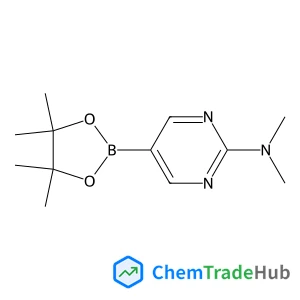
N,N-Dimethyl-5-(4,4,5,5-tetramethyl-1,3,2-dioxaborolan-2-yl)-2-pyrimidinamine
CAS番号:
1032759-30-0
分子式:
C12H20BN3O2
おすすめサプライヤー




免責事項
このページに表示される学術雑誌情報は、参考および研究目的のみを目的としています。当社は雑誌出版社とは提携しておらず、投稿の取り扱いも行っておりません。出版に関するお問い合わせは、各雑誌出版社に直接ご連絡ください。
表示されている情報に誤りがある場合は、support@chemtradehub.com までご連絡ください。迅速に確認し、対応いたします。