












Protonation of a subsite analogue of [FeFe]-hydrogenase: mechanism of a deceptively simple reaction revealed by time-resolved IR spectroscopy
文献情報
出版日
2009-09-01
DOI
10.1039/B912499C
インパクトファクター
6.222
著者
Joseph A. Wright, Christopher J. Pickett
原文を見る
要旨
We provide the first detailed time-resolved mechanistic information on the protonation of a model of the subsite of [FeFe]-hydrogenase, [Fe2(μ-pdt)(CO)4(PMe3)2]; the deceptively simple stoichiometric reaction is shown to be limited by the rate of protonation of the basal–apical isomer followed by its rearrangement to the transoid basal form.
関連文献
Two-dimensional self-organization of rectangular OPE amphiphiles into microcrystalline lamellae
Gustavo Fernández, Fátima García, Fátima Aparicio, Emilio Matesanz, Luis Sánchez
2009-10-14
Communication
DOI: 10.1039/B916418A
Deazaflavins as mediators in light-driven cytochrome P450 catalyzed hydroxylations
Felipe E. Zilly, Andreas Taglieber, Frank Schulz, Frank Hollmann, Manfred T. Reetz
2009-10-14
Communication
DOI: 10.1039/B913863C
Simultaneous blue, green, and red emission from diblock copolymer micellar films: a new approach to white-light emission
Ruobing Wang, Juan Peng, Feng Qiu, Yuliang Yang, Zhiyuan Xie
2009-10-15
Communication
DOI: 10.1039/B915378K
Radiolytic cyclization of stem-and-loop structured oligodeoxynucleotide with neighboring arrangement of α,ω-bis-disulfides
Kazuhito Tanabe, Eiji Matsumoto, Takeo Ito, Sei-ichi Nishimoto
2010-09-03
Paper
DOI: 10.1039/C0OB00275E
Tin(ii) chloride assisted synthesis of N-protected γ-amino β-keto esters through semipinacol rearrangement
Anupam Bandyopadhyay, Neha Agrawal, Sachitanand M. Mali, Sandip V. Jadhav, Hosahudya N. Gopi
2010-08-24
Paper
DOI: 10.1039/C0OB00199F
N3-Alkylation during formation of quinazolin-4-ones from condensation of anthranilamides and orthoamides
Amit Nathubhai, Richard Patterson, Timothy J. Woodman, Miranda T. Y. Chui, Hugo H. K. Chung, Stephanie W. S. Lau, Jun Zheng, Matthew D. Lloyd, Andrew S. Thompson, Michael D. Threadgill
2011-05-26
Paper
DOI: 10.1039/C1OB05430A
Sulfonic acid functionalized crystal-like mesoporous benzene–silica as a remarkable water-tolerant catalyst
Ayman Karam, João Carlos Alonso, Tsvetelina Ivanova Gerganova, Paula Ferreira, Nicolas Bion, Joël Barrault, François Jérôme
2009-10-06
Communication
DOI: 10.1039/B914689J
Splendid symmetry: crystallization of an unbridged isomer of Co2(CO)8 in Co2(CO)8·C60
Thelma Y. Garcia, James C. Fettinger, Marilyn M. Olmstead, Alan L. Balch
2009-10-29
Communication
DOI: 10.1039/B915083H
Self-association-free dimeric cinchona alkaloid organocatalysts: unprecedented catalytic activity, enantioselectivity and catalyst recyclability in dynamic kinetic resolution of racemic azlactones
Ji Woong Lee, Tae Hi Ryu, Joong Suk Oh, Han Yong Bae, Hyeong Bin Jang
2009-10-16
Communication
DOI: 10.1039/B917882A
Intrinsic acidity and electrophilicity of gaseous propargyl/allenyl carbocations
Priscila M. Lalli, Yuri E. Corilo, Patrícia V. Abdelnur, Marcos N. Eberlin
2010-03-29
Paper
DOI: 10.1039/C001985B
こちらもおすすめ
化合物よくある質問
環戊烷-1,3-二甲酸甲酯はどのように合成されますか?
環戊烷-1,3-二甲酸甲酯は、環戊烷と塩酸によるヒンデンブルク反応を経由して合成されます。この反応では、環戊烷が塩酸と作用し、1,3-ジカルボキシ基が導入されま...
2435-36-1Dimethyl 1,3-cyclope...
化合物よくある質問
4-メトキシ-1,2,3-スチアゼ-3,5-ジオンとは何ですか?
4-メトキシ-1,2,3-スチアゼ-3,5-ジオンは、CAS番号107843-77-6の化合物で、(E)-ベンジル3-(3,4-ジヒドロキシフェニル) acry...
107843-77-6(E)-Benzyl 3-(3,4-di...
化合物よくある質問
プロスタグランジンA2について「に適用される法規ガイドラインは何ですか?'
プロスタグランジンA2 (CAS番号: 41691-92-3) は、化学物質の安全管理に関する規制として、GHS (危険物質の国際的ハザード分類・ラベル付けシス...
41691-92-316,16-DIMETHYL PROST...
化合物よくある質問
4-アミノ-1-ナフタレン sulfonic 酸についての物理化学的性質は何ですか?
4-アミノ-1-ナフタレン sulfonic 酸のCAS番号は84-86-6です。この化合物は結晶性で、分子量は212.15 g/molです。アルコールや水など...
84-86-64-Amino-1-naphthalen...
化合物よくある質問
N-GlcNAc-生物素を取り扱う際の実験室安全事項は何ですか?
N-GlcNAc-生物素は吸収性があり、皮膚や目への接触を避けることが重要です。PPE(個体保護具)は使用し、ドラフトチャンバーは必要に応じて使用します。漏洩時...
1272755-69-72-Acetamido-2-deoxy-...
化合物よくある質問
3-アミノメチルフローラノピペリジン-1-カルボニル酸テルブチルエステルとは何ですか?
CAS番号1209781-11-2の3-アミノメチルフローラノピペリジン-1-カルボニル酸テルブチルエステルは、有機化合物の一種で、化学式はC10H17FNO3...
1209781-11-22-Methyl-2-propanyl ...
化合物よくある質問
6-溴-1-甲基-1H-ベンゾ[d][1,2,3]三氮唑はどのように合成されますか?
6- bromo-1-methyl-1H-benzotriazoleは、ブロモフリオリンと1-メチル-1H-ベンゾ[d][1,2,3]三氮唑の反応により合成され...
944718-32-56-Bromo-1-methyl-1H-...
化合物よくある質問
4-硫代尿苷はどのように合成されますか?
4-硫代尿苷は、尿素とD-リボシルヒドロキシアルデヒドを用いてスルホン化反応を経て合成されます。通常は塩酸ヒドロキシチオニルスルホン酸などの触媒を使用し、選択性...
6741-73-71-(4-thio-beta-D-rib...
化合物よくある質問
ブレインナトリユリックペプチド32ラットとは何ですか?
ブレインナトリユリックペプチド32ラット(CAS番号: 133448-20-1)は、心臓で作られるホルモンの一つで、心不全の診断や予後評価に使用されます。
133448-20-1Brain Natriuretic Pe...
化合物よくある質問
1-(3-氮杂啶)-4-羟基哌啶双盐酸盐の物理化学的性質は何ですか?
CAS番号810680-60-5の1-(3-氮杂啶)-4-羟基哌啶双盐酸盐は、白色の結晶性粉末である。分子量は360.84 g/molで、水に溶けやすい。反応活...
810680-60-51-(3-Azetidinyl)-4-p...
掲載誌
Chemical Communications

CiteScore:
8.6
自己引用率:
4.7%
年間論文数:
2458
ChemComm publishes urgent research which is of outstanding significance and interest to experts in the field, while also appealing to the journal’s broad chemistry readership. Our communication format is ideally suited to short, urgent studies that are of such importance that they require accelerated publication. Our scope covers all topics in chemistry, and research at the interface of chemistry and other disciplines (such as materials science, nanoscience, physics, engineering and biology) where there is a significant novelty in the chemistry aspects. Major topic areas covered include: Analytical Chemistry Catalysis Chemical Biology and medicinal chemistry Computational Chemistry and Machine Learning Energy and sustainable chemistry Environmental Chemistry Green Chemistry Inorganic Chemistry Materials Chemistry Nanoscience Organic Chemistry Physical Chemistry Polymer Chemistry Supramolecular Chemistry
おすすめ化合物
![2-{[(1R,2S)-2-Aminocyclohexyl]amino}-4-{[3-(2H-1,2,3-triazol-2-yl)phenyl]amino}-5-pyrimidinecarboxamide structure](https://static.chemtradehub.com/structs/137/1370261-96-3-40df.webp "2-{[(1R,2S)-2-Aminocyclohexyl]amino}-4-{[3-(2H-1,2,3-triazol-2-yl)phenyl]amino}-5-pyrimidinecarboxamide structure")
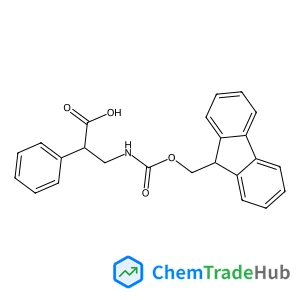
(S)-3-((((9H-Fluoren-9-yl)methoxy)carbonyl)amino)-2-phenylpropanoic acid
CAS番号:
1217663-60-9
分子式:
C24H21NO4
おすすめサプライヤー





免責事項
このページに表示される学術雑誌情報は、参考および研究目的のみを目的としています。当社は雑誌出版社とは提携しておらず、投稿の取り扱いも行っておりません。出版に関するお問い合わせは、各雑誌出版社に直接ご連絡ください。
表示されている情報に誤りがある場合は、support@chemtradehub.com までご連絡ください。迅速に確認し、対応いたします。