


Skeletal Ru/Cucatalysts prepared from crystalline and quasicrystalline ternary alloy precursors: characterization by X-ray absorption spectroscopy and COoxidation
文献情報
出版日
2009-01-08
DOI
10.1039/B811775F
インパクトファクター
3.676
著者
James Highfield, Tao Liu, Yook Si Loo, Benjamin Grushko, Armando Borgna
原文を見る
要旨
The Ru/Cu system is of historical significance in catalysis. The early development and application of X-ray absorption spectroscopy (XAS) led to the original ‘bimetallic cluster” concept for highly-immiscible systems. This work explores alkali leaching of Al-based ternary crystalline and quasicrystalline precursors as a potential route to bulk Ru/Cu alloys. Single-phase ternary alloys at 3 trial compositions; Al71Ru22Cu7, Al70.5Ru17Cu12.5, and Al70Ru10Cu20, were prepared by arc melting of the pure metal components. After leaching, the bimetallic residues were characterized principally by transmission XAS, “as-leached” and after annealing in H2 (and passivation) in a thermobalance. XRD and BET revealed a nanocrystalline product with a native structure of hexagonal Ru. XPS surface analysis of Ru22Cu7 and Ru17Cu12.5 found only slight enrichment by Cu in the as-leached forms, with little change upon annealing. Ru10Cu20 was highly segregated as-leached. XANES data showed preferential oxidation of Cu in Ru22Cu7, implying that it exists as an encapsulating layer. TG data supports this view since it does not show the distinct two-stage O2 uptake characteristic of skeletal Ru. Cu K-edge EXAFS data for Ru22Cu7 were unique in showing a high proportion of Ru neighbours. The spacing, dCuRu = 2.65 Å, was that expected from a hypothetical (ideal) solid solution at this composition, but this is unlikely in such a bulk-immiscible system and Ru K-edge EXAFS failed to confirm bulk alloying. Furthermore its invariance under annealing was more indicative of an interfacial bond between bulk components, although partial alloying with retention of local order cannot entirely be ruled out. The XAS and XPS data were reconciled in a model involving surface and bulk segregation, Cu being present at both the grain exterior and in ultra-fine internal pores. This structure can be considered as the 3-dimensional analogue of the classical type. Preliminary studies in CO and H2 oxidation were made in a DRIFTS flow reactor with on-line MS, and their activities and selectivities were compared against skeletal Ru and Cu controls, Ru/Al2O3, and Au/Fe2O3. All samples were active in CO oxidation above ∼50 °C, showing light-off temperatures in the range 60–70 °C. Ru22Cu7 and Ru17Cu12.5 also showed good selectivities (vs. H2 oxidation), attributed tentatively to Ru-modified Cu surfaces of varying thickness. These compositions are promising candidates to test in a (PROX) fuel processor to supply purified (CO-free) H2 to a PEM fuel cell.
おすすめジャーナル

Kinetics and Catalysis

Journal of Heterocyclic Chemistry

Israel Journal of Chemistry

Nature

Proceedings of the National Academy of Sciences of the United States of America

Journal of Physics and Chemistry of Solids

Organic Preparations and Procedures International

Helvetica Chimica Acta

Journal of Medicinal Chemistry

Journal of Organometallic Chemistry
関連文献
A novel method to prepare water-soluble core microcapsules with controlled burst release
Mingming Zuo, Tianqing Liu, Jingjing Han
2014-06-30
Paper
DOI: 10.1039/C4PY00616J
Reactive polymeric micelles with disulfide groups in the coronae
Lichao Sun, Jinchuan Liu, Hanying Zhao
2014-07-29
Paper
DOI: 10.1039/C4PY00938J
σ-p Conjugated copolymers via dehydrocoupling polymerization of phenylsilane and mesitylborane
Raman Vedarajan, Noriyoshi Matsumi
2016-05-09
Paper
DOI: 10.1039/C6PY00205F
Renewable itaconic acid based cross-linked fluorescent polymeric nanoparticles for cell imaging
Xiqi Zhang, Bin Yang, Yang Yang, Yen Wei
2014-07-04
Communication
DOI: 10.1039/C4PY00794H
Six-membered-ring photocyclization in phenyl-substituted p-phenylenevinylene derivatives: a potential factor of instability in conjugated polymers
Linlin Liu, Hongcheng Gao, Yupeng Li, Muddasir Hanif, Chuan Li, Yu Gao, Bing Yang, Zengqi Xie, Yuguang Ma
2016-04-25
Communication
DOI: 10.1039/C6PY00180G
Probing the dendritic architecture through AIE: challenges and successes
Mathieu Arseneault, Nelson L. C. Leung, Lai Tsz Fung, Rongrong Hu, Jean-François Morin
2014-07-04
Paper
DOI: 10.1039/C4PY00817K
Limonene induced chiroptical generation and inversion during aggregation of achiral polyfluorene analogs: structure-dependence and mechanism
Laibing Wang, Nozomu Suzuki, Jiangfei Liu, Takashi Matsuda, Nor Azura Abdul Rahim, Wei Zhang, Michiya Fujiki, Zhengbiao Zhang, Nianchen Zhou, Xiulin Zhu
2014-07-31
Paper
DOI: 10.1039/C4PY00865K
Thermal and living anionic polymerization of 4-vinylbenzyl piperidine
Alison R. Schultz, Chainika Jangu, Timothy E. Long
2014-07-02
Paper
DOI: 10.1039/C4PY00763H
こちらもおすすめ
化合物よくある質問
6- bromo-1-cyclopropyl-1H-benzimidazoleの市場動向や研究トレンドはどうですか?
6- bromo-1-cyclopropyl-1H-benzimidazoleは、抗炎症、抗ウイルス作用を持つことが報告されており、新薬開発の研究対象として注目...
1416713-53-56-Bromo-1-cyclopropy...
化合物よくある質問
環氧プロpanol-d5を取り扱う際の実験室安全事項は何ですか?
取り扱う際には、防護眼鏡と手袋を使用し、ドラフトチャンバー内で操作することを推奨します。漏洩時には適切な手順で処理し、安全データシートを常に参照してください。
1246819-20-4Glycidol-d5
化合物よくある質問
2,2’-ジメチル-3,3’-ビピリジンはどのように合成されますか?
2,2’-ジメチル-3,3’-ビピリジンは、ピリジンと2-メチルアクリルアミドを有機合成反応で合成します。この反応では、ピリジンと2-メチルアクリルアミドを含有...
86156-55-02,2’-Dimethyl-3,3’-b...
化合物よくある質問
6-甲基ピリジン-2-ボリック酸の主な用途は何ですか?
6-甲基ピリジン-2-ボリック酸は、合成化学、医薬品合成、以及研究用途などに広く使用され、特に組換えDNA技術や分子生物学の研究において重要な役割を果たします。
372963-50-3(6-Methyl-2-pyridiny...
化合物よくある質問
(R)-3-(1-甲基-2-氧環己基)プロpano酸メチルは安全ですか?
(R)-3-(1-甲基-2-氧環己基)プロpano酸メチルは一定の安全性がありますが、直接的な皮膚接触や吸入は避けるべきです。使用する際は適切な個々の安全データ...
94089-47-1methyl 3-[(1R)-1-met...
化合物よくある質問
ketorolacはどのように保存すればよいですか?
ketorolacは、密封して遮光容器に保管し、直射日光や高温を避けて保存してください。温度は常温で保存し、湿度をなるべく低く保つことが推奨されます。
74103-06-3rac Ketorolac
化合物よくある質問
L-2,3-二氨基丙酸二盐酸盐を取り扱う際の実験室安全事項は何ですか?
L-2,3-二氨基丙酸二盐酸盐は腐食性が強く、皮膚や粘膜に刺激を与える可能性があります。取り扱う際は、防塵マスク、ゴーグル、手袋を使用し、適切な排気設備を使用し...
19777-68-5(S)-2,3-Diaminopropa...
化合物よくある質問
2-(4-溴ピリジン-2-基)乙腈の物理化学的性質は何ですか?
2-(4-溴ピリジン-2-基)乙腈のCAS番号は312325-73-8です。主に結晶形態で存在し、分子量は159.01 g/molです。この化合物は水に溶けやす...
312325-73-8(4-Bromo-2-pyridinyl...
化合物よくある質問
3-フローロ-[1,1-ベンジレン]-3,4-ジカルボン酸を取り扱う際の実験室安全事項は何ですか?
この化合物は毒性は低いですが、直接的な接触や吸入に注意が必要です。PPE(個人防護具)を着用し、ドラフトチャンバーを使用して操作することを推奨します。また、漏洩...
1261915-32-53'-Fluoro-[1,1'-biph...
化合物よくある質問
3-(1-氧代-1,3-二氢-2H-2-异吲哚)丙酸の主な用途は何ですか?
3-(1-氧代-1,3-二氢-2H-2-异吲哚)丙酸は、薬理学研究や医薬品製造において広く用いられる化合物です。また、工業的な用途でも一部の化学反応の触媒や助剤...
83747-30-23-(1-Oxo-1,3-dihydro...
掲載誌
Physical Chemistry Chemical Physics

CiteScore:
5.5
自己引用率:
10.3%
年間論文数:
3036
Physical Chemistry Chemical Physics (PCCP) is an international journal co-owned by 19 physical chemistry and physics societies from around the world. This journal publishes original, cutting-edge research in physical chemistry, chemical physics and biophysical chemistry. To be suitable for publication in PCCP, articles must include significant innovation and/or insight into physical chemistry; this is the most important criterion that reviewers and Editors will judge against when evaluating submissions. The journal has a broad scope and welcomes contributions spanning experiment, theory, computation and data science. Topical coverage includes spectroscopy, dynamics, kinetics, statistical mechanics, thermodynamics, electrochemistry, catalysis, surface science, quantum mechanics, quantum computing and machine learning. Interdisciplinary research areas such as polymers and soft matter, materials, nanoscience, energy, surfaces/interfaces, and biophysical chemistry are welcomed if they demonstrate significant innovation and/or insight into physical chemistry. Joined experimental/theoretical studies are particularly appreciated when complementary and based on up-to-date approaches.
おすすめ化合物
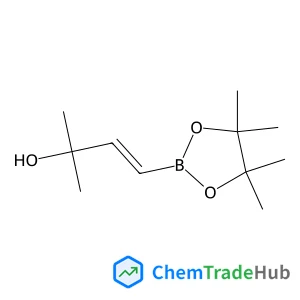
(E)-2-methyl-4-(4,4,5,5-tetramethyl-1,3,2-dioxaborolan-2-yl)but-3-en-2-ol
CAS番号:
581802-26-8
分子式:
C11H21BO3
おすすめサプライヤー





免責事項
このページに表示される学術雑誌情報は、参考および研究目的のみを目的としています。当社は雑誌出版社とは提携しておらず、投稿の取り扱いも行っておりません。出版に関するお問い合わせは、各雑誌出版社に直接ご連絡ください。
表示されている情報に誤りがある場合は、support@chemtradehub.com までご連絡ください。迅速に確認し、対応いたします。