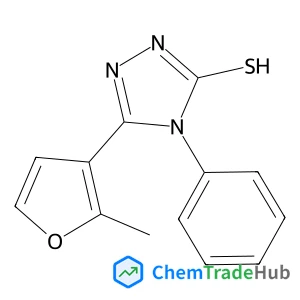
5-(2-Methyl-3-furyl)-4-phenyl-2,4-dihydro-3H-1,2,4-triazole-3-thione
CAS番号:
346464-59-3
分子式:
C13H11N3OS
Soyab A. Patel, Felicity Currie, Nalin Thakker, Royston Goodacre
The release of active pharmaceutical ingredients (APIs) into the environment is an ecologically important topic for study because, whilst APIs have been designed to have a wide range of biological properties for the target of interest (usually in man), little information on potential ecological risks is currently available regarding their effects on the organisms that inhabit the environment. In this study, the algae Micrasterias hardyi was exposed to propranolol, metoprolol (beta-adrenergic receptor agonist drugs) and mefenamic acid (a non steroidal anti-inflammatory drug), at concentrations ranging between 0.002–0.2 mM. Initial studies showed that Fourier transform infrared (FT-IR) spectroscopy on algal homogenates illustrated that all three APIs had a quantitative effect on the metabolism of the organisms and it was possible to estimate the level of API exposure from the FT-IR metabolic fingerprints using partial least squares (PLS) regression. From the inspection of the PLS loadings matrices it was possible to elucidate that all drugs caused effects on protein and lipid levels. Most strikingly propranolol had significant effects on the lipid components of the cell. These were dramatically reduced possibly as a consequence of loss of membrane integrity. In order to investigate this further, FT-IR microspectroscopy was used to generate detailed metabolic fingerprinting maps. These chemical maps revealed that all the drugs had a dramatic effect on the distribution of various chemical species throughout the algae, and that all drugs had an affect on protein and lipid levels. In particular, as noted in the PLS analyses for propranolol treated cells, the lipid complement found in the lipid storage areas in the processes of M. hardyi was greatly reduced. This illustrates the power of spatial metabolic fingerprinting for investigating abiotic stresses on complex biological species.
Andrea Dorsa, Qing Xie, Martin Wagner, Xiaoji G. Xu
DOI: 10.1039/D2AN01103D
Devesh Barshilia, Akhil Chandrakanth Komaram, Pin-Chuan Chen
DOI: 10.1039/D2AN01092E
M. Brown, W. B. Dunn, P. Dobson, Y. Patel, C. L. Winder, S. Francis-McIntyre, P. Begley, K. Carroll, D. Broadhurst, A. Tseng, N. Swainston, I. Spasic
DOI: 10.1039/B901179J
Jacek Klaudiusz Pijanka, Ying Yang, Paul Dumas, Sirinart Chio-Srichan, Michel Manfait, Ganesh Dhruvananda Sockalingum
DOI: 10.1039/B821112D
David Perez-Guaita, Piotr Chlosta, Krzysztof Okon, Kamilla Malek
DOI: 10.1039/D2AN01583H
Hyowon Jin, Mark R. Liles, Beelee Chua, Ahjeong Son
DOI: 10.1039/D2AN01164F
Paul Bassan, Hugh J. Byrne, Joe Lee, Franck Bonnier, Colin Clarke, Paul Dumas, Ehsan Gazi, Michael D. Brown, Peter Gardner
DOI: 10.1039/B821349F
Dian Liu, Feifei Huang, Ting Peng
DOI: 10.1039/D2AN01471H
取り扱いにはPPE(プロテクティブ・パーソナル・エイド)が必要で、防ぐ手袋と保護眼鏡を着用してください。ドラフトチャンバーの使用を推奨します。漏洩した場合は、適...
この化合物の代替品としては、BOC保護基を有さないアミノ酸やその他の保護基化合物が考えられます。また、メチオキシ基を有しない他の芳香族アミノ酸も代替品として挙げ...
Methyl 2-(chloromethyl)-3-nitrobenzoate(1218910-61-2)の代替品としては、化学組成を変えることで効果を達成する...
(2R)-2-アミノ-N-ベンジル-3-ヒドロキシプロパナミドを含む廃棄物は、適切な廃棄物管理ガイドラインに基づき処理する必要があります。まず、廃棄物を適切に収...
6,7-二氢-咪唑並[1,2-a]ピリドイン-8(5h)-酮は、2-ブロモフェニルアセトインとリン酸ハロゲン化物を反応させることで合成できます。この反応は高温で...
エチル(3R)-3-ピロリジニル酢酸水和塩は、CAS番号1332459-32-1の化合物で、(R)-乙基2-(ピロリジン-3-基)酢酸塩水和塩と呼ばれます。この...
(2S)-{[(2-メチルエチルオキシ]カルボニル}アミノ)[2-(トリアフルオロメチルフェニル]エチカシック酸のCAS番号は1203454-45-8です。この...
2-ブロモ-1-(2-メチル-2-プロパニル)-4-ニトロベンゼンは、直射日光を避けて暗所で、室温(約15℃〜25℃)、乾燥した場所に保存する必要があります。ま...
市場動向としては、1-[(4-硝基フェニル)スルホニル]-1H-1,2,4-三唑は主に農業用除草剤や合成化学製品の原料として利用されています。研究トレンドとして...

Analyst publishes analytical and bioanalytical research that reports premier fundamental discoveries and inventions, and the applications of those discoveries, unconfined by traditional discipline barriers.
![1-[4-(4-Methyl-1H-imidazol-1-yl)phenyl]ethanone structure](https://static.chemtradehub.com/structs/142/142161-53-3-7f55.webp "1-[4-(4-Methyl-1H-imidazol-1-yl)phenyl]ethanone structure")