












A versatile method for quantification of DNA and PCR products based on time-resolved Euiii luminescence
文献情報
出版日
2008-09-05
DOI
10.1039/B807959E
インパクトファクター
4.616
著者
Bo Song, Caroline D. B. Vandevyver, Emmanuel Deiters, Anne-Sophie Chauvin, Ilkka Hemmilä, Jean-Claude G. Bünzli
原文を見る
要旨
A versatile and robust method for the determination of DNA and PCR products (<500 bp) is presented, based on a mix of an EuIII chelate and acridine orange (AO). The nucleic acid selective stains acridine orange (AO) and ethidium bromide (EB) quench the luminescence of the bimetallic [Eu2(LC2)3] and of other monometallic chelates such as the macrocyclic complex [Eu(Lkel)], even at very low molar ratios. Stern–Volmer plots of the metal-centered emission intensities (F0/F) and Eu(5D0) lifetimes (τ0/τ) show the AO quenching being purely dynamic with KD = 6.7 × 10⁵ M−1 for [Eu2(LC2)3] and 1.6 × 10⁶ M−1 for [Eu(Lkel)], and bimolecular rate constants kq = 2.7 × 10⁸ M−1 s−1 and 3.4 × 10⁹ M−1 s−1, respectively. On the other hand, EB quenching is due to both dynamic and static mechanisms. In the presence of various types of DNA > 0.1 ng μL−1 (dsDNA, ssDNA or circular DNA), the quenched luminescence is reinstated, AO and EB intercalating into DNA, which removes the interaction with the EuIII complexes. The best results are obtained with [Eu2(LC2)3]/AO with detections limits in the range 0.18–0.66 ng μL−1; detection limits for the [Eu(Lkel)]/AO system are slightly larger; simpler monometallic EuIII complexes with dipicolinate derivatives do not follow suit in that they decompose in the presence of DNA. The EuIII/AO method is shown to be pH insensitive in the range 3–10; furthermore it is essentially insensitive to 1000-fold excesses of potential interfering substances, e.g. BSA, glucose, chelating agents and anions, alkaline earth and transition metal cations, variations in luminescence intensity being < 5%, (10 analytes) or 5–10% (4 analytes); only CoII and CuII interfere substantially.
関連文献
Hydrogentracer diffusion in LiBH4 measured by spatially resolved Raman spectroscopy
A. Borgschulte, R. Gremaud, Z. Łodziana, A. Züttel
2010-03-29
Paper
DOI: 10.1039/C000229A
Equation-of-state modeling of mixtures with ionic liquids
Costas Tsioptsias, Ioannis Tsivintzelis, Costas Panayiotou
2010-03-16
Paper
DOI: 10.1039/C000208A
Photophysical pathways of cytosine in aqueous solution
Kurt A. Kistler, Spiridoula Matsika
2010-02-24
Paper
DOI: 10.1039/B926125G
The gas-phase reaction between silylene and 2-butyne: kinetics, isotope studies, pressure dependence studies and quantum chemical calculations
Rosa Becerra, J. Pat Cannady, Guy Dormer, Robin Walsh
2009-04-17
Paper
DOI: 10.1039/B823109E
Theoretical study of the gas-phase ozonolysis of β-pinene (C10H16)
T. L. Nguyen, J. Peeters, L. Vereecken
2009-05-07
Paper
DOI: 10.1039/B822984H
Hybrid functional study of proper and improper multiferroics
A. Stroppa, S. Picozzi
2010-05-05
Paper
DOI: 10.1039/B927508H
Time-resolved spectroscopy of dye-labeled photoactive yellow protein suggests a pathway of light-induced structural changes in the N-terminal cap
Daniel Hoersch, Harald Otto, Michael A. Cusanovich, Maarten P. Heyn
2009-03-03
Paper
DOI: 10.1039/B821345C
Full quadrupolar tensor determination by NMR using a micro-crystal spinning at the magic angle
Suresh Kumar Vasa, Ernst R. H. van Eck, J. W. G. Janssen, Arno P. M. Kentgens
2010-03-22
Paper
DOI: 10.1039/B927449A
Dynamics of ionic liquid mediated quantised charging of monolayer-protected clusters
Stijn F. L. Mertens, Thomas Wandlowski
2010-04-07
Paper
DOI: 10.1039/B921368F
Shannon entropy as a new measure of aromaticity, Shannon aromaticity
Siamak Noorizadeh, Ehsan Shakerzadeh
2010-03-16
Paper
DOI: 10.1039/B916509F
こちらもおすすめ
化合物よくある質問
2-氟-4-イオドベンzo酸エチルエステルを取り扱う際の実験室安全事項は何ですか?
2-氟-4-イオドベンzo酸エチルエステルは有機溶媒を用いた反応であり、ドラフトチャンバーでの操作が必要です。漏洩時にはSDS参照の安全措置を講じ、PPE(防護...
205750-82-9Benzoic acid, 2-fluo...
化合物よくある質問
血根碱の主な用途は何ですか?
血根碱は主に医薬分野で利用され、抗炎症や抗がん剤としての潜在的な効果が研究されています。また、化学研究や薬物開発において、新しい薬剤設計の参考となる化合物として...
2447-54-313-Methyl[1,3]benzod...
化合物よくある質問
Methyl 3-methoxythiophene-2-carboxylateの主な用途は何ですか?
Methyl 3-メトキシスチフェン-2-カルボン酸メチルエステルは、薬品合成、染料製造、以及合成中間体としての用途が広がっています。
62353-75-7Methyl 3-methoxythio...
化合物よくある質問
丹磺酰-L-亮氨酸はどのように保存すればよいですか?
丹磺酰-L-亮氨酸は乾燥した場所で、直射日光から保護し、低温(室温以下)で保存してください。密閉容器に入れて保管することをおすすめします。
1100-22-7N-{[5-(Dimethylamino...
化合物よくある質問
5-(苄氧基)ピラミジン-4-アミンの代替品はありますか?
5-(苄氧基)ピラミジン-4-アミンの代替品として、6-メトキシピラミジンや5-フェニルピラミジンなどが挙げられます。これらの化合物は、5-(苄氧基)ピラミジン...
92289-50-45-benzyloxypyrimidin...
化合物よくある質問
8-ヒドロキシノルデコペントアセートの物理化学的性質は何ですか?
8-ヒドロキシノルデコペントアセートはCAS番号84807-87-4の化合物で、分子量は750.02 uです。これは油溶性で、水に溶けにくい特徴があります。反応...
84807-87-4(5Z,8Z,11Z,13E,15S)-...
化合物よくある質問
tert-ブチル(エス)-1-ヒドロキシペンタ-4-エン-2-イルカルバamateの主な用途は何ですか?
tert-ブチル(エス)-1-ヒドロキシペンタ-4-エン-2-イルカルバamateは主に医薬品の合成材料や分析化学の試薬として使用されます。
116613-81-12-Methyl-2-propanyl ...
化合物よくある質問
ブコール-L-2-フローヨルブリンについて適切な法規ガイドラインは何ですか?
ブコール-L-2-フローヨルブリン(CAS番号: 1196107-73-9)は、GHS(グローバルハザードアサessmentシステム)に基づく危害分類と表示が求...
1196107-73-92-Bromo-13,13-dimeth...
化合物よくある質問
6-ブロモ-N-環丙基-2-ピリジニニメタンの市場動向や研究トレンドはどうですか
6-ブロモ-N-環丙基-2-ピリジニニメタンは、薬理学研究や合成化学に使用される化合物であり、特に抗ウイルス薬や抗がん薬の開発に注目されています。市場では、薬物...
959237-20-86-Bromo-N-cyclopropy...
化合物よくある質問
RS-AMPÀはどのように保存すればよいですか?
RS-AMPÀは、遮光容器に保存し、室温(15〜25℃)で保管することが推奨されます。高湿や熱は物質を劣化させるため、湿度は50%以下に保つことが重要です。また...
74341-63-2(RS)-AMPA
掲載誌
Analyst

CiteScore:
7.8
自己引用率:
5.6%
年間論文数:
653
Analyst publishes analytical and bioanalytical research that reports premier fundamental discoveries and inventions, and the applications of those discoveries, unconfined by traditional discipline barriers.
おすすめ化合物
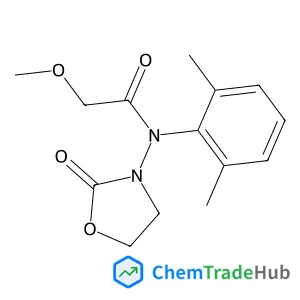
N-(2,6-Dimethylphenyl)-2-methoxy-N-(2-oxo-1,3-oxazolidin-3-yl)acetamide
CAS番号:
77732-09-3
分子式:
C14H18N2O4
![(1R)-3-Bromo-1,7,7-trimethylbicyclo[2.2.1]heptan-2-one structure](https://static.chemtradehub.com/structs/102/10293-06-8-dd8a.webp "(1R)-3-Bromo-1,7,7-trimethylbicyclo[2.2.1]heptan-2-one structure")
おすすめサプライヤー






免責事項
このページに表示される学術雑誌情報は、参考および研究目的のみを目的としています。当社は雑誌出版社とは提携しておらず、投稿の取り扱いも行っておりません。出版に関するお問い合わせは、各雑誌出版社に直接ご連絡ください。
表示されている情報に誤りがある場合は、support@chemtradehub.com までご連絡ください。迅速に確認し、対応いたします。