












Shannon entropy as a new measure of aromaticity, Shannon aromaticity
文献情報
出版日
2010-03-16
DOI
10.1039/B916509F
インパクトファクター
3.676
著者
Siamak Noorizadeh, Ehsan Shakerzadeh
原文を見る
要旨
Based on the local Shannon entropy concept in information theory, a new measure of aromaticity is introduced. This index, which describes the probability of electronic charge distribution between atoms in a given ring, is called Shannon aromaticity (SA). Using B3LYP method and different basis sets (6-31G**, 6-31+G** and 6-311++G**), the SA values of some five-membered heterocycles, C4H4X, are calculated. Significant linear correlations are observed between the evaluated SAs and some other criteria of aromaticity such as ASE, Λ and NICS indices. According to the obtained relationships, the range of 0.003 < SA < 0.005 is chosen as the boundary of aromaticity/antiaromaticity. Using B3LYP/6-31+G** level of theory, the Shannon aromaticities for a series of mono-substituted benzene derivatives are calculated and analyzed. It is found that the least standard deviation between the aromaticities and the best linear correlation with the Hammett substituent constants are observed for the new index in comparison with the other indices. Also the values of the new index are evaluated for some substituted penta- and heptafulvenes, which successfully predict the order of aromaticity in these compounds. Applying this index to some non-benzonoids, linear and angular polyacenes also give satisfactory results and prove to be quite suitable for determining the local aromaticity of different rings in polyaromatic hydrocarbons.
関連文献
Microwave induced preparation of a-axis oriented double-ended needle-shaped ZnO microparticles
Deirdre Ledwith, Suresh C. Pillai, Graeme W. Watson, John M. Kelly
2004-09-01
Communication
DOI: 10.1039/B407768G
Poly(vinyl alcohol) star polymers prepared via MADIX/RAFT polymerisation
Martina H. Stenzel, Thomas P. Davis, Christopher Barner-Kowollik
2004-06-02
Communication
DOI: 10.1039/B404763J
A new (63)·(69.81) non-interpenetrated paramagnetic network with helical nanochannels based on a tricarboxylic perchlorotriphenylmethyl radical
Daniel Maspoch, Daniel Ruiz-Molina, Klaus Wurst, Concepció Rovira, Jaume Veciana
2004-04-22
Communication
DOI: 10.1039/B315147F
Synthesis and study of a new diamidodipyrromethane macrocycle. An anion receptor with a high sulfate-to-nitrate binding selectivity
Jonathan L. Sessler, G. Dan Pantos, Yuri A. Ustynyuk
2004-05-03
Communication
DOI: 10.1039/B403665D
The rediscovery of Alfred Werner's second hexol
W. Gregory Jackson, Josephine A. McKeon, Margareta Zehnder, Markus Neuberger, Silvio Fallab
2004-09-06
Communication
DOI: 10.1039/B408277J
Ultrasonic cavitation in microspace
Yasuo Iida, Kyuichi Yasui, Toru Tuziuti, Manickam Sivakumar, Yoshishige Endo
2004-09-28
Communication
DOI: 10.1039/B410015H
An enantioselective imprinted receptor for Z-glutamate exhibiting a binding induced color change
Panagiotis Manesiotis, Andrew J. Hall, Marco Emgenbroich, Milena Quaglia, Ersilia De Lorenzi, Börje Sellergren
2004-09-09
Communication
DOI: 10.1039/B407870E
Stereochemistry of hydrogen removal from the ‘unactivated’ C-3 position of 4-hydroxybutyryl-CoA catalysed by 4-hydroxybutyryl-CoA dehydratase
Richard Scott, Ulrike Näser, Peter Friedrich, Thorsten Selmer, Wolfgang Buckel, Bernard T. Golding
2004-04-23
Communication
DOI: 10.1039/B402322F
Superhydrophobic silica aerogels by fluorination at the gel stage
Anna Roig, Elies Molins, Elisenda Rodríguez, Sandra Martínez, Marcial Moreno-Mañas, Adelina Vallribera
2004-09-06
Communication
DOI: 10.1039/B407987F
Mesoporous silica anchored Ru catalysts for highly enantioselective hydrogenation of β-ketoesters
Banu Kesanli, Wenbin Lin
2004-08-25
Communication
DOI: 10.1039/B406697A
こちらもおすすめ
化合物よくある質問
2-氟-4-イオドベンzo酸エチルエステルを取り扱う際の実験室安全事項は何ですか?
2-氟-4-イオドベンzo酸エチルエステルは有機溶媒を用いた反応であり、ドラフトチャンバーでの操作が必要です。漏洩時にはSDS参照の安全措置を講じ、PPE(防護...
205750-82-9Benzoic acid, 2-fluo...
化合物よくある質問
血根碱の主な用途は何ですか?
血根碱は主に医薬分野で利用され、抗炎症や抗がん剤としての潜在的な効果が研究されています。また、化学研究や薬物開発において、新しい薬剤設計の参考となる化合物として...
2447-54-313-Methyl[1,3]benzod...
化合物よくある質問
Methyl 3-methoxythiophene-2-carboxylateの主な用途は何ですか?
Methyl 3-メトキシスチフェン-2-カルボン酸メチルエステルは、薬品合成、染料製造、以及合成中間体としての用途が広がっています。
62353-75-7Methyl 3-methoxythio...
化合物よくある質問
丹磺酰-L-亮氨酸はどのように保存すればよいですか?
丹磺酰-L-亮氨酸は乾燥した場所で、直射日光から保護し、低温(室温以下)で保存してください。密閉容器に入れて保管することをおすすめします。
1100-22-7N-{[5-(Dimethylamino...
化合物よくある質問
5-(苄氧基)ピラミジン-4-アミンの代替品はありますか?
5-(苄氧基)ピラミジン-4-アミンの代替品として、6-メトキシピラミジンや5-フェニルピラミジンなどが挙げられます。これらの化合物は、5-(苄氧基)ピラミジン...
92289-50-45-benzyloxypyrimidin...
化合物よくある質問
8-ヒドロキシノルデコペントアセートの物理化学的性質は何ですか?
8-ヒドロキシノルデコペントアセートはCAS番号84807-87-4の化合物で、分子量は750.02 uです。これは油溶性で、水に溶けにくい特徴があります。反応...
84807-87-4(5Z,8Z,11Z,13E,15S)-...
化合物よくある質問
tert-ブチル(エス)-1-ヒドロキシペンタ-4-エン-2-イルカルバamateの主な用途は何ですか?
tert-ブチル(エス)-1-ヒドロキシペンタ-4-エン-2-イルカルバamateは主に医薬品の合成材料や分析化学の試薬として使用されます。
116613-81-12-Methyl-2-propanyl ...
化合物よくある質問
ブコール-L-2-フローヨルブリンについて適切な法規ガイドラインは何ですか?
ブコール-L-2-フローヨルブリン(CAS番号: 1196107-73-9)は、GHS(グローバルハザードアサessmentシステム)に基づく危害分類と表示が求...
1196107-73-92-Bromo-13,13-dimeth...
化合物よくある質問
6-ブロモ-N-環丙基-2-ピリジニニメタンの市場動向や研究トレンドはどうですか
6-ブロモ-N-環丙基-2-ピリジニニメタンは、薬理学研究や合成化学に使用される化合物であり、特に抗ウイルス薬や抗がん薬の開発に注目されています。市場では、薬物...
959237-20-86-Bromo-N-cyclopropy...
化合物よくある質問
RS-AMPÀはどのように保存すればよいですか?
RS-AMPÀは、遮光容器に保存し、室温(15〜25℃)で保管することが推奨されます。高湿や熱は物質を劣化させるため、湿度は50%以下に保つことが重要です。また...
74341-63-2(RS)-AMPA
掲載誌
Physical Chemistry Chemical Physics

CiteScore:
5.5
自己引用率:
10.3%
年間論文数:
3036
Physical Chemistry Chemical Physics (PCCP) is an international journal co-owned by 19 physical chemistry and physics societies from around the world. This journal publishes original, cutting-edge research in physical chemistry, chemical physics and biophysical chemistry. To be suitable for publication in PCCP, articles must include significant innovation and/or insight into physical chemistry; this is the most important criterion that reviewers and Editors will judge against when evaluating submissions. The journal has a broad scope and welcomes contributions spanning experiment, theory, computation and data science. Topical coverage includes spectroscopy, dynamics, kinetics, statistical mechanics, thermodynamics, electrochemistry, catalysis, surface science, quantum mechanics, quantum computing and machine learning. Interdisciplinary research areas such as polymers and soft matter, materials, nanoscience, energy, surfaces/interfaces, and biophysical chemistry are welcomed if they demonstrate significant innovation and/or insight into physical chemistry. Joined experimental/theoretical studies are particularly appreciated when complementary and based on up-to-date approaches.
おすすめ化合物
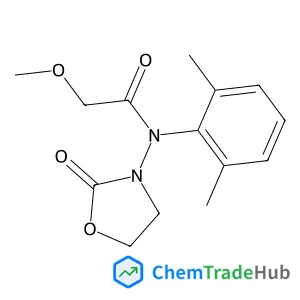
N-(2,6-Dimethylphenyl)-2-methoxy-N-(2-oxo-1,3-oxazolidin-3-yl)acetamide
CAS番号:
77732-09-3
分子式:
C14H18N2O4
おすすめサプライヤー






免責事項
このページに表示される学術雑誌情報は、参考および研究目的のみを目的としています。当社は雑誌出版社とは提携しておらず、投稿の取り扱いも行っておりません。出版に関するお問い合わせは、各雑誌出版社に直接ご連絡ください。
表示されている情報に誤りがある場合は、support@chemtradehub.com までご連絡ください。迅速に確認し、対応いたします。