












Effect of underlying coronene and perylene adlayers for [60]fullerene molecular assembly
文献情報
出版日
2005-01-18
DOI
10.1039/B415034A
インパクトファクター
6.222
著者
Soichiro Yoshimoto, Eishi Tsutsumi, Oomi Fujii, Ryuji Narita
原文を見る
要旨
Supramolecularly assembled layers of C60 on coronene- and perylene-modified Au(111) surfaces were investigated and the structure of the C60 adlayer was found to be strongly influenced by the underlying organic layers, suggesting that the latter underlying organic adlayers play an important role in the process of formation of the C60 molecular adlayer.
関連文献
The structure and chemical bonding in inverse sandwich B6Ca2 and B8Ca2 clusters: conflicting aromaticity vs. double aromaticity
Ying-Jin Wang, Min-Min Guo, Gui-Lin Wang, Chang-Qing Miao, Nan Zhang, Teng-Dan Xue
2020-08-18
Paper
DOI: 10.1039/D0CP03703F
Identifying the catalyst chemical state and adsorbed species during methanol conversion on copper using ambient pressure X-ray spectroscopies
Baran Eren, Christopher G. Sole, Jesús S. Lacasa, David Grinter, Federica Venturini, Georg Held, Cruz S. Esconjauregui
2020-03-19
Paper
DOI: 10.1039/D0CP00347F
Polymer models for the mechanisms of chromatin 3D folding: review and perspective
Rui Zhou
2020-08-06
Perspective
DOI: 10.1039/D0CP01877E
Operando potassium K-edge X-ray absorption spectroscopy: investigating potassium catalysts during soot oxidation
Catherine J. Davies, Alexander Mayer, Jess Gabb, Jake M. Walls, Volkan Degirmenci, Giannantonio Cibin, Stan Golunski, Simon A. Kondrat
2020-07-02
Paper
DOI: 10.1039/D0CP01227K
Coherently and fluorescence-detected two-dimensional electronic spectroscopy: direct comparison on squaraine dimers
Pavel Malý, Julian Lüttig, Stefan Mueller, Maximilian H. Schreck
2020-09-03
Paper
DOI: 10.1039/D0CP03218B
Thickness-dependent elastic strain in Stranski–Krastanow growth
Alexander V. Voitsekhovskii
2020-08-21
Paper
DOI: 10.1039/D0CP03538F
Homogeneous nucleation of carbon dioxide in supersonic nozzles I: experiments and classical theories
Kayane K. Dingilian, Roope Halonen, Valtteri Tikkanen, Bernhard Reischl, Hanna Vehkamäki
2020-08-10
Paper
DOI: 10.1039/D0CP02279A
The behavior of conductivity dynamic modulus and its connection to thermodynamic bulk modulus in ionic liquids
Shinian Cheng, Zaneta Wojnarowska, Małgorzata Musiał, Marian Paluch
2020-08-03
Paper
DOI: 10.1039/D0CP03422C
Dielectric relaxation of deep eutectic solvent + water mixtures: structural implications and application to microwave heating
Vira Agieienko, Richard Buchner
2020-08-28
Paper
DOI: 10.1039/D0CP03334K
Identification of the key steps in the self-assembly of homogeneous gold metal nanoparticles produced using inverse micelles
2019-08-23
Paper
DOI: 10.1039/C9CP03473K
こちらもおすすめ
化合物よくある質問
2-メトキシ-4-(メチルスルフィニル)アミンの主な用途は何ですか?
2-メトキシ-4-(メチルスルフィニル)アミンは、主に医薬品および農薬の製造に使用されます。また、合成化学の一部として研究用材料としても利用されます。
41608-73-52-Methoxy-4-(methyls...
118684-13-24-(Bromomethyl)-3-me...
化合物よくある質問
4,6-二氯-N-甲基ピラミジンアミンの代替品はありますか?
代替品としては、4,6-二クロロピラミジンアミンや他のピラミジン系化合物が考えられます。ただし、目的と用途によって最適な代替品は異なります。
10397-15-64,6-Dichloro-N-methy...
化合物よくある質問
6-氯-4-甲基-1H-吲哚を含む廃棄物はどのように処理すべきですか?
6-氯-4-甲基-1H-吲哚の廃棄物は、適切な容器に収集し、密閉して保管します。温度は常温、湿度は低く、直射日光を避けて保管することを推奨します。廃棄処理は専門...
885520-84-36-chloro-4-methyl-1H...
化合物よくある質問
2-フローユロ-4-(トリフルオロメチル)ベンゾイドについて「に適用される法規ガイドラインは何ですか」
2-フローユロ-4-(トリフルオロメチル)ベンゾイドのCAS番号は207974-08-1です。この化合物はGHS分類で毒性物質と有害な反応物質として分類されます...
207974-08-1[2-Fluoro-4-(trifluo...
化合物よくある質問
4-ニトロフェニルN-[(ベンゼルオキシルカーボンイル]グリシングリシングリシン酸はどのように保存すればよいですか?
4-ニトロフェニルN-[(ベンゼルオキシルカーボンイル]グリシングリシングリシン酸は、室温で暗所に保管し、乾燥した環境で保存することを推奨します。容器は密閉性の...
19811-64-44-Nitrophenyl N-[(be...
化合物よくある質問
イソデスロラタドリンの代替品はありますか?
イソデスロラタドリンの代替品としては、デスロラタドリンや他の抗ヒスタミン薬が挙げられます。具体的には、デスロラタドリン、ラセカミド、フェルタドリンなどが、症状や...
183198-49-4Iso Desloratadine
化合物よくある質問
5-甲氧基-1,2,3,4-四氢异喹啉盐酸盐はどのように合成されますか?
5-甲氧基-1,2,3,4-四氢异喹啉盐酸盐の一般的な合成方法は、メタノール中で5-メトキシ-1,2,3,4-四ヒュドロイソキシンを塩酸で塩化します。この反応で...
103030-69-95-Methoxy-1,2,3,4-te...
化合物よくある質問
4-アミノ-5-メトキシ-2-トルエンサルホニック酸についての法規ガイドラインは何ですか?
CAS番号6471-78-9の4-アミノ-5-メトキシ-2-トルエンサルホニック酸は、GHS分類では corrosive(腐食性)と識別されます。EUのREAC...
6471-78-94-Amino-5-Methoxy-2-...
化合物よくある質問
甲基孕酮を取り扱う際の実験室安全事項は何ですか?
甲基孕酮の取り扱いは、PPE(個人保護具)の使用が必要な重要な安全事項を伴います。防塵マスク、ゴーグル、手袋を着用することが推奨されます。ドラフトチャンバーを使...
204063-33-22-[(Diphenylmethyl)a...
掲載誌
Chemical Communications

CiteScore:
8.6
自己引用率:
4.7%
年間論文数:
2458
ChemComm publishes urgent research which is of outstanding significance and interest to experts in the field, while also appealing to the journal’s broad chemistry readership. Our communication format is ideally suited to short, urgent studies that are of such importance that they require accelerated publication. Our scope covers all topics in chemistry, and research at the interface of chemistry and other disciplines (such as materials science, nanoscience, physics, engineering and biology) where there is a significant novelty in the chemistry aspects. Major topic areas covered include: Analytical Chemistry Catalysis Chemical Biology and medicinal chemistry Computational Chemistry and Machine Learning Energy and sustainable chemistry Environmental Chemistry Green Chemistry Inorganic Chemistry Materials Chemistry Nanoscience Organic Chemistry Physical Chemistry Polymer Chemistry Supramolecular Chemistry
おすすめ化合物

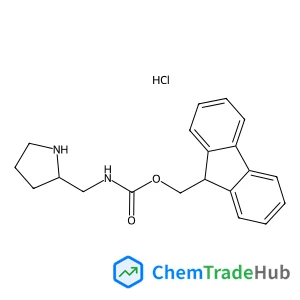
(S)-(9H-Fluoren-9-yl)methyl (pyrrolidin-2-ylmethyl)carbamate hydrochloride
CAS番号:
1217813-15-4
分子式:
C20H23ClN2O2
おすすめサプライヤー





免責事項
このページに表示される学術雑誌情報は、参考および研究目的のみを目的としています。当社は雑誌出版社とは提携しておらず、投稿の取り扱いも行っておりません。出版に関するお問い合わせは、各雑誌出版社に直接ご連絡ください。
表示されている情報に誤りがある場合は、support@chemtradehub.com までご連絡ください。迅速に確認し、対応いたします。