


Synthesis, X-ray characterisation and reactions of a trigonal planar palladium(0) carbonyl complex, (tbpx)PdCO
文献情報
出版日
2003-06-26
DOI
10.1039/B305854A
インパクトファクター
6.222
著者
Ronan M. Bellabarba, Robert P. Tooze, Alexandra M. Z. Slawin
原文を見る
要旨
The novel complex (tbpx)PdCO (1), the first example of a structurally characterised sixteen electron, trigonal planar palladium(0) carbonyl complex, was prepared, characterised by NMR spectroscopy and X-ray crystallography, and some unusual aspects of its reactivity were studied.
おすすめジャーナル

Bioorganic & Medicinal Chemistry Letters

Heteroatom Chemistry

Cellulose

Herald of the Russian Academy of Sciences

Medicinal Chemistry Research

Electroanalysis

Critical Reviews in Solid State and Materials Sciences

Biocatalysis and Biotransformation

Journal of the Indian Institute of Science

Journal of Chemical Sciences
関連文献
A density functional study of silver clusters on a stepped graphite surface: formation of self-assembled nano-wires
Akansha Singh, Prasenjit Sen
2015-04-14
Paper
DOI: 10.1039/C5CP01016K
Bringing light into the dark triplet space of molecular systems
Jing Ge, Zhigang Geng, Shenlong Jiang, Kaili Fan, Zhenkun Guo, Jiahua Hu, Zongwei Chen
2015-04-20
Paper
DOI: 10.1039/C5CP00323G
A systematic study of metal-supported boron nitride materials for the oxygen reduction reaction
Ralph Koitz
2015-04-17
Paper
DOI: 10.1039/C5CP01384D
In silico prediction of MOFs with high deliverable capacity or internal surface area
Yi Bao, Richard L. Martin, Maciej Haranczyk
2015-02-19
Paper
DOI: 10.1039/C5CP00002E
Electrical and thermal transport properties of Pb1−xSnxSe solid solution thermoelectric materials
Chao-Feng Wu, Tian-Ran Wei, Jing-Feng Li
2015-04-20
Paper
DOI: 10.1039/C4CP06021K
A molecular dynamics study of guest–host hydrogen bonding in alcohol clathrate hydrates
Masaki Hiratsuka, Ryo Ohmura, Amadeu K. Sum, Saman Alavi, Kenji Yasuoka
2015-03-25
Paper
DOI: 10.1039/C4CP05732E
Graphene networks and their influence on free-volume properties of graphene–epoxidized natural rubber composites with a segregated structure: rheological and positron annihilation studies
Jieping Zhong, Shuangquan Liao, Wei Gong, Jianhe Liao, Lingxue Kong
2015-04-09
Paper
DOI: 10.1039/C5CP00465A
A class of rare antiferromagnetic metallic oxides: double perovskite AMn3V4O12 (A = Na+, Ca2+, and La3+) and the site-selective doping effect
Guangbiao Zhang, Yuanxu Wang, Yuli Yan, Chengxiao Peng, Chao Wang, Shuai Dong
2015-04-15
Paper
DOI: 10.1039/C5CP00186B
A microfluidic platform for quantitative measurements of effective protein charges and single ion binding in solution
Therese W. Herling, Paolo Arosio, Thomas Müller, Sara Linse, Tuomas P. J. Knowles
2015-04-16
Paper
DOI: 10.1039/C5CP00746A
Observations of probe dependence of the solvation dynamics in ionic liquids
Jens Breffke, Nikolaus P. Ernsting, Mark Maroncelli
2015-04-10
Paper
DOI: 10.1039/C5CP00814J
こちらもおすすめ
化合物よくある質問
2-メトキシ-4-(メチルスルフィニル)アミンの主な用途は何ですか?
2-メトキシ-4-(メチルスルフィニル)アミンは、主に医薬品および農薬の製造に使用されます。また、合成化学の一部として研究用材料としても利用されます。
41608-73-52-Methoxy-4-(methyls...
118684-13-24-(Bromomethyl)-3-me...
化合物よくある質問
4,6-二氯-N-甲基ピラミジンアミンの代替品はありますか?
代替品としては、4,6-二クロロピラミジンアミンや他のピラミジン系化合物が考えられます。ただし、目的と用途によって最適な代替品は異なります。
10397-15-64,6-Dichloro-N-methy...
化合物よくある質問
6-氯-4-甲基-1H-吲哚を含む廃棄物はどのように処理すべきですか?
6-氯-4-甲基-1H-吲哚の廃棄物は、適切な容器に収集し、密閉して保管します。温度は常温、湿度は低く、直射日光を避けて保管することを推奨します。廃棄処理は専門...
885520-84-36-chloro-4-methyl-1H...
化合物よくある質問
2-フローユロ-4-(トリフルオロメチル)ベンゾイドについて「に適用される法規ガイドラインは何ですか」
2-フローユロ-4-(トリフルオロメチル)ベンゾイドのCAS番号は207974-08-1です。この化合物はGHS分類で毒性物質と有害な反応物質として分類されます...
207974-08-1[2-Fluoro-4-(trifluo...
化合物よくある質問
4-ニトロフェニルN-[(ベンゼルオキシルカーボンイル]グリシングリシングリシン酸はどのように保存すればよいですか?
4-ニトロフェニルN-[(ベンゼルオキシルカーボンイル]グリシングリシングリシン酸は、室温で暗所に保管し、乾燥した環境で保存することを推奨します。容器は密閉性の...
19811-64-44-Nitrophenyl N-[(be...
化合物よくある質問
イソデスロラタドリンの代替品はありますか?
イソデスロラタドリンの代替品としては、デスロラタドリンや他の抗ヒスタミン薬が挙げられます。具体的には、デスロラタドリン、ラセカミド、フェルタドリンなどが、症状や...
183198-49-4Iso Desloratadine
化合物よくある質問
5-甲氧基-1,2,3,4-四氢异喹啉盐酸盐はどのように合成されますか?
5-甲氧基-1,2,3,4-四氢异喹啉盐酸盐の一般的な合成方法は、メタノール中で5-メトキシ-1,2,3,4-四ヒュドロイソキシンを塩酸で塩化します。この反応で...
103030-69-95-Methoxy-1,2,3,4-te...
化合物よくある質問
4-アミノ-5-メトキシ-2-トルエンサルホニック酸についての法規ガイドラインは何ですか?
CAS番号6471-78-9の4-アミノ-5-メトキシ-2-トルエンサルホニック酸は、GHS分類では corrosive(腐食性)と識別されます。EUのREAC...
6471-78-94-Amino-5-Methoxy-2-...
化合物よくある質問
甲基孕酮を取り扱う際の実験室安全事項は何ですか?
甲基孕酮の取り扱いは、PPE(個人保護具)の使用が必要な重要な安全事項を伴います。防塵マスク、ゴーグル、手袋を着用することが推奨されます。ドラフトチャンバーを使...
204063-33-22-[(Diphenylmethyl)a...
掲載誌
Chemical Communications

CiteScore:
8.6
自己引用率:
4.7%
年間論文数:
2458
ChemComm publishes urgent research which is of outstanding significance and interest to experts in the field, while also appealing to the journal’s broad chemistry readership. Our communication format is ideally suited to short, urgent studies that are of such importance that they require accelerated publication. Our scope covers all topics in chemistry, and research at the interface of chemistry and other disciplines (such as materials science, nanoscience, physics, engineering and biology) where there is a significant novelty in the chemistry aspects. Major topic areas covered include: Analytical Chemistry Catalysis Chemical Biology and medicinal chemistry Computational Chemistry and Machine Learning Energy and sustainable chemistry Environmental Chemistry Green Chemistry Inorganic Chemistry Materials Chemistry Nanoscience Organic Chemistry Physical Chemistry Polymer Chemistry Supramolecular Chemistry
おすすめ化合物

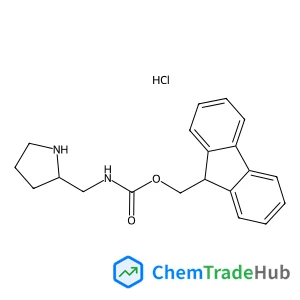
(S)-(9H-Fluoren-9-yl)methyl (pyrrolidin-2-ylmethyl)carbamate hydrochloride
CAS番号:
1217813-15-4
分子式:
C20H23ClN2O2
おすすめサプライヤー





免責事項
このページに表示される学術雑誌情報は、参考および研究目的のみを目的としています。当社は雑誌出版社とは提携しておらず、投稿の取り扱いも行っておりません。出版に関するお問い合わせは、各雑誌出版社に直接ご連絡ください。
表示されている情報に誤りがある場合は、support@chemtradehub.com までご連絡ください。迅速に確認し、対応いたします。