













Insights in the biochemical composition of skin as investigated by micro infrared spectroscopic imaging
文献情報
出版日
2003-05-22
DOI
10.1039/B302749J
インパクトファクター
3.676
著者
原文を見る
要旨
The conventional methods for biochemical and histophatological tissue characterisation necessitate complex and “time consuming” sample manipulations and the results are rarely quantifiable. Micro infrared imaging is a relatively new approach for the examination of tissue sections. In contrast to standard light microscopy based procedures, the IR approach requires neither sample staining nor complicated fixation. The contrast in infrared images is solely derived from differences in the spectral and spatial heterogeneity of the biochemical components. In this study the morphological organisation and biochemical composition of “Göttingen” pig skin is analysed. The upper layer of the skin, the so called stratum corneum, is composed of corneocytes (terminally differentiated cells) imbedded in a lipid matrix. Based on the integral intensity of specific bio-marker absorption bands for the lipid as well as for the protein fraction (cells), infrared images were generated (functional group imaging). These infrared images represent the biochemical distribution of the analysed fraction within the sample. The characteristic bio-marker bands for the lipids are: the asymmetric (∼2920 cm−1) and symmetric methylene (∼2851 cm−1) stretching absorptions, and the carbonyl (∼1740 cm−1) vibration. The protein fraction is imaged by using the integral intensity of the asymmetric methyl vibration (∼2957 cm−1) as well as by the amide I (∼1655 cm−1), amide II (∼1545 cm−1) and amide B (∼3080 cm−1) absorptions. Evidence is given, that the upper stratum corneum is characterised by large areas of lipids and aggregated corneocytes. Phase separation is also observed for the deeper stratum corneum layers. However, the detected domains are much smaller. This demonstrates that the stratum corneum is not so regularly organised as described in the simplified “bricks and mortar” model. The different layers of the skin (stratum corneum, epidermis and dermis) are easily made visible by using the presented imaging technique and are fairly different concerning its biochemical composition. Micro infrared imaging is also used for analysing the penetration and distribution of a sun cream lotion in the skin. Depending on the used formulation, the distribution in the tissue can be quite different. The presented example demonstrates how this technique can be used for the development of topical applied formulations. The results in this report suggest that micro infrared spectroscopic imaging may become a new and promising investigation tool in bio-medicinal research and will provide a wealth of information on tissues that is not readily accessible by other physical and biochemical techniques.
関連文献
Density-induced molecular arrangements of water inside carbon nanotubes
M. Sadeghi
2013-03-18
Paper
DOI: 10.1039/C3CP44563A
Nature of proton transport in a water-filled carbon nanotube and in liquid water
Ji Chen, Qianfan Zhang, Angelos Michaelides, Enge Wang
2013-03-07
Paper
DOI: 10.1039/C3CP50218J
Modeling CO2reduction on Pt(111)
Chuan Shi, Christopher P. O'Grady, Andrew A. Peterson, Heine A. Hansen
2013-03-19
Paper
DOI: 10.1039/C3CP50645B
Interaction of CO2 with oxygen adatoms on rutile TiO2(110)
Xiao Lin, Zhi-Tao Wang, Igor Lyubinetsky, Bruce D. Kay, Zdenek Dohnálek
2013-01-10
Paper
DOI: 10.1039/C3CP44040K
Thermal oxidation of Ni films for p-type thin-film transistors
Jie Jiang, Xinghui Wang, Qing Zhang, Jingqi Li, X. X. Zhang
2013-03-15
Paper
DOI: 10.1039/C3CP50197C
Staying hydrated: the molecular journey of gaseous sulfur dioxide to a water surface
Eric S. Shamay, Nicholas A. Valley, Frederick G. Moore, Geraldine L. Richmond
2013-03-18
Paper
DOI: 10.1039/C3CP50609F
Stability and physical properties of a tri-ring based porous g-C4N3 sheet
Xiaowei Li, Shunhong Zhang, Qian Wang
2013-04-04
Paper
DOI: 10.1039/C3CP44660C
Ultrafast photoinduced dynamics of halogenated cyclopentadienes: observation of geminate charge-transfer complexes in solution
T. J. A. Wolf, R. Radloff, P. Lang, A. Stolow, A.-N. Unterreiner
2013-02-11
Paper
DOI: 10.1039/C3CP44295K
Non-bonding interactions and internal dynamics in CH2F2⋯H2CO: a rotational and model calculations study
Qian Gou, Gang Feng, Luca Evangelisti, Alberto Lesarri, Emilio J. Cocinero, Walther Caminati
2013-03-01
Paper
DOI: 10.1039/C3CP50306B
こちらもおすすめ
化合物よくある質問
2-ブロモ-9,9-ジフェニル-9H-フルオレンの主な用途は何ですか?
2-溴-9,9-二苯基芴は、医薬品、工業材料、有機合成の研究分野で応用されます。特に、レーザー材料や機能性ポリマーの合成に使用されることがあります。また、蛍光色...
474918-32-62-Bromo-9,9-diphenyl...
化合物よくある質問
四氯化铱の市場動向や研究トレンドはどうですか?
四氯化铱の市場は研究開発分野で注目されており、特にナノ技術や金属有機框架(MOFs)の分野での需要が増加傾向にあります。価格は安定しており、中国や韓国での生産が...
207399-11-9Tetrachloroiridium h...
882-06-44-Nitrocinnamic acid
化合物よくある質問
1-(4-溴-3-氟苯基)-2-氯乙酮を含む廃棄物はどのように処理すべきですか?
1-(4-溴-3-氟苯基)-2-氯乙酮 (CAS番号: 1260857-14-4) の廃棄物は専門的な廃棄処理が必要です。まず、廃棄物は密閉された容器に収集し、...
1260857-14-41-(4-Bromo-3-fluorop...
化合物よくある質問
苦参酚Kとは何ですか?
苦参酚Kは、CAS番号101236-49-1を持つ化合物で、主に天然由来の生薬から抽出されます。この化合物は、抗炎症作用や抗癌作用を持つことが報告されています。
101236-49-1Kushenol K
化合物よくある質問
POTASSIUM (1-(TERTBUTOXYCARBONYL)AZETIDIN-3-YL)TRIFLUOROBORATE を含む廃棄物はどのように処理すべきですか?
POTASSIUM (1-(TERTBUTOXYCARBONYL)AZETIDIN-3-YL)TRIFLUOROBORATE を含む廃棄物は、まず安全なエント...
1430219-73-0Potassium (1-(tert-b...
化合物よくある質問
4-庚基-4’-联苯羧酸の市場動向や研究トレンドはどうですか?
4-庚基-4’-聯苯羧酸は、特殊化学品や合成化学の分野で用いられる化学物質ですが、市場動向としては、研究開発の進展とともに需要が増加しています。また、環境配慮型...
58573-94-74'-Heptyl-4-biphenyl...
化合物よくある質問
6-ブロモ-3-メトキシ-1-フェニル-1H-インドゾールを含む廃棄物はどのように処理すべきですか?
6-ブロモ-3-メトキシ-1-フェニル-1H-インドゾールを含む廃棄物は、適切な化学廃棄処理が必要です。通常、廃棄物は密閉容器に収集され、専門の廃棄処理業者に引...
1332527-03-36-Bromo-3-methoxy-1-...
化合物よくある質問
4,4-二甲基-2-吡咯烷酮はどの業界で使用されていますか?
4,4-二甲基-2-吡咯烷酮は医薬、ポリマー、センサー、半導体などの業界で広く使用されています。特に溶媒としての性能が高く評価されています。
66899-02-34,4-dimethylpyrrolid...
51312-42-6Sodium Phosphotungst...
掲載誌
Physical Chemistry Chemical Physics

CiteScore:
5.5
自己引用率:
10.3%
年間論文数:
3036
Physical Chemistry Chemical Physics (PCCP) is an international journal co-owned by 19 physical chemistry and physics societies from around the world. This journal publishes original, cutting-edge research in physical chemistry, chemical physics and biophysical chemistry. To be suitable for publication in PCCP, articles must include significant innovation and/or insight into physical chemistry; this is the most important criterion that reviewers and Editors will judge against when evaluating submissions. The journal has a broad scope and welcomes contributions spanning experiment, theory, computation and data science. Topical coverage includes spectroscopy, dynamics, kinetics, statistical mechanics, thermodynamics, electrochemistry, catalysis, surface science, quantum mechanics, quantum computing and machine learning. Interdisciplinary research areas such as polymers and soft matter, materials, nanoscience, energy, surfaces/interfaces, and biophysical chemistry are welcomed if they demonstrate significant innovation and/or insight into physical chemistry. Joined experimental/theoretical studies are particularly appreciated when complementary and based on up-to-date approaches.
おすすめ化合物

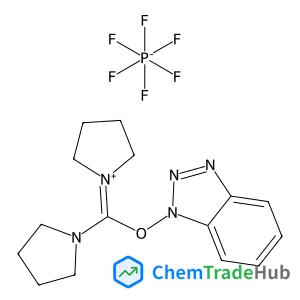
(1H-Benzotriazol-1-yloxy)(di-1-pyrrolidinyl)methylium hexafluorophosphate
CAS番号:
105379-24-6
分子式:
C15H21F6N5OP
おすすめサプライヤー





免責事項
このページに表示される学術雑誌情報は、参考および研究目的のみを目的としています。当社は雑誌出版社とは提携しておらず、投稿の取り扱いも行っておりません。出版に関するお問い合わせは、各雑誌出版社に直接ご連絡ください。
表示されている情報に誤りがある場合は、support@chemtradehub.com までご連絡ください。迅速に確認し、対応いたします。