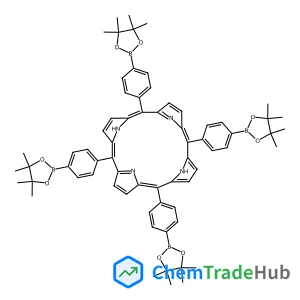
5,10,15,20-tetrakis(4-boronic acid pinacol ester phenyl) porphyrin
CAS番号:
1332748-00-1
分子式:
C68H74B4N4O8
P. Dagaut, G. Pengloan, A. Ristori
The oxidation of toluene was studied in a jet-stirred reactor at 1 atm. New experimental results were obtained over the high temperature range 1000–1375 K, and variable equivalence ratio (0.5 ⩽ φ ⩽ 1.5). Concentration profiles of reactants, stable intermediates and final products were measured by probe sampling followed by on-line and off-line GC analyses. These experiments were modeled using a detailed kinetic reaction mechanism (120 species and 920 reactions, most of them reversible). This kinetic scheme was also used to simulate the ignition of toluene–oxygen–argon mixtures and the burning velocities of toluene–air mixtures. The presently proposed mechanism has already been validated by simulating the oxidation of benzene at 0.46 to 10 atm under stirred-reactor conditions, the ignition of benzene–oxygen–argon mixtures and the combustion of benzene in flames. Sensitivity analyses and reaction path analyses, based on species rates of reaction, were used to interpret the results. The routes involved in toluene oxidation have been delineated: toluene oxidation proceeds via the formation of benzyl, by H-atom abstraction, and the formation of benzene, by H-atom displacement yielding methyl and benzene; benzyl oxidation yields benzaldehyde, that further reacts yielding phenyl whereas benzyl thermal decomposition yields acetylene and cyclopentadienyl; further reactions of cyclopentadienyl yield vinylacetylene.
Haixin Guo, Youfen Lian, Lulu Yan, Xinhua Qi, Richard Lee Smith, Jr.
DOI: 10.1039/C3GC40433A
Michael R. Reithofer, Yin Ngai Sum, Yugen Zhang
DOI: 10.1039/C3GC40790J
Fei Gao, Ronghua Jin, Dacheng Zhang, Quanxi Liang, Qunqun Ye, Guohua Liu
DOI: 10.1039/C3GC40547H
Qingde Zhang, Yizhuo Han, Yisheng Tan
DOI: 10.1039/C3GC40279G
Sara K. Green, Jechan Lee, Hyung Ju Kim, Geoffrey A. Tompsett, Won Bae Kim, George W. Huber
DOI: 10.1039/C3GC00090G
Erwann Durand, Jérôme Lecomte, Bruno Baréa, Eric Dubreucq, Robert Lortie, Pierre Villeneuve
DOI: 10.1039/C3GC40899J
Marco Giardiello, Tom O. McDonald, Jet-Sing Lee, Aled D. Roberts, Andrew Owen, Steve P. Rannard
DOI: 10.1039/C3GC40573G
Hongbing Song, Emilia Păunescu, Félix D. Bobbink, Huizhen Liu, Zhaofu Fei, Gabor Laurenczy, Mojtaba Bagherzadeh, Paul J. Dyson
DOI: 10.1039/C3GC37085B
Cristina Mottillo, Yuneng Lu, Minh-Hao Pham, Matthew J. Cliffe, Trong-On Do, Tomislav Friščić
DOI: 10.1039/C3GC40520F
Ali Pourjavadi, Seyed Hassan Hosseini, Firouz Matloubi Moghaddam, Behzad Koushki Foroushani, Craig Bennett
DOI: 10.1039/C3GC41307A
4-アミノフェノール酸ナトリウム水和物は、CAS番号206557-08-6の化合物で、4-アミノフェノールとナトリウムが結合した塩と水和物です。この化合物は、白...
この化合物は特定の合成プロセスに使用される可能性がありますが、代替品として、他の类似的な化合物、例えばMethyl 3-methyl-N-{[(2-methyl...
4-Boc-2-哌嗪甲酸は、薬品開発や合成化学分野で広く使用されており、その需要は継続的に推移しています。特に、新薬開発における合成化学分野での需要が高まってい...
4,4'-二羟甲基联苯のCAS番号は1667-12-5です。この化合物は白色の結晶粉末で、分子量は154.20です。水にわずかに溶けますが、アルコールや有機溶媒...
5-甲硫基戊腈は医薬品産業で使用される可能性があります。また、ポリマー合成の触媒として、センサー製造の一部として、半導体製造のプロセス改善に使用される可能性があ...
この化合物は、1-abieta-8,11,13-trien-19-イルと6'-メトキシシンコナナン-9-基を含有する窒素含有化合物から合成されます。一般的な合成...
6-ブロモベンジジミダゾール-2-カルビルデオキシドは、避光・乾燥した容器(密閉容器)で-20℃~4℃の低温で保存してください。高温や直射日光、湿気は避けてくだ...
621-65-8のCAS番号を持つBoc-N-甲基氨甲环酸は、化学式C7H13NO5を有する化合物です。この化合物は白色の結晶性粉末で、吸湿性があります。
乙基三氟硼酸钾は、トリフLUオール酸カリウムとエチルブロミドを反応させて合成されます。この反応は高い選択性と収率を持ち、触媒を用いることで効率的に進行します。
2-フロウロ-5-クロロ-4-アミノフェノールは、直射日光を避けて冷却された暗所で保存し、密閉容器に保管してください。温度は常温か低温が適しています。

Physical Chemistry Chemical Physics (PCCP) is an international journal co-owned by 19 physical chemistry and physics societies from around the world. This journal publishes original, cutting-edge research in physical chemistry, chemical physics and biophysical chemistry. To be suitable for publication in PCCP, articles must include significant innovation and/or insight into physical chemistry; this is the most important criterion that reviewers and Editors will judge against when evaluating submissions. The journal has a broad scope and welcomes contributions spanning experiment, theory, computation and data science. Topical coverage includes spectroscopy, dynamics, kinetics, statistical mechanics, thermodynamics, electrochemistry, catalysis, surface science, quantum mechanics, quantum computing and machine learning. Interdisciplinary research areas such as polymers and soft matter, materials, nanoscience, energy, surfaces/interfaces, and biophysical chemistry are welcomed if they demonstrate significant innovation and/or insight into physical chemistry. Joined experimental/theoretical studies are particularly appreciated when complementary and based on up-to-date approaches.
![2,4-Dichloro-6-isopropyl-5H-pyrrolo[3,4-d]pyrimidin-7(6H)-one structure](https://static.chemtradehub.com/structs/107/1079649-94-7-ad4a.webp "2,4-Dichloro-6-isopropyl-5H-pyrrolo[3,4-d]pyrimidin-7(6H)-one structure")