


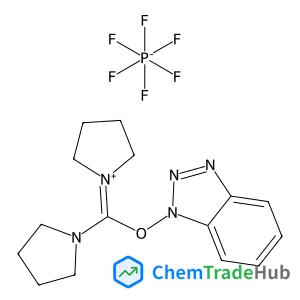
(1H-Benzotriazol-1-yloxy)(di-1-pyrrolidinyl)methylium hexafluorophosphate
CAS番号:
105379-24-6
分子式:
C15H21F6N5OP
The photochemistry of ketoprofen in aqueous solutions is strongly influenced by its acid–base chemistry. While the acid form of ketoprofen behaves as a typical benzophenone chromophore, the ketoprofen carboxylate undergoes efficient photodecarboxylation involving a carbanion intermediate. In the present work we have conducted studies in organic solvent–water mixtures in attempts to establish the nature of the carbanion precursor. We find a dual photochemical behavior of ketoprofen depending on the protic state of the ground state absorbing species. The detection of both the ketoprofen triplet and the carbanion during the photolysis of ketoprofen in these mixtures, and the experimentally determined independence of both pathways indicates that the carbanion originates from the singlet state in the system under study.

Geotextiles and Geomembranes

Composites Science and Technology

Ferroelectrics Letters Section

Fire Safety Journal

Applied Organometallic Chemistry

Journal of Analytical Atomic Spectrometry

Bulletin of the Korean Chemical Society

Heterocycles

Experimental Techniques

Journal of the Royal Society of New Zealand
Ishtvan Boldog, Eduard B. Rusanov, Joachim Sieler, Steffen Blaurock, Konstantin V. Domasevitch
DOI: 10.1039/B212540D
Joseph A. R. Schmidt, Garth R. Giesbrecht, Chunming Cui, John Arnold
DOI: 10.1039/B208525A
Peter A. Nkansah, Alan H. Haines, N. Patrick J. Stamford
DOI: 10.1039/B211399F
Akinori Kuzuya, Ryo Mizoguchi, Fumi Morisawa, Makoto Komiyama
DOI: 10.1039/B300368J
Nanguo Liu, Darren R. Dunphy, Mark A. Rodriguez, Sarany Singer
DOI: 10.1039/B301569F
K. Cassiers, T. Linssen, V. Meynen, P. Van Der Voort, P. Cool, E. F. Vansant
DOI: 10.1039/B302116E
Sang Wook Kang, Jong Hak Kim, Jongok Won, Kookheon Char, Yong Soo Kang
DOI: 10.1039/B211933A
Iver Schmidt, Anna Carlsson, Søren Dahl, Michael Brorson, Claus J. H. Jacobsen
DOI: 10.1039/B212646J
Tamis Darbre, Miguel Machuqueiro
DOI: 10.1039/B301117H
Jennifer L. Beck, Rajesh Gupta, Thitima Urathamakul, Nyree L. Williamson, Margaret M. Sheil, Janice R. Aldrich-Wright, Stephen F. Ralph
DOI: 10.1039/B212132H
2-溴-9,9-二苯基芴は、医薬品、工業材料、有機合成の研究分野で応用されます。特に、レーザー材料や機能性ポリマーの合成に使用されることがあります。また、蛍光色...
四氯化铱の市場は研究開発分野で注目されており、特にナノ技術や金属有機框架(MOFs)の分野での需要が増加傾向にあります。価格は安定しており、中国や韓国での生産が...
1-(4-溴-3-氟苯基)-2-氯乙酮 (CAS番号: 1260857-14-4) の廃棄物は専門的な廃棄処理が必要です。まず、廃棄物は密閉された容器に収集し、...
苦参酚Kは、CAS番号101236-49-1を持つ化合物で、主に天然由来の生薬から抽出されます。この化合物は、抗炎症作用や抗癌作用を持つことが報告されています。
POTASSIUM (1-(TERTBUTOXYCARBONYL)AZETIDIN-3-YL)TRIFLUOROBORATE を含む廃棄物は、まず安全なエント...
4-庚基-4’-聯苯羧酸は、特殊化学品や合成化学の分野で用いられる化学物質ですが、市場動向としては、研究開発の進展とともに需要が増加しています。また、環境配慮型...
6-ブロモ-3-メトキシ-1-フェニル-1H-インドゾールを含む廃棄物は、適切な化学廃棄処理が必要です。通常、廃棄物は密閉容器に収集され、専門の廃棄処理業者に引...
4,4-二甲基-2-吡咯烷酮は医薬、ポリマー、センサー、半導体などの業界で広く使用されています。特に溶媒としての性能が高く評価されています。

Physical Chemistry Chemical Physics (PCCP) is an international journal co-owned by 19 physical chemistry and physics societies from around the world. This journal publishes original, cutting-edge research in physical chemistry, chemical physics and biophysical chemistry. To be suitable for publication in PCCP, articles must include significant innovation and/or insight into physical chemistry; this is the most important criterion that reviewers and Editors will judge against when evaluating submissions. The journal has a broad scope and welcomes contributions spanning experiment, theory, computation and data science. Topical coverage includes spectroscopy, dynamics, kinetics, statistical mechanics, thermodynamics, electrochemistry, catalysis, surface science, quantum mechanics, quantum computing and machine learning. Interdisciplinary research areas such as polymers and soft matter, materials, nanoscience, energy, surfaces/interfaces, and biophysical chemistry are welcomed if they demonstrate significant innovation and/or insight into physical chemistry. Joined experimental/theoretical studies are particularly appreciated when complementary and based on up-to-date approaches.
![1-Naphthalenesulfonic acid, 2-[(2-hydroxy-1-naphthalenyl)azo]-, bariumsalt (2:1) structure](https://static.chemtradehub.com/structs/110/1103-38-4-0b33.webp "1-Naphthalenesulfonic acid, 2-[(2-hydroxy-1-naphthalenyl)azo]-, bariumsalt (2:1) structure")
![[4-Amino-2-(methylsulfanyl)-5-pyrimidinyl]methanol structure](https://static.chemtradehub.com/structs/588/588-36-3-fc73.webp "[4-Amino-2-(methylsulfanyl)-5-pyrimidinyl]methanol structure")



