











Anionic triazacyclononanes: new supporting ligands in main group and transition metal organometallic chemistry
文献情報
出版日
2002-11-28
DOI
10.1039/B208525A
インパクトファクター
6.222
著者
Joseph A. R. Schmidt, Garth R. Giesbrecht, Chunming Cui, John Arnold
原文を見る
要旨
In the course of developing new ligands to support chemistry with main-group, transition and lanthanide elements, a number of research groups have focused attention on functionalized triazacyclononanes; this article provides a summary of the more recent findings with an emphasis on the organometallic chemistry of one particular class of tacn ligands, namely those involving the anionic tacn moiety.
関連文献
Transition metal-catalyzed three-component coupling of allenes and the related allylation reactions
Masilamani Jeganmohan, Chien-Hong Cheng
2008-05-15
Feature Article
DOI: 10.1039/B800440D
1,3-Diindolylureas: high affinity dihydrogen phosphate receptors
Claudia Caltagirone, Philip A. Gale, Jennifer R. Hiscock, Simon J. Brooks, Michael B. Hursthouse, Mark E. Light
2008-05-29
Communication
DOI: 10.1039/B806238B
Synthesis and catalytic properties of MIL-100(Fe), an iron(iii) carboxylate with large pores
Patricia Horcajada, Suzy Surblé, Christian Serre, Do-Young Hong, You-Kyong Seo, Jong-San Chang, Jean-Marc Grenèche, Irene Margiolaki, Gérard Férey
2007-05-15
Communication
DOI: 10.1039/B704325B
Synthesis of an open-framework copper–germanium phosphate [Cu(H2O)2(OH)]2Ge(PO4)2
Yan Liu, Xiao-Li Yang, Jun Zhang, Yi-Zhi Li, You Song, Hong-Bin Du, Xiao-Zeng You
2008-05-19
Communication
DOI: 10.1039/B801542B
Synthesis of α-keto esters by the rhodium-catalysed reaction of cyanoformate with arylboronic acids
Hiroshi Shimizu, Masahiro Murakami
2007-04-26
Communication
DOI: 10.1039/B704105E
Polymerization of an optically active phenylacetylene derivative bearing an azide residue by click reaction and reaction with a rhodium catalyst
Shinzo Kobayashi, Ken Itomi, Kazuhide Morino, Hiroki Iida, Eiji Yashima
2008-06-06
Communication
DOI: 10.1039/B806343E
Cationic calix[4]arenes as anion-selective ionophores
Irene Izzo, Sabina Licen, Nakia Maulucci, Giuseppina Autore, Stefania Marzocco, Paolo Tecilla, Francesco De Riccardis
2008-03-31
Communication
DOI: 10.1039/B719482J
An azido–CuII–triazolate complex with utp-type topological network, showing spin-canted antiferromagnetism
Jian-Rong Li, Qun Yu, E. Carolina Sañudo, Ying Tao, Xian-He Bu
2007-04-12
Communication
DOI: 10.1039/B702988H
Shape-controlled synthesis of protein-conjugated silver sulfide nanocrystals and study on the inhibition of tumor cell viability
Lin Yang, Hua-Jie Wang, Hua-Yan Yang, Shan-Hu Liu, Bao-Fang Zhang, Kui Wang, Xiao-Ming Ma, Zhi Zheng
2008-05-08
Communication
DOI: 10.1039/B804274H
One-pot, large-scale synthesis of SnO2nanotubes at room temperature
Ning Du, Hui Zhang, Bingdi Chen, Xiangyang Ma, Deren Yang
2008-04-21
Communication
DOI: 10.1039/B800401C
こちらもおすすめ
化合物よくある質問
6- bromo-1-cyclopropyl-1H-benzimidazoleの市場動向や研究トレンドはどうですか?
6- bromo-1-cyclopropyl-1H-benzimidazoleは、抗炎症、抗ウイルス作用を持つことが報告されており、新薬開発の研究対象として注目...
1416713-53-56-Bromo-1-cyclopropy...
化合物よくある質問
環氧プロpanol-d5を取り扱う際の実験室安全事項は何ですか?
取り扱う際には、防護眼鏡と手袋を使用し、ドラフトチャンバー内で操作することを推奨します。漏洩時には適切な手順で処理し、安全データシートを常に参照してください。
1246819-20-4Glycidol-d5
化合物よくある質問
2,2’-ジメチル-3,3’-ビピリジンはどのように合成されますか?
2,2’-ジメチル-3,3’-ビピリジンは、ピリジンと2-メチルアクリルアミドを有機合成反応で合成します。この反応では、ピリジンと2-メチルアクリルアミドを含有...
86156-55-02,2’-Dimethyl-3,3’-b...
化合物よくある質問
6-甲基ピリジン-2-ボリック酸の主な用途は何ですか?
6-甲基ピリジン-2-ボリック酸は、合成化学、医薬品合成、以及研究用途などに広く使用され、特に組換えDNA技術や分子生物学の研究において重要な役割を果たします。
372963-50-3(6-Methyl-2-pyridiny...
化合物よくある質問
(R)-3-(1-甲基-2-氧環己基)プロpano酸メチルは安全ですか?
(R)-3-(1-甲基-2-氧環己基)プロpano酸メチルは一定の安全性がありますが、直接的な皮膚接触や吸入は避けるべきです。使用する際は適切な個々の安全データ...
94089-47-1methyl 3-[(1R)-1-met...
化合物よくある質問
ketorolacはどのように保存すればよいですか?
ketorolacは、密封して遮光容器に保管し、直射日光や高温を避けて保存してください。温度は常温で保存し、湿度をなるべく低く保つことが推奨されます。
74103-06-3rac Ketorolac
化合物よくある質問
L-2,3-二氨基丙酸二盐酸盐を取り扱う際の実験室安全事項は何ですか?
L-2,3-二氨基丙酸二盐酸盐は腐食性が強く、皮膚や粘膜に刺激を与える可能性があります。取り扱う際は、防塵マスク、ゴーグル、手袋を使用し、適切な排気設備を使用し...
19777-68-5(S)-2,3-Diaminopropa...
化合物よくある質問
2-(4-溴ピリジン-2-基)乙腈の物理化学的性質は何ですか?
2-(4-溴ピリジン-2-基)乙腈のCAS番号は312325-73-8です。主に結晶形態で存在し、分子量は159.01 g/molです。この化合物は水に溶けやす...
312325-73-8(4-Bromo-2-pyridinyl...
化合物よくある質問
3-フローロ-[1,1-ベンジレン]-3,4-ジカルボン酸を取り扱う際の実験室安全事項は何ですか?
この化合物は毒性は低いですが、直接的な接触や吸入に注意が必要です。PPE(個人防護具)を着用し、ドラフトチャンバーを使用して操作することを推奨します。また、漏洩...
1261915-32-53'-Fluoro-[1,1'-biph...
化合物よくある質問
3-(1-氧代-1,3-二氢-2H-2-异吲哚)丙酸の主な用途は何ですか?
3-(1-氧代-1,3-二氢-2H-2-异吲哚)丙酸は、薬理学研究や医薬品製造において広く用いられる化合物です。また、工業的な用途でも一部の化学反応の触媒や助剤...
83747-30-23-(1-Oxo-1,3-dihydro...
掲載誌
Chemical Communications

CiteScore:
8.6
自己引用率:
4.7%
年間論文数:
2458
ChemComm publishes urgent research which is of outstanding significance and interest to experts in the field, while also appealing to the journal’s broad chemistry readership. Our communication format is ideally suited to short, urgent studies that are of such importance that they require accelerated publication. Our scope covers all topics in chemistry, and research at the interface of chemistry and other disciplines (such as materials science, nanoscience, physics, engineering and biology) where there is a significant novelty in the chemistry aspects. Major topic areas covered include: Analytical Chemistry Catalysis Chemical Biology and medicinal chemistry Computational Chemistry and Machine Learning Energy and sustainable chemistry Environmental Chemistry Green Chemistry Inorganic Chemistry Materials Chemistry Nanoscience Organic Chemistry Physical Chemistry Polymer Chemistry Supramolecular Chemistry
おすすめ化合物
![[4-(Isobutyrylamino)phenyl]boronic acid structure](https://static.chemtradehub.com/structs/874/874219-50-8-6ab5.webp "[4-(Isobutyrylamino)phenyl]boronic acid structure")
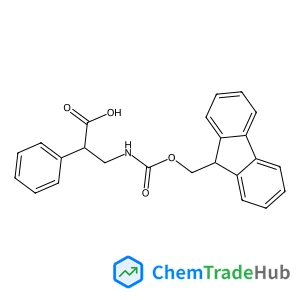
(S)-3-((((9H-Fluoren-9-yl)methoxy)carbonyl)amino)-2-phenylpropanoic acid
CAS番号:
1217663-60-9
分子式:
C24H21NO4
おすすめサプライヤー





免責事項
このページに表示される学術雑誌情報は、参考および研究目的のみを目的としています。当社は雑誌出版社とは提携しておらず、投稿の取り扱いも行っておりません。出版に関するお問い合わせは、各雑誌出版社に直接ご連絡ください。
表示されている情報に誤りがある場合は、support@chemtradehub.com までご連絡ください。迅速に確認し、対応いたします。