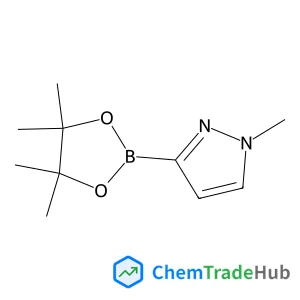
1-Methyl-3-(4,4,5,5-tetramethyl-1,3,2-dioxaborolan-2-yl)-1H-pyrazole
CAS番号:
1020174-04-2
分子式:
C10H17BN2O2
Infrared and Raman spectra have been used extensively for the characterisation of the mineral component of mineralised tissues, especially bone and teeth. Often the vibrational modes of hydroxy groups and hydrogen phosphate are masked in the presence of substituent anions such as carbonate. The inelastic neutron scattering (INS) spectra are dominated by the vibrations of groups with hydrogen or with hydrogen riding on groups. Two sets of bands have been assigned to the hydroxy librations related to the hexagonal and monoclinic polymorphs of hydroxyapatite. Of the phosphate bands in brushite only the HPO42- bands are seen in the INS spectrum. These INS studies of synthetic hydroxyapatites and brushite present new opportunities for studying aspects of biominerals not accessible by standard vibrational techniques.
Rémi Métivier, Isabelle Leray, Bernard Valeur
DOI: 10.1039/B301323E
Yuan-Te Fu, Vincent M. Lynch, Richard J. Lagow
DOI: 10.1039/B212789J
Maria Helena Araujo, Peter B. Hitchcock, John F. Nixon, Uwe Kuehner, Othmar Stelzer
DOI: 10.1039/B301335A
Rajendra Prasad, Elisa Murguly, Neil R. Branda
DOI: 10.1039/B209812A
Debasis Samanta, Nicolas Faure, Francis Rondelez, Amitabha Sarkar
DOI: 10.1039/B300833A
Hiroyuki Nishikawa, Asami Machida, Takanobu Morimoto, Koichi Kikuchi, Takeshi Kodama, Isao Ikemoto, Jun-ichi Yamada, Harukazu Yoshino, Keizo Murata
DOI: 10.1039/B211275B
Carolyn G. Leong, Okwado M. Akotsi, Michael J. Ferguson, Steven H. Bergens
DOI: 10.1039/B212544G
Joe Otsuki, Akane Yasuda, Toshio Takido
DOI: 10.1039/B212912D
Pierre Braunstein, Xavier Morise, Marc Bénard, Marie-Madeleine Rohmer, Richard Welter
DOI: 10.1039/B211289M
Moloy Banerjee, Sujit Roy
DOI: 10.1039/B211555G
2-溴-9,9-二苯基芴は、医薬品、工業材料、有機合成の研究分野で応用されます。特に、レーザー材料や機能性ポリマーの合成に使用されることがあります。また、蛍光色...
四氯化铱の市場は研究開発分野で注目されており、特にナノ技術や金属有機框架(MOFs)の分野での需要が増加傾向にあります。価格は安定しており、中国や韓国での生産が...
1-(4-溴-3-氟苯基)-2-氯乙酮 (CAS番号: 1260857-14-4) の廃棄物は専門的な廃棄処理が必要です。まず、廃棄物は密閉された容器に収集し、...
苦参酚Kは、CAS番号101236-49-1を持つ化合物で、主に天然由来の生薬から抽出されます。この化合物は、抗炎症作用や抗癌作用を持つことが報告されています。
POTASSIUM (1-(TERTBUTOXYCARBONYL)AZETIDIN-3-YL)TRIFLUOROBORATE を含む廃棄物は、まず安全なエント...
4-庚基-4’-聯苯羧酸は、特殊化学品や合成化学の分野で用いられる化学物質ですが、市場動向としては、研究開発の進展とともに需要が増加しています。また、環境配慮型...
6-ブロモ-3-メトキシ-1-フェニル-1H-インドゾールを含む廃棄物は、適切な化学廃棄処理が必要です。通常、廃棄物は密閉容器に収集され、専門の廃棄処理業者に引...
4,4-二甲基-2-吡咯烷酮は医薬、ポリマー、センサー、半導体などの業界で広く使用されています。特に溶媒としての性能が高く評価されています。

Physical Chemistry Chemical Physics (PCCP) is an international journal co-owned by 19 physical chemistry and physics societies from around the world. This journal publishes original, cutting-edge research in physical chemistry, chemical physics and biophysical chemistry. To be suitable for publication in PCCP, articles must include significant innovation and/or insight into physical chemistry; this is the most important criterion that reviewers and Editors will judge against when evaluating submissions. The journal has a broad scope and welcomes contributions spanning experiment, theory, computation and data science. Topical coverage includes spectroscopy, dynamics, kinetics, statistical mechanics, thermodynamics, electrochemistry, catalysis, surface science, quantum mechanics, quantum computing and machine learning. Interdisciplinary research areas such as polymers and soft matter, materials, nanoscience, energy, surfaces/interfaces, and biophysical chemistry are welcomed if they demonstrate significant innovation and/or insight into physical chemistry. Joined experimental/theoretical studies are particularly appreciated when complementary and based on up-to-date approaches.