












Front cover
文献情報
出版日
2024-01-03
DOI
10.1039/D4TB90007C
インパクトファクター
6.331
著者
原文を見る
要旨
A graphical abstract is available for this content
関連文献
Synthesis and properties of D–A copolymers based on dithienopyrrole and benzothiadiazole with various numbers of thienyl units as spacers
Yanfang Geng, Junzi Cong, Keisuke Tajima, Qingdao Zeng, Erjun Zhou
2014-08-14
Paper
DOI: 10.1039/C4PY00975D
Photodegradable poly(ester amide)s for indirect light-triggered release of paclitaxel
Abdolrasoul Soleimani, Aneta Borecki
2014-09-09
Paper
DOI: 10.1039/C4PY00996G
Multicomponent isocyanide-based synthesis of reactive styrenic and (meth)acrylic monomers and their RAFT (co)polymerization
Sonja Schmidt, Miriam Koldevitz, Janina-Miriam Noy, Peter J. Roth
2014-09-26
Paper
DOI: 10.1039/C4PY01147C
Using an orthogonal approach and one-pot method to simplify the synthesis of nonlinear optical (NLO) dendrimers
Wenbo Wu, Zhen Xu, Wendi Xiang, Zhen Li
2014-08-12
Communication
DOI: 10.1039/C4PY01058B
Thiol–bromo click polymerization for multifunctional polymers: synthesis, light refraction, aggregation-induced emission and explosive detection
Yiren Zhang, Gan Chen, Yiliu Lin, Lifang Zhao, Wang Zhang Yuan, Ping Lu, Cathy K. W. Jim, Yongming Zhang
2014-09-08
Paper
DOI: 10.1039/C4PY01164C
Hyperbranched poly(phosphoester)s as flame retardants for technical and high performance polymers
Karoline Täuber, Frederik R. Wurm, Bernhard Schartel
2014-09-08
Paper
DOI: 10.1039/C4PY00830H
Metal-free photoinduced electron transfer–atom transfer radical polymerization (PET–ATRP) via a visible light organic photocatalyst
Xiaodong Liu, Lifen Zhang, Zhenping Cheng, Xiulin Zhu
2015-11-26
Paper
DOI: 10.1039/C5PY01765C
A new oligo(hexafluoropropylene oxide)-b-oligo(ethylene oxide) diblock surfactant obtained by radical reactions
Olinda Gimello, Vincent Ladmiral, Chadron Mark Friesen, Bruno Ameduri
2014-08-29
Paper
DOI: 10.1039/C4PY00965G
BODIPY-based macromolecular photosensitizer with cation-enhanced antibacterial activity
Zhentan Lu, Xinge Zhang, Yu Zhao, Yinan Xue, Tingting Zhai, Zhongming Wu, Chaoxing Li
2014-10-06
Paper
DOI: 10.1039/C4PY00715H
こちらもおすすめ
化合物よくある質問
3-(5-フェニル-2-ファイル)-プロパン酸の市場動向や研究トレンドはどうですか?
この化合物の市場動向は不明ですが、類似化合物の需要は化学繊維、医薬品、農薬分野で安定しています。研究トレンドとしては、該当化合物の生物学的活性の評価や、その他の...
3465-61-03-(5-Phenyl-2-furyl)...
化合物よくある質問
3- Chloro-1H-indazol-5-olはどのように保存すればよいですか?
3- チロロ-1H-吲唑-5-醇は遮光し、直射日光を避けて、温度は室温を推奨し、密閉容器に保存してください。
885519-34-63-Chloro-1H-indazol-...
849924-76-11,2,3,4,5-Cyclopenta...
化合物よくある質問
L-(1-~13~C)メチオニンの市場動向や研究トレンドはどうですか?
L-(1-~13~C)メチオニンは、医薬品やバイオテクノロジー分野での研究が増加しており、その価格は安定しています。新興研究分野では、代謝解析や遺伝子機能解析で...
81202-04-2L-(1-~13~C)Methionin...
化合物よくある質問
1,3-フェニレンビスメチレンビスアクリレートは安全ですか?
1,3-フェニレンビスメチレンビスアクリレートは一般的に安全ですが、直接皮膚に触れる場合は保護用具を使用することを推奨します。高濃度の蒸気が吸入された場合は呼吸...
22757-16-01,3-Phenylenebis(met...
化合物よくある質問
丹参醇Aはどのように保存すればよいですか?
丹参醇Aは、直射日光を避けて室温で保存し、密栓容器に入れることをお勧めします。適切な保存条件は、安定性を保ち、安全性を確保する上で重要です。
189308-08-5Danshenol A
化合物よくある質問
4-メチル-2-(1,1,1-三フロロ-2-メチルプロパニル)ピリドインとは何ですか?
CAS番号1378865-93-0の4-メチル-2-(1,1,1-三フロロ-2-メチルプロパニル)ピリドインは、合成化学分野で用いられる有機化合物の一種です。こ...
1378865-93-04-Methyl-2-(1,1,1-tr...
化合物よくある質問
N-フェニルベンジル-2-クロロ酢氨を取り扱う際の実験室安全事項は何ですか?
N-フェニルベンジル-2-クロロ酢氨は毒性があり、皮膚や粘膜に刺激を与えます。取り扱う際には、保護眼鏡、手袋、ゴーグルを着用することを強く推奨します。ドラフトチ...
2653-14-7N-benzyl-2-chloro-N-...
化合物よくある質問
UCN-02を取り扱う際の実験室安全事項は何ですか?
UCN-02は毒性は低いですが、人体への直接的な接触は避けるべきです。PPE要件はグローブと顔面保護具を着用することです。ドラフトチャンバーを使用して漏洩を処理...
121569-61-7UCN-02
化合物よくある質問
N-[3-[2-(二甲基氨基)乙氧基]-4-甲氧基苯基]-2'-甲基-4'-(5-甲基-1,2,4-恶二唑-3-基)-[1,1'-联苯]-4-甲酰胺を取り扱う際の実験室安全事項は何ですか?
手袋と保護眼鏡を着用し、漏洩時には吸気防止装置を使用してください。室温、乾燥した場所に保管し、直日光から隔離してください。SDS(安全データシート)を参照してく...
170230-39-4N-{3-[2-(Dimethylami...
掲載誌
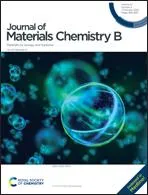
Journal of Materials Chemistry B
CiteScore:
12
自己引用率:
4.9%
年間論文数:
831
Journal of Materials Chemistry A, B & C cover high quality studies across all fields of materials chemistry. The journals focus on those theoretical or experimental studies that report new understanding, applications, properties and synthesis of materials. The journals have a strong history of publishing quality reports of interest to interdisciplinary communities and providing an efficient and rigorous service through peer review and publication. The journals are led by an international team of Editors-in-Chief and Associate Editors who are all active researchers in their fields. Journal of Materials Chemistry A, B & C are separated by the intended application of the material studied. Broadly, applications in energy and sustainability are of interest to Journal of Materials Chemistry A, applications in biology and medicine are of interest to Journal of Materials Chemistry B, and applications in optical, magnetic and electronic devices are of interest to Journal of Materials Chemistry C. More than one Journal of Materials Chemistry journal may be suitable for certain fields and researchers are encouraged to submit their paper to the journal that they feel best fits for their particular article. Example topic areas within the scope of Journal of Materials Chemistry B are listed below. This list is neither exhaustive nor exclusive. Antifouling coatings Biocompatible materials Bioelectronics Bioimaging Biomimetics Biomineralisation Bionics Biosensors Diagnostics Drug delivery Gene delivery Immunobiology Nanomedicine Regenerative medicine & Tissue engineering Scaffolds Soft robotics Stem cells Therapeutic devices image block All articles published in Journal of Materials Chemistry B from 2019 onwards will be indexed in MEDLINE®. Articles that primarily focus on providing insight into the underlying science and performance of biomaterials within a biological environment are more suited to our companion journal, Biomaterials Science.
おすすめ化合物
おすすめサプライヤー




免責事項
このページに表示される学術雑誌情報は、参考および研究目的のみを目的としています。当社は雑誌出版社とは提携しておらず、投稿の取り扱いも行っておりません。出版に関するお問い合わせは、各雑誌出版社に直接ご連絡ください。
表示されている情報に誤りがある場合は、support@chemtradehub.com までご連絡ください。迅速に確認し、対応いたします。