












Contents list
文献情報
出版日
2024-01-02
DOI
10.1039/D4EE90003K
インパクトファクター
38.532
著者
原文を見る
要旨
The first page of this article is displayed as the abstract.
関連文献
Influence of process variables on extraction of Cefalexin in a novel biocompatible ionic liquid based-aqueous two phase system
Shiva Abdolrahimi, Bahram Nasernejad, Gholamreza Pazuki
2014-11-07
Paper
DOI: 10.1039/C4CP02923B
Enhanced visible light photocatalytic activity of Cu2O via cationic–anionic passivated codoping
Yao Jiang, Hongkunag Yuan
2014-11-05
Paper
DOI: 10.1039/C4CP03631J
Polymer-grafted multiwall carbon nanotubes functionalized by nitrene chemistry: effect on cooperativity and phase miscibility
Goutam Prasanna Kar, Priti Xavier, Suryasarathi Bose
2014-06-25
Paper
DOI: 10.1039/C4CP01594K
Structural dynamics effects on the ultrafast chemical bond cleavage of a photodissociation reaction
María E. Corrales, Garikoitz Balerdi, Rebeca de Nalda, Luis Bañares, Ahmed H. Zewail
2013-12-24
Paper
DOI: 10.1039/C3CP54677B
Cyclotriphosphazene appended porphyrins and fulleropyrrolidine complexes as supramolecular multiple photosynthetic reaction centers: steady and excited states photophysical investigation
Yogita Pareek, Venugopal Karunakaran, Mangalampalli Ravikanth
2014-01-15
Paper
DOI: 10.1039/C3CP54269F
High DNP efficiency of TEMPONE radicals in liquid toluene at low concentrations
Nikolay Enkin, Guoquan Liu, Igor Tkach, Marina Bennati
2014-03-20
Communication
DOI: 10.1039/C4CP00854E
Hexagonal ice stability and growth in the presence of glyoxal and secondary organic aerosols
Vangelis Daskalakis, Marios Hadjicharalambous
2014-07-07
Paper
DOI: 10.1039/C4CP02290D
Morphology and chemical states of size-selected Ptn clusters on an aluminium oxide film on NiAl(110)
Atsushi Beniya, Noritake Isomura, Hirohito Hirata, Yoshihide Watanabe
2014-07-01
Paper
DOI: 10.1039/C4CP01767F
The role of an active site Mg2+ in HDV ribozyme self-cleavage: insights from QM/MM calculations
Vojtěch Mlýnský, Nils G. Walter
2014-11-12
Paper
DOI: 10.1039/C4CP03857F
Ultrafast photoinduced charge transport in Pt(ii) donor–acceptor assembly bearing naphthalimide electron acceptor and phenothiazine electron donor
Jonathan Best, Paul A. Scattergood, Michael Towrie, Sergei A. Tikhomirov, Oleg V. Bouganov, Anthony J. H. M. Meijer, Julia A. Weinstein
2014-10-24
Paper
DOI: 10.1039/C4CP03995E
こちらもおすすめ
化合物よくある質問
S-(甲硅烷基丙基)異硫酰氯を取り扱う際の実験室安全事項は何ですか?
取り扱う際にはPPE(防護具)が必要です。特に手袋と面マスクは必須です。ドラフトチャンバーを使用して漏洩処理を行い、温度は常温、湿度は乾燥状態、容器はガラス容器...
84682-36-02-Amino-7,7-dimethox...
化合物よくある質問
8-硝基-咪唑并[1,2-a]吡啶とは何ですか?
8-硝基-咪唑并[1,2-a]吡啶は、CAS番号52310-46-0の化合物で、8-位に硝基を有する咪唑並みの结构をもつ吡啶の化合物です。この化合物は、酸化還元...
52310-46-08-Nitroimidazo[1,2-a...
化合物よくある質問
4-ブロモ-5-メトキシピリジン-2-甲醇の代替品はありますか?
4-ブロモ-5-メトキシピリジン-2-甲醇の代替品には、類似構造を持つ化合物や機能性に等しい代替試薬があります。例えば、4-クロロ-5-メトキシピリジン-2-甲...
1454849-84-3(4-Bromo-5-methoxy-2...
化合物よくある質問
全氟-1,2-二甲基環己烷を含む廃棄物はどのように処理すべきですか?
全氟-1,2-二甲基環己烷(CAS番号:306-98-9)の廃棄物は、特別な処理が必要です。まず、廃棄物を密閉容器に収集し、適切な防漏容器に保管します。次に、専...
306-98-91,1,2,2,3,3,4,4,5,6-...
化合物よくある質問
3-(溴甲基)苯乙酸の主な用途は何ですか?
3-(溴甲基)苯乙酸は主に研究用化学薬品として利用され、有機合成や医薬品の開発に用いられます。また、特定の化合物の合成中間体としても使用されることがあります。
118647-53-32-(3-(Bromomethyl)ph...
化合物よくある質問
5-イドキド-4-メチオキシ-6-メチルピリミジニン-2-アミンはどのように保存すればよいですか?
5-イドキド-4-メチオキシ-6-メチルピリミジニン-2-アミンは冷暗所で密栓の容器に保存し、直射日光を避けて保管することをお勧めします。温度は常温とし、湿気を...
23368-84-55-Iodo-4-methoxy-6-m...
化合物よくある質問
1-(2-溴-6-甲氧基苯基)乙酮を取り扱う際の実験室安全事項は何ですか?
実験室では、1-(2- Bromo-6-methoxyphenyl)ethanoneを取り扱う際には、ゴーグルや面具、手袋などのPPEを使用することが推奨されま...
380225-68-31-(2-Bromo-6-methoxy...
化合物よくある質問
5-(4,4,5,5-テトラメチル-1,3,2-ダイオキサボラロール-2-イル)-1,3-ジヒドロ-2-ベンゾフランは安全ですか?
5-(4,4,5,5-テトラメチル-1,3,2-ダイオキサボラロール-2-イル)-1,3-ジヒドロ-2-ベンゾフランは一般に安全ですが、取扱いには注意が必要です...
1352037-60-55-(4,4,5,5-Tetrameth...
化合物よくある質問
4-溴萘-1-甲酸の代替品はありますか?
4-溴萘-1-甲酸は比較的稀な化合物ですが、類似物としては、4-クロロ-1-ナフホリック酸やその他のブロモ置換ナフホリック酸が挙げられます。ただし、これらの代替...
16650-55-84-Bromo-1-naphthoic ...
化合物よくある質問
ε-白藜芦醇脱氢二聚体の代替品はありますか?
ε-白藜芦醇脱氢二聚体の代替品としては、ε-白藜芦醇、ポリフェノール類、フラボノイド類が挙げられます。これらは類似の化学構造と生物学的活性を持っています。ただし...
62218-08-05-{(2R,3R)-6-Hydroxy...
掲載誌
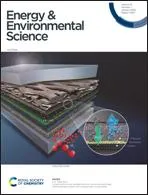
Energy & Environmental Science
CiteScore:
32.34
自己引用率:
3.4%
年間論文数:
481
Energy & Environmental Science is an international journal dedicated to publishing exceptionally important and high quality, agenda-setting research tackling the key global and societal challenges of ensuring the provision of energy and protecting our environment for the future. The scope is intentionally broad and the journal recognises the complexity of issues and challenges relating to energy conversion and storage, alternative fuel technologies and environmental science. For work to be published it must be linked to the energy-environment nexus and be of significant general interest to our community-spanning readership. All scales of studies and analysis, from impactful fundamental advances, to interdisciplinary research across the (bio)chemical, (bio/geo)physical sciences and chemical engineering disciplines are welcomed. Topics include, but are not limited to, the following: Solar energy conversion and photovoltaics Solar fuels and artificial photosynthesis Fuel cells Hydrogen storage and (bio) hydrogen production Materials for energy systems Capture, storage and fate of CO2, including chemicals and fuels from CO2 Catalysis for a variety of feedstocks (for example, oil, gas, coal, biomass and synthesis gas) Biofuels and biorefineries Materials in extreme environments Environmental impacts of energy technologies Global atmospheric chemistry and climate change as related to energy systems Water-energy nexus Energy systems and networks Globally applicable principles of energy policy and techno-economics
おすすめ化合物

おすすめサプライヤー



免責事項
このページに表示される学術雑誌情報は、参考および研究目的のみを目的としています。当社は雑誌出版社とは提携しておらず、投稿の取り扱いも行っておりません。出版に関するお問い合わせは、各雑誌出版社に直接ご連絡ください。
表示されている情報に誤りがある場合は、support@chemtradehub.com までご連絡ください。迅速に確認し、対応いたします。