












Correction: Critical role of hydrogen bonding between microcrystalline cellulose and g-C3N4 enables highly efficient photocatalysis
文献情報
出版日
2024-01-12
DOI
10.1039/D4CC90017K
インパクトファクター
6.222
著者
Zhaoqiang Wang, Guixiang Ding, Juntao Zhang, Xianqing Lv, Peng Wang, Li Shuai, Chunxue Li, Yonghao Ni, Guangfu Liao
原文を見る
要旨
Correction for ‘Critical role of hydrogen bonding between microcrystalline cellulose and g-C3N4 enables highly efficient photocatalysis’ by Zhaoqiang Wang et al., Chem. Commun., 2024, 60, 204–207, https://doi.org/10.1039/D3CC04800D.
おすすめジャーナル
関連文献
O2 adsorption and dissociation on neutral, positively and negatively charged Aun (n = 5–79) clusters
Josep Manel Ricart, Gianfranco Pacchioni
2010-07-08
Paper
DOI: 10.1039/C004110F
High-resolution 17O double-rotation NMR characterization of ring and non-ring oxygen in vitreous B2O3
Alan Wong, Andy P. Howes, Ben Parkinson, Tiit Anupõld, Ago Samoson, Diane Holland, Ray Dupree
2009-06-22
Paper
DOI: 10.1039/B906501F
Photochemistry of carbon monoxide and methanol in water and nitric acid hydrate ices: A NEXAFS study
C. Laffon, J. Lasne, F. Bournel, K. Schulte, S. Lacombe, Ph. Parent
2010-07-26
Paper
DOI: 10.1039/C0CP00229A
Hot plasmonic interactions: a new look at the photothermal efficacy of gold nanoparticles
Ekaterina Y. Lukianova-Hleb, Lindsey J. E. Anderson, Seunghyun Lee
2010-08-16
Paper
DOI: 10.1039/C0CP00499E
Inhibition of efflorescence in mixed organic–inorganic particles at temperatures less than 250 K
A. Bodsworth, B. Zobrist, A. K. Bertram
2010-08-16
Paper
DOI: 10.1039/C0CP00572J
Translational, rotational and vibrational energy partitioning in the sequential loss of carbon dimers from fullerenes
2009-06-03
Paper
DOI: 10.1039/B901557D
Mechanistic insight into light-driven molecular rotors: a conformational search in chiral overcrowded alkenes by a pseudo-random approach
Guillermo Pérez-Hernández, Leticia González
2010-08-16
Paper
DOI: 10.1039/C0CP00324G
The reduced [2Fe-2S] clusters in adrenodoxin and Arthrospira platensisferredoxin share spin density with proteinnitrogens, probed using 2D ESEEM
Sergei A. Dikanov, Rimma I. Samoilova, Reinhard Kappl, Antony R. Crofts, Jürgen Hüttermann
2009-07-01
Paper
DOI: 10.1039/B904597J
A spiro-configured ambipolar host material for impressively efficient single-layer green electrophosphorescent devices
Wen-Yi Hung, Ting-Chih Wang, Hao-Chih Chiu, Hsiao-Fan Chen, Ken-Tsung Wong
2010-08-16
Communication
DOI: 10.1039/C0CP00490A
A W-band pulsed EPR/ENDOR study of CoIIS4 coordination in the Co[(SPPh2)(SPiPr2)N]2 complex
Silvia Sottini, Guinevere Mathies, Peter Gast, Dimitrios Maganas, Panayotis Kyritsis, Edgar J.J. Groenen
2009-07-08
Paper
DOI: 10.1039/B905726A
こちらもおすすめ
化合物よくある質問
2-氟-4-イオドベンzo酸エチルエステルを取り扱う際の実験室安全事項は何ですか?
2-氟-4-イオドベンzo酸エチルエステルは有機溶媒を用いた反応であり、ドラフトチャンバーでの操作が必要です。漏洩時にはSDS参照の安全措置を講じ、PPE(防護...
205750-82-9Benzoic acid, 2-fluo...
化合物よくある質問
血根碱の主な用途は何ですか?
血根碱は主に医薬分野で利用され、抗炎症や抗がん剤としての潜在的な効果が研究されています。また、化学研究や薬物開発において、新しい薬剤設計の参考となる化合物として...
2447-54-313-Methyl[1,3]benzod...
化合物よくある質問
Methyl 3-methoxythiophene-2-carboxylateの主な用途は何ですか?
Methyl 3-メトキシスチフェン-2-カルボン酸メチルエステルは、薬品合成、染料製造、以及合成中間体としての用途が広がっています。
62353-75-7Methyl 3-methoxythio...
化合物よくある質問
丹磺酰-L-亮氨酸はどのように保存すればよいですか?
丹磺酰-L-亮氨酸は乾燥した場所で、直射日光から保護し、低温(室温以下)で保存してください。密閉容器に入れて保管することをおすすめします。
1100-22-7N-{[5-(Dimethylamino...
化合物よくある質問
5-(苄氧基)ピラミジン-4-アミンの代替品はありますか?
5-(苄氧基)ピラミジン-4-アミンの代替品として、6-メトキシピラミジンや5-フェニルピラミジンなどが挙げられます。これらの化合物は、5-(苄氧基)ピラミジン...
92289-50-45-benzyloxypyrimidin...
化合物よくある質問
8-ヒドロキシノルデコペントアセートの物理化学的性質は何ですか?
8-ヒドロキシノルデコペントアセートはCAS番号84807-87-4の化合物で、分子量は750.02 uです。これは油溶性で、水に溶けにくい特徴があります。反応...
84807-87-4(5Z,8Z,11Z,13E,15S)-...
化合物よくある質問
tert-ブチル(エス)-1-ヒドロキシペンタ-4-エン-2-イルカルバamateの主な用途は何ですか?
tert-ブチル(エス)-1-ヒドロキシペンタ-4-エン-2-イルカルバamateは主に医薬品の合成材料や分析化学の試薬として使用されます。
116613-81-12-Methyl-2-propanyl ...
化合物よくある質問
ブコール-L-2-フローヨルブリンについて適切な法規ガイドラインは何ですか?
ブコール-L-2-フローヨルブリン(CAS番号: 1196107-73-9)は、GHS(グローバルハザードアサessmentシステム)に基づく危害分類と表示が求...
1196107-73-92-Bromo-13,13-dimeth...
化合物よくある質問
6-ブロモ-N-環丙基-2-ピリジニニメタンの市場動向や研究トレンドはどうですか
6-ブロモ-N-環丙基-2-ピリジニニメタンは、薬理学研究や合成化学に使用される化合物であり、特に抗ウイルス薬や抗がん薬の開発に注目されています。市場では、薬物...
959237-20-86-Bromo-N-cyclopropy...
化合物よくある質問
RS-AMPÀはどのように保存すればよいですか?
RS-AMPÀは、遮光容器に保存し、室温(15〜25℃)で保管することが推奨されます。高湿や熱は物質を劣化させるため、湿度は50%以下に保つことが重要です。また...
74341-63-2(RS)-AMPA
掲載誌
Chemical Communications

CiteScore:
8.6
自己引用率:
4.7%
年間論文数:
2458
ChemComm publishes urgent research which is of outstanding significance and interest to experts in the field, while also appealing to the journal’s broad chemistry readership. Our communication format is ideally suited to short, urgent studies that are of such importance that they require accelerated publication. Our scope covers all topics in chemistry, and research at the interface of chemistry and other disciplines (such as materials science, nanoscience, physics, engineering and biology) where there is a significant novelty in the chemistry aspects. Major topic areas covered include: Analytical Chemistry Catalysis Chemical Biology and medicinal chemistry Computational Chemistry and Machine Learning Energy and sustainable chemistry Environmental Chemistry Green Chemistry Inorganic Chemistry Materials Chemistry Nanoscience Organic Chemistry Physical Chemistry Polymer Chemistry Supramolecular Chemistry
おすすめ化合物
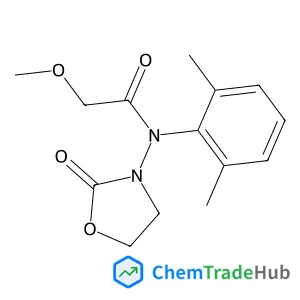
N-(2,6-Dimethylphenyl)-2-methoxy-N-(2-oxo-1,3-oxazolidin-3-yl)acetamide
CAS番号:
77732-09-3
分子式:
C14H18N2O4
おすすめサプライヤー





免責事項
このページに表示される学術雑誌情報は、参考および研究目的のみを目的としています。当社は雑誌出版社とは提携しておらず、投稿の取り扱いも行っておりません。出版に関するお問い合わせは、各雑誌出版社に直接ご連絡ください。
表示されている情報に誤りがある場合は、support@chemtradehub.com までご連絡ください。迅速に確認し、対応いたします。