













Subambient passive radiative cooling effects of barium sulfate and calcium carbonate paints under Malaysia's tropical climate
文献情報
出版日
2023-10-24
DOI
10.1039/D3VA00161J
インパクトファクター
0
著者
William Raphael Joseph, Jun Yeang Tan, Apurav Krishna Koyande, Ianatul Khoiroh, Jerry Joynson, Steve Willis
原文を見る
要旨
Global cooling requirements are increasing at an unprecedented rate due to rapid urbanization and population growth, further aggravating climate concerns. Passive radiative cooling is a unique phenomenon that can be utilized to reduce global cooling, energy consumption and alleviate the urban heat island effect. Paints can act as passive cooling devices that are able to reflect incoming sunlight and emit radiation in the atmospheric window (8–13 μm), where it propagates directly into deep space without any interference. In this work, we have successfully fabricated and tested two different types of cooling paints, consisting of BaSO4 and CaCO3 as their respective pigments under Malaysia's tropical climate. Different types of binders, solvents, and pigment concentrations were tested to obtain the most optimum cooling paint configuration. Field test results proved that both cooling paints were able to achieve remarkable subambient temperatures throughout the entire day, even under direct solar irradiation. The BaSO4 cooling paint was able to achieve subambient temperature reductions of up to −6.1 °C and a mean net cooling power of 71.0 W m−2 while the CaCO3 cooling paint achieved a maximum subambient temperature reduction of −6.0 °C and a mean net cooling power of 69.9 W m−2. Both paints were able to significantly outperform commercial white paint on a variety of different surfaces, in terms of cooling performance. The hindering effects of various climate conditions including humidity levels and local wind speeds on the overall cooling performance of both the paints were also investigated.
おすすめジャーナル
関連文献
Reversibly photo-switchable wettability of stearic acid monolayer modified bismuth-based micro-/nanomaterials
Hao Yang, Xiaojing Hu, Chunping Su, Yunling Liu, Rong Chen
2017-11-06
Paper
DOI: 10.1039/C7CP05848A
Hydrogen sorption efficiency of titanium decorated calix[4]pyrroles
Sandeep Kumar, Rohit Y. Sathe, T. J. Dhilip Kumar
2017-11-20
Paper
DOI: 10.1039/C7CP06781J
Theoretical exploration of the potential applications of Sc-based MXenes
Xiang Kan, Bin Amin, Yong Zhao
2017-11-16
Paper
DOI: 10.1039/C7CP06224A
What regulates the catalytic activities in AGE catalysis? An answer from quantum mechanics/molecular mechanics simulations
Yulai Zhang, Hongxing Zhang
2017-11-10
Paper
DOI: 10.1039/C7CP07079A
Dynamics of poly(vinyl butyral) studied using dielectric spectroscopy and 1H NMR relaxometry
Silvia Pizzanelli, Daniele Prevosto, Massimiliano Labardi, Tommaso Guazzini, Simona Bronco, Claudia Forte, Lucia Calucci
2017-11-13
Paper
DOI: 10.1039/C7CP02595E
Polysulfide intercalation in bilayer-structured graphitic C3N4: a first-principles study
Sinan Li, Shaobin Yang, Ding Shen, Wen Sun, Xueying Shan, Wei Dong, Yuehui Chen, Xu Zhang, Yongqiang Mao, Shuwei Tang
2017-11-16
Paper
DOI: 10.1039/C7CP05334G
Ion chemistry at elevated ion–molecule interaction energies in a selected ion flow-drift tube: reactions of H3O+, NO+ and O2+ with saturated aliphatic ketones
Anatolii Spesyvyi, David Smith, Patrik Španěl
2017-11-16
Paper
DOI: 10.1039/C7CP05795D
Adsorption and diffusion of hydrogen and oxygen in FCC-Co: a first-principles study
Wusong Liu, Jian Zhou
2017-11-20
Paper
DOI: 10.1039/C7CP07208B
Characterising the evaporation kinetics of water and semi-volatile organic compounds from viscous multicomponent organic aerosol particles
Stephen Ingram, Chen Cai, Young-Chul Song, David O. Topping, Simon O’Meara, Jonathan P. Reid
2017-11-13
Paper
DOI: 10.1039/C7CP05172G
Conformational analysis of spiro-epoxides by principal component analysis of molecular dynamics trajectories
T. Hrenar, I. Primožič, D. Fijan, M. Majerić Elenkov
2017-11-07
Paper
DOI: 10.1039/C7CP05600A
こちらもおすすめ
化合物よくある質問
1-{3-[5-(エチルカルボンイル)-2,4-ジメチル-1H-ピロロール-3-基]プロパニル}ピペリジン-4-カルボン酸について、適用される法規ガイドラインは何ですか?
この化合物はCAS番号1142209-81-1であり、GHS分類では corrosive (腐食性物質) と classified (分類物質) として指定され...
1142209-81-11-{3-[5-(Ethoxycarbo...
化合物よくある質問
2,2-二氟-1,3-ベンゾジオキサン-5-カルボキシlic酸とは何ですか?
2,2-二氟-1,3-ベンゾジオキサン-5-カルボキシlic酸は、CAS番号656-46-2の化合物で、化学式はC8H4F2O4です。この化合物は白色の結晶性粉...
656-46-22,2-Difluoro-1,3-ben...
化合物よくある質問
8-氯-4-色原酮の代替品はありますか?
8-氯-4-色原酮(CAS番号: 49701-11-3)の代替品には、他の色原酮類似物や、構造が似ている化合物があります。例えば、8-メチル-4-色原酮や、他の...
49701-11-38-Chloro-2,3-dihydro...
化合物よくある質問
エチル6,6-ジメチル-4,5,6,7-テトラヒドロ-1H-インドアゼー-3-カルボキシレートとは何ですか?
エチル6,6-ジメチル-4,5,6,7-テトラヒドロ-1H-インドアゼー-3-カルボキシレートは、CAS番号1233243-56-5を有する化合物です。これは有...
1233243-56-5Ethyl 6,6-dimethyl-4...
化合物よくある質問
4-叔丁基-6-氯-嘧啶に適用される法規ガイドラインは何ですか?
4-叔丁基-6-氯-嘧啶はCAS番号3435-24-3で、GHS分類では毒性物質とみなし、GHSの危険性分類が適用されます。REACH規則では登録が必要で、Eu...
3435-24-34-Tert-butyl-6-chlor...
化合物よくある質問
維库溴铵杂质Bはどのように合成されますか?
維库溴铵杂质Bは、アンドロステンデンから始まり、一連の合成反応、包括的な選択性と高い収率で合成されます。具体的には、ブロミド化、酸化、ジマーゼ反応、アミド化など...
50587-95-6(2beta,3alpha,5alpha...
化合物よくある質問
2-(4-氟苄基)-吡咯烷の物理化学的性質は何ですか?
CAS番号350017-04-8の2-(4-氟苄基)-吡咯烷は、結晶性の白色粉末です。分子量は199.17 g/molで、水に溶けにくいです。化学反応では比較的...
350017-04-82-(4-Fluorobenzyl)py...
化合物よくある質問
3-喹啉甲醛(2-チロール-8-エチル)は安全ですか?
3-喹啉甲醛(2-チロール-8-エチル)は一定の毒性を持つため、取扱には注意が必要です。使用する際は適切な防護具を着用し、密閉容器で保管・搬送し、直接的な接触を...
335196-05-92-Chloro-8-ethyl-3-q...
化合物よくある質問
エチル3-(ヒドロキシメチル)-1H-ピロール-2-カルボキシレートはどのように保存すればよいですか?
エチル3-(ヒドロキシメチル)-1H-ピロール-2-カルボキシレートは、室温(25℃)以下で保存し、直射日光を避け、乾燥した環境で保管することが推奨されます。ま...
75448-69-0Ethyl 3-(hydroxymeth...
119410-05-88-Chloro-11-(4-piper...
掲載誌
おすすめ化合物

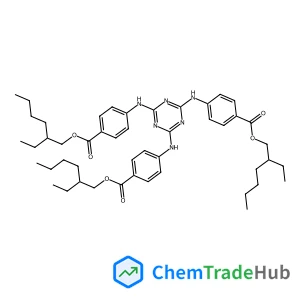
Tris(2-ethylhexyl) 4,4',4''-(1,3,5-triazine-2,4,6-triyltriimino)tribenzoate
CAS番号:
88122-99-0
分子式:
C48H66N6O6
おすすめサプライヤー




免責事項
このページに表示される学術雑誌情報は、参考および研究目的のみを目的としています。当社は雑誌出版社とは提携しておらず、投稿の取り扱いも行っておりません。出版に関するお問い合わせは、各雑誌出版社に直接ご連絡ください。
表示されている情報に誤りがある場合は、support@chemtradehub.com までご連絡ください。迅速に確認し、対応いたします。