












A polyhexamethylene biguanide-assembly assisted strategy of dentin bonding greatly promotes bonding effects and caries treatment
文献情報
出版日
2023-10-25
DOI
10.1039/D3TB02083E
インパクトファクター
6.331
著者
Chang Shu, Yadong Chen, Zhenzhen Zhang, Yuqing Lei, Jiajia Xu, Weiwei Lao, Qingping Xi, Qiang Sun, Xiaojun Li, Hongbing Liao, Qiaojie Luo, Xiaodong Li
原文を見る
要旨
Structural degeneration of a hybrid layer composed of a demineralized dentin matrix (DDM) and adhesive causes unsatisfactory functional outcomes in terms of bonding repair and caries treatment and is accompanied by high prevalence of secondary caries. Clinically, defects in the hybrid layer from insufficient adhesive infiltration, bacterial load from retained infected-dentin, and bacterial attack from the oral cavity are the main threats to degeneration. Currently, there is no strategy to simultaneously address adhesive penetration and bacterial infection. Herein, based on the core role of the strongly-polar hydrated DDM interface in dentin bonding, an interface-reconstructed bonding strategy assisted by electrostatic assembly of broad-spectrum germicidal polyhexamethylene biguanide (PHMB) is proposed that kills two birds with one stone. PHMB is absorbed onto the anionic 3D DDM forming a PHMB/DDM complex. The surface potential of the DDM increases by about 100 mV, the anion content decreases by 20%, and the interface water content decreases by nearly 40%. All of these changes contribute to the penetration of the adhesive, thereby improving the bonding strength and durability. After thermal cycling aging, the bonding strength of the PHMB group was 1.45–1.65 times that of the control group. In terms of antibacterial properties, PHMB treatment not only has a bacterial-killing ability due to the already formed biofilm but also significantly reduces the adhesion of bacteria, thereby delaying the occurrence of secondary caries. In summary, PHMB treatment reconstructed the DDM interface, resulting in a defect-low and inherent antibacterial hybrid layer that improves the bonding effect, treatment of caries and even prevention of secondary caries.
関連文献
Origins of possible synergistic effects in the interactions between metal atoms and MoS2/graphene heterostructures for battery applications
Jiaxin Fan, Sean Li
2018-06-19
Paper
DOI: 10.1039/C8CP02740D
Pressure dependence of spin canting in ammonium metal formate antiferromagnets
Alexander A. Tsirlin, Maxim Bykov, Elena Bykova, Michael Hanfland, Philipp Gegenwart, Sander van Smaalen, Leonid Dubrovinsky, Natalia Dubrovinskaia
2018-08-23
Paper
DOI: 10.1039/C8CP03761B
Electronic structure and rovibrational predissociation of the 21Π state in KLi
P. Jasik, J. Kozicki, T. Kilich, J. E. Sienkiewicz, N. E. Henriksen
2018-06-25
Paper
DOI: 10.1039/C8CP02551G
Electronic and structural properties of fluorene–thiophene copolymers as function of the composition ratio between the moieties: a theoretical study
L. Benatto, M. G. E. da Luz, M. Koehler
2018-06-26
Paper
DOI: 10.1039/C8CP02622J
CS2 capture in the ionic liquid 1-alkyl-3-methylimidazolium acetate: reaction mechanism and free energetics
Fangyong Yan, Ryohei Kakuchi, Kenji Takahashi, Hyung J. Kim
2018-07-02
Paper
DOI: 10.1039/C8CP01724G
Exploring the electrochemical performance of graphite and graphene paste electrodes composed of varying lateral flake sizes
Graham C. Smith, Kathryn A. Whitehead
2018-07-11
Paper
DOI: 10.1039/C8CP02196A
Partitioning of nanoscale particles on a heterogeneous multicomponent lipid bilayer
Ran Yang, Xiaodong Tian, Kejie He, Seth Leon Filbrun, Ning Fang
2018-10-17
Paper
DOI: 10.1039/C8CP05710A
Palladium nanoparticle formation processes in fluoropolymers by thermal decomposition of organometallic precursors
Fan W. Zeng, Dajie Zhang, James B. Spicer
2018-09-04
Paper
DOI: 10.1039/C8CP04997A
A 4,4′-bis(2-benzoxazolyl)stilbene luminescent probe: assessment of aggregate formation through photophysics experiments and quantum-chemical calculations
Matteo Ambrosetti, Giacomo Ruggeri, Chiara Cappelli, Andrea Pucci
2018-09-24
Paper
DOI: 10.1039/C8CP04450C
こちらもおすすめ
化合物よくある質問
2-ブロモ-9,9-ジフェニル-9H-フルオレンの主な用途は何ですか?
2-溴-9,9-二苯基芴は、医薬品、工業材料、有機合成の研究分野で応用されます。特に、レーザー材料や機能性ポリマーの合成に使用されることがあります。また、蛍光色...
474918-32-62-Bromo-9,9-diphenyl...
化合物よくある質問
四氯化铱の市場動向や研究トレンドはどうですか?
四氯化铱の市場は研究開発分野で注目されており、特にナノ技術や金属有機框架(MOFs)の分野での需要が増加傾向にあります。価格は安定しており、中国や韓国での生産が...
207399-11-9Tetrachloroiridium h...
882-06-44-Nitrocinnamic acid
化合物よくある質問
1-(4-溴-3-氟苯基)-2-氯乙酮を含む廃棄物はどのように処理すべきですか?
1-(4-溴-3-氟苯基)-2-氯乙酮 (CAS番号: 1260857-14-4) の廃棄物は専門的な廃棄処理が必要です。まず、廃棄物は密閉された容器に収集し、...
1260857-14-41-(4-Bromo-3-fluorop...
化合物よくある質問
苦参酚Kとは何ですか?
苦参酚Kは、CAS番号101236-49-1を持つ化合物で、主に天然由来の生薬から抽出されます。この化合物は、抗炎症作用や抗癌作用を持つことが報告されています。
101236-49-1Kushenol K
化合物よくある質問
POTASSIUM (1-(TERTBUTOXYCARBONYL)AZETIDIN-3-YL)TRIFLUOROBORATE を含む廃棄物はどのように処理すべきですか?
POTASSIUM (1-(TERTBUTOXYCARBONYL)AZETIDIN-3-YL)TRIFLUOROBORATE を含む廃棄物は、まず安全なエント...
1430219-73-0Potassium (1-(tert-b...
化合物よくある質問
4-庚基-4’-联苯羧酸の市場動向や研究トレンドはどうですか?
4-庚基-4’-聯苯羧酸は、特殊化学品や合成化学の分野で用いられる化学物質ですが、市場動向としては、研究開発の進展とともに需要が増加しています。また、環境配慮型...
58573-94-74'-Heptyl-4-biphenyl...
化合物よくある質問
6-ブロモ-3-メトキシ-1-フェニル-1H-インドゾールを含む廃棄物はどのように処理すべきですか?
6-ブロモ-3-メトキシ-1-フェニル-1H-インドゾールを含む廃棄物は、適切な化学廃棄処理が必要です。通常、廃棄物は密閉容器に収集され、専門の廃棄処理業者に引...
1332527-03-36-Bromo-3-methoxy-1-...
化合物よくある質問
4,4-二甲基-2-吡咯烷酮はどの業界で使用されていますか?
4,4-二甲基-2-吡咯烷酮は医薬、ポリマー、センサー、半導体などの業界で広く使用されています。特に溶媒としての性能が高く評価されています。
66899-02-34,4-dimethylpyrrolid...
51312-42-6Sodium Phosphotungst...
掲載誌
Journal of Materials Chemistry B
CiteScore:
12
自己引用率:
4.9%
年間論文数:
831
Journal of Materials Chemistry A, B & C cover high quality studies across all fields of materials chemistry. The journals focus on those theoretical or experimental studies that report new understanding, applications, properties and synthesis of materials. The journals have a strong history of publishing quality reports of interest to interdisciplinary communities and providing an efficient and rigorous service through peer review and publication. The journals are led by an international team of Editors-in-Chief and Associate Editors who are all active researchers in their fields. Journal of Materials Chemistry A, B & C are separated by the intended application of the material studied. Broadly, applications in energy and sustainability are of interest to Journal of Materials Chemistry A, applications in biology and medicine are of interest to Journal of Materials Chemistry B, and applications in optical, magnetic and electronic devices are of interest to Journal of Materials Chemistry C. More than one Journal of Materials Chemistry journal may be suitable for certain fields and researchers are encouraged to submit their paper to the journal that they feel best fits for their particular article. Example topic areas within the scope of Journal of Materials Chemistry B are listed below. This list is neither exhaustive nor exclusive. Antifouling coatings Biocompatible materials Bioelectronics Bioimaging Biomimetics Biomineralisation Bionics Biosensors Diagnostics Drug delivery Gene delivery Immunobiology Nanomedicine Regenerative medicine & Tissue engineering Scaffolds Soft robotics Stem cells Therapeutic devices image block All articles published in Journal of Materials Chemistry B from 2019 onwards will be indexed in MEDLINE®. Articles that primarily focus on providing insight into the underlying science and performance of biomaterials within a biological environment are more suited to our companion journal, Biomaterials Science.
おすすめ化合物
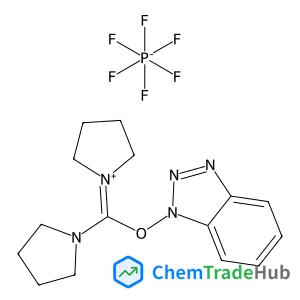
(1H-Benzotriazol-1-yloxy)(di-1-pyrrolidinyl)methylium hexafluorophosphate
CAS番号:
105379-24-6
分子式:
C15H21F6N5OP
おすすめサプライヤー





免責事項
このページに表示される学術雑誌情報は、参考および研究目的のみを目的としています。当社は雑誌出版社とは提携しておらず、投稿の取り扱いも行っておりません。出版に関するお問い合わせは、各雑誌出版社に直接ご連絡ください。
表示されている情報に誤りがある場合は、support@chemtradehub.com までご連絡ください。迅速に確認し、対応いたします。