












Efficient thermal energy conversion and storage enabled by hybrid graphite nanoparticles/silica-encapsulated phase-change microcapsules
文献情報
出版日
2023-12-13
DOI
10.1039/D3TA06678A
インパクトファクター
12.732
著者
Kunjie Yuan, Qiuyang Chen, Aijia Zhang, Nan Xiao, Xuelin Zou, Zhiqun Lin
原文を見る
要旨
The ability to achieve efficient solar energy utilization via photo-thermal conversion underscores the need for efficient working fluids in solar thermal collectors. However, traditional working fluids suffer from a set of disadvantages, including low heat storage density, low efficiency, and poor heat transfer efficiency, thereby restricting effective use of solar energy. Herein, we report the crafting of robust microencapsulated phase change composites as a heat transfer fluid that manifests high heat storage capacity and outstanding photo-thermal conversion performance. Specifically, microscopic composites, composed of paraffin/nano-graphite microspheres that are capped by a silica (SiO2) shell, are constructed via in situ polycondensation of tetraethoxysilane (yielding SiO2) in the presence of nano-graphite-encapsulated paraffin microspheres, where paraffin functions as a phase change material. The resulting composites are referred to as paraffin/nano-graphite (NG)@SiO2 microcapsules and exploited as a heat transfer fluid. The melting temperature and latent heat of paraffin/NG@SiO2 microcapsules are 49.4 °C and 82.5 J g−1, respectively. Particularly, the thermal conductivity of microcapsules with a hybrid NG/SiO2 shell (1.562 W m−1 K−1) is found to be enhanced by ∼500% compared to that of paraffin (0.256 W m−1 K−1). More importantly, the visible light absorption rate of microcapsules with a hybrid NG/SiO2 shell has increased up to 80% compared with that of single SiO2 shell microcapsules (almost zero absorption). The addition of the as-crafted microcapsules in water not only enhances the thermal conductivity and heat capacity of the base fluid, but also boosts its optical–thermal performance as a heat transfer medium in direct-absorption solar collectors (DASCs). Notably, the receivers based on this heat transfer fluid (i.e., paraffin/NG@SiO2 microcapsules) are found to retain more than 80% of solar-to-thermal efficiency over a temperature range from room temperature to 60 °C. Importantly, paraffin/NG@SiO2 microcapsules maintain their phase transition after 50 melting–freezing cycles with no leakage of paraffin found. Such a high heat storage capacity and photo-thermal conversion capability highlight the potential of paraffin/NG@SiO2 microcapsules to store solar energy for practical applications.
関連文献
Effective and selective iodofunctionalisation of organic molecules in water using the iodine–hydrogen peroxide tandem
Marjan Jereb, Stojan Stavber
2004-10-04
Communication
DOI: 10.1039/B409919B
A copper-complexed rotaxane in motion: pirouetting of the ring on the millisecond timescale
2004-01-23
Communication
DOI: 10.1039/B315080A
NRIS study on the [FeN6] core in photo-induced high-spin state of [Fe(2-pic)3]Cl2·EtOH
Gergely Juhász, Makoto Seto, Yoshitaka Yoda, Shinya Hayami, Yonezo Maeda
2004-09-29
Communication
DOI: 10.1039/B409025J
Low temperature 1,1,1-trichloroethane dehydrochlorination over Pt catalysts: from model surfaces to the real world
Adam F. Lee, Paul A. Carr, Karen Wilson
2004-10-22
Communication
DOI: 10.1039/B408745C
Ruthenium- and gold-catalysed sequential reactions: a straightforward synthesis of substituted oxazoles from propargylic alcohols and amides
Marilyn Daisy Milton, Youichi Inada, Yoshiaki Nishibayashi, Sakae Uemura
2004-10-13
Communication
DOI: 10.1039/B411180J
Ordered mesoporous titanosilicates with catalytically stable and active four-coordinated titanium sites
Xiaoyu Yang, Yu Han, Kaifeng Lin, Ge Tian, Yefei Feng, Xiangju Meng, Yan Di, Yuncheng Du, Yonglai Zhang, Feng-Shou Xiao
2004-10-04
Communication
DOI: 10.1039/B410305J
A chiroptical molecular switch with perfect stereocontrol
Richard A. van Delden, Matthijs K. J. ter Wiel, Ben L. Feringa
2003-12-05
Communication
DOI: 10.1039/B312170D
Contrasting coordination behaviour of 22-membered chalcogenaaza (Se, Te) macrocylces towards Pd(ii) and Pt(ii): Isolation and structural characterization of the first metallamacrocyle with a C–Pt–Se linkage
Snigdha Panda, Harkesh B. Singh, Ray J. Butcher
2004-01-08
Communication
DOI: 10.1039/B312358H
An Fe(iii) wheel with a zwitterionic ligand: the structure and magnetic properties of [Fe(OMe)2(proline)]12[ClO4]12
Abd-Alhakeem H. Abu-Nawwas, Joan Cano, Paul Christian, Talal Mallah, Gopalan Rajaraman, Simon J. Teat, Richard E. P. Winpenny, Yasuhiko Yukawa
2004-01-07
Communication
DOI: 10.1039/B312947K
A mild and efficient procedure for α-bromination of ketones using N-bromosuccinimide catalysed by ammonium acetate
Kiyoshi Tanemura, Tsuneo Suzuki, Yoko Nishida, Koko Satsumabayashi, Takaaki Horaguchi
2004-01-28
Communication
DOI: 10.1039/B315340A
こちらもおすすめ
化合物よくある質問
2-氟-4-イオドベンzo酸エチルエステルを取り扱う際の実験室安全事項は何ですか?
2-氟-4-イオドベンzo酸エチルエステルは有機溶媒を用いた反応であり、ドラフトチャンバーでの操作が必要です。漏洩時にはSDS参照の安全措置を講じ、PPE(防護...
205750-82-9Benzoic acid, 2-fluo...
化合物よくある質問
血根碱の主な用途は何ですか?
血根碱は主に医薬分野で利用され、抗炎症や抗がん剤としての潜在的な効果が研究されています。また、化学研究や薬物開発において、新しい薬剤設計の参考となる化合物として...
2447-54-313-Methyl[1,3]benzod...
化合物よくある質問
Methyl 3-methoxythiophene-2-carboxylateの主な用途は何ですか?
Methyl 3-メトキシスチフェン-2-カルボン酸メチルエステルは、薬品合成、染料製造、以及合成中間体としての用途が広がっています。
62353-75-7Methyl 3-methoxythio...
化合物よくある質問
丹磺酰-L-亮氨酸はどのように保存すればよいですか?
丹磺酰-L-亮氨酸は乾燥した場所で、直射日光から保護し、低温(室温以下)で保存してください。密閉容器に入れて保管することをおすすめします。
1100-22-7N-{[5-(Dimethylamino...
化合物よくある質問
5-(苄氧基)ピラミジン-4-アミンの代替品はありますか?
5-(苄氧基)ピラミジン-4-アミンの代替品として、6-メトキシピラミジンや5-フェニルピラミジンなどが挙げられます。これらの化合物は、5-(苄氧基)ピラミジン...
92289-50-45-benzyloxypyrimidin...
化合物よくある質問
8-ヒドロキシノルデコペントアセートの物理化学的性質は何ですか?
8-ヒドロキシノルデコペントアセートはCAS番号84807-87-4の化合物で、分子量は750.02 uです。これは油溶性で、水に溶けにくい特徴があります。反応...
84807-87-4(5Z,8Z,11Z,13E,15S)-...
化合物よくある質問
tert-ブチル(エス)-1-ヒドロキシペンタ-4-エン-2-イルカルバamateの主な用途は何ですか?
tert-ブチル(エス)-1-ヒドロキシペンタ-4-エン-2-イルカルバamateは主に医薬品の合成材料や分析化学の試薬として使用されます。
116613-81-12-Methyl-2-propanyl ...
化合物よくある質問
ブコール-L-2-フローヨルブリンについて適切な法規ガイドラインは何ですか?
ブコール-L-2-フローヨルブリン(CAS番号: 1196107-73-9)は、GHS(グローバルハザードアサessmentシステム)に基づく危害分類と表示が求...
1196107-73-92-Bromo-13,13-dimeth...
化合物よくある質問
6-ブロモ-N-環丙基-2-ピリジニニメタンの市場動向や研究トレンドはどうですか
6-ブロモ-N-環丙基-2-ピリジニニメタンは、薬理学研究や合成化学に使用される化合物であり、特に抗ウイルス薬や抗がん薬の開発に注目されています。市場では、薬物...
959237-20-86-Bromo-N-cyclopropy...
化合物よくある質問
RS-AMPÀはどのように保存すればよいですか?
RS-AMPÀは、遮光容器に保存し、室温(15〜25℃)で保管することが推奨されます。高湿や熱は物質を劣化させるため、湿度は50%以下に保つことが重要です。また...
74341-63-2(RS)-AMPA
掲載誌
Journal of Materials Chemistry A

CiteScore:
19.5
自己引用率:
4.7%
年間論文数:
2211
Journal of Materials Chemistry A, B & C cover high quality studies across all fields of materials chemistry. The journals focus on those theoretical or experimental studies that report new understanding, applications, properties and synthesis of materials. The journals have a strong history of publishing quality reports of interest to interdisciplinary communities and providing an efficient and rigorous service through peer review and publication. The journals are led by an international team of Editors-in-Chief and Associate Editors who are all active researchers in their fields. Journal of Materials Chemistry A, B & C are separated by the intended application of the material studied. Broadly, applications in energy and sustainability are of interest to Journal of Materials Chemistry A, applications in biology and medicine are of interest to Journal of Materials Chemistry B, and applications in optical, magnetic and electronic devices are of interest to Journal of Materials Chemistry C. More than one Journal of Materials Chemistry journal may be suitable for certain fields and researchers are encouraged to submit their paper to the journal that they feel best fits for their particular article. Example topic areas within the scope of Journal of Materials Chemistry A are listed below. This list is neither exhaustive nor exclusive. Artificial photosynthesis Batteries Carbon dioxide conversion Catalysis Fuel cells Gas capture/separation/storage Green/sustainable materials Hydrogen generation Hydrogen storage Photocatalysis Photovoltaics Self-cleaning materials Self-healing materials Sensors Supercapacitors Thermoelectrics Water splitting Water treatment
おすすめ化合物
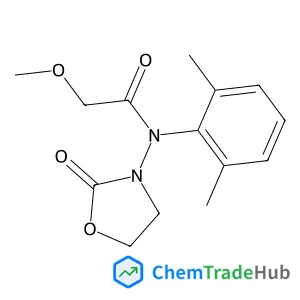
N-(2,6-Dimethylphenyl)-2-methoxy-N-(2-oxo-1,3-oxazolidin-3-yl)acetamide
CAS番号:
77732-09-3
分子式:
C14H18N2O4
おすすめサプライヤー





免責事項
このページに表示される学術雑誌情報は、参考および研究目的のみを目的としています。当社は雑誌出版社とは提携しておらず、投稿の取り扱いも行っておりません。出版に関するお問い合わせは、各雑誌出版社に直接ご連絡ください。
表示されている情報に誤りがある場合は、support@chemtradehub.com までご連絡ください。迅速に確認し、対応いたします。