


A novel Cu single-atom catalyst prepared through the adsorption characteristics of MoS2: from preparation to application
文献情報
出版日
2023-12-06
DOI
10.1039/D3TA06517K
インパクトファクター
12.732
著者
Xu Zhang, Lang Ran, Yajuan Zheng, Heng Zhang, Lingxiao Zhu, Lincheng Zhou, Hong Zhang
原文を見る
要旨
Single-atom catalysis is one of the most popular methods to treat wastewater at present. However, how to improve the catalyst performance without aggregation and broaden the application range is the main problem that puzzles the further development of this technology. Herein, a novel method for the preparation of single-atom catalysts was proposed to solve this problem. Cu loaded on flower-like MoS2 layers with atomic dispersion was obtained through the adsorption of metal ions by MoS2 and high-temperature annealing in the presence of thiourea. The atomic level dispersion of Cu was confirmed by high-angle annular dark field scanning transmission electron microscopy and X-ray absorption fine structure. The electronic and coordination structures of central Cu were revealed by X-ray absorption near edge structure (XANES) and extended X-ray absorption fine structure (EXAFS). Notably, the removal efficiency of methylene blue by the catalyst was nearly 80% even at a pH of 11.0, and such excellent performance could be attributed to the synergistic effect with MoS2. Furthermore, the application potential of the catalyst was validated through experiments in a reactor. In conclusion, this study not only presents innovative concepts for the design of single-atom catalysts but also provides valuable insights into their application in aquatic environments.
おすすめジャーナル

Heteroatom Chemistry

Electroanalysis

Acta Metallurgica Sinica-English Letters

Journal of the Indian Institute of Science

Main Group Chemistry

Critical Reviews in Solid State and Materials Sciences

Biocatalysis and Biotransformation

Topics in Catalysis

Herald of the Russian Academy of Sciences

NDT & E International
関連文献
Insights into the roles of organic coating in tuning the defect chemistry of monodisperse TiO2nanocrystals for tailored properties
Liping Li, Guangshe Li, Jiaoxing Xu, Jing Zheng, Wenming Tong, Wanbiao Hu
2010-07-26
Paper
DOI: 10.1039/C004282J
Methaneactivation by V3PO10˙+ and V4O10˙+clusters: A comparative study
Xun-Lei Ding, Sheng-Gui He
2010-08-16
Paper
DOI: 10.1039/C0CP00360C
Aromaticity of neutral and doubly charged polyacenes
Toshimasa Ishida, Jun-ichi Aihara
2009-06-10
Paper
DOI: 10.1039/B903815A
Density functional theory calculations on magnetic properties of actinide compounds
Eugene Heifets, David Sedmidubsky
2010-08-16
Paper
DOI: 10.1039/C0CP00372G
Rhodamines in the gas phase: cations, neutrals, anions, and adducts with metal cations
Konstantin Chingin, Roman M. Balabin, Konstantin Barylyuk, Huanwen Chen, Vladimir Frankevich, Renato Zenobi
2010-08-10
Paper
DOI: 10.1039/C000807A
Proton transport in choline dihydrogen phosphate/H3PO4 mixtures
Usman Ali Rana, Paul M. Bayley, R. Vijayaraghavan, Douglas R. MacFarlane, Maria Forsyth
2010-08-02
Paper
DOI: 10.1039/C0CP00156B
Enantioselective binding of structural epoxide isomers by a chiral vanadyl salen complex: a pulsed EPR, cw-ENDOR and DFT investigation
Damien M. Murphy, Ian A. Fallis, Emma Carter, David J. Willock, James Landon, Sabine Van Doorslaer, Evi Vinck
2009-06-25
Paper
DOI: 10.1039/B907807J
Activated carbon immersed in water—the origin of linear correlation between enthalpy of immersion and oxygen content studied by molecular dynamics simulation
Artur P. Terzyk, Piotr A. Gauden, Sylwester Furmaniak, Radosław P. Wesołowski, Piotr Kowalczyk
2010-07-29
Paper
DOI: 10.1039/C003894F
Translational, rotational and vibrational energy partitioning in the sequential loss of carbon dimers from fullerenes
2009-06-03
Paper
DOI: 10.1039/B901557D
こちらもおすすめ
化合物よくある質問
2-氟-4-イオドベンzo酸エチルエステルを取り扱う際の実験室安全事項は何ですか?
2-氟-4-イオドベンzo酸エチルエステルは有機溶媒を用いた反応であり、ドラフトチャンバーでの操作が必要です。漏洩時にはSDS参照の安全措置を講じ、PPE(防護...
205750-82-9Benzoic acid, 2-fluo...
化合物よくある質問
血根碱の主な用途は何ですか?
血根碱は主に医薬分野で利用され、抗炎症や抗がん剤としての潜在的な効果が研究されています。また、化学研究や薬物開発において、新しい薬剤設計の参考となる化合物として...
2447-54-313-Methyl[1,3]benzod...
化合物よくある質問
Methyl 3-methoxythiophene-2-carboxylateの主な用途は何ですか?
Methyl 3-メトキシスチフェン-2-カルボン酸メチルエステルは、薬品合成、染料製造、以及合成中間体としての用途が広がっています。
62353-75-7Methyl 3-methoxythio...
化合物よくある質問
丹磺酰-L-亮氨酸はどのように保存すればよいですか?
丹磺酰-L-亮氨酸は乾燥した場所で、直射日光から保護し、低温(室温以下)で保存してください。密閉容器に入れて保管することをおすすめします。
1100-22-7N-{[5-(Dimethylamino...
化合物よくある質問
5-(苄氧基)ピラミジン-4-アミンの代替品はありますか?
5-(苄氧基)ピラミジン-4-アミンの代替品として、6-メトキシピラミジンや5-フェニルピラミジンなどが挙げられます。これらの化合物は、5-(苄氧基)ピラミジン...
92289-50-45-benzyloxypyrimidin...
化合物よくある質問
8-ヒドロキシノルデコペントアセートの物理化学的性質は何ですか?
8-ヒドロキシノルデコペントアセートはCAS番号84807-87-4の化合物で、分子量は750.02 uです。これは油溶性で、水に溶けにくい特徴があります。反応...
84807-87-4(5Z,8Z,11Z,13E,15S)-...
化合物よくある質問
tert-ブチル(エス)-1-ヒドロキシペンタ-4-エン-2-イルカルバamateの主な用途は何ですか?
tert-ブチル(エス)-1-ヒドロキシペンタ-4-エン-2-イルカルバamateは主に医薬品の合成材料や分析化学の試薬として使用されます。
116613-81-12-Methyl-2-propanyl ...
化合物よくある質問
ブコール-L-2-フローヨルブリンについて適切な法規ガイドラインは何ですか?
ブコール-L-2-フローヨルブリン(CAS番号: 1196107-73-9)は、GHS(グローバルハザードアサessmentシステム)に基づく危害分類と表示が求...
1196107-73-92-Bromo-13,13-dimeth...
化合物よくある質問
6-ブロモ-N-環丙基-2-ピリジニニメタンの市場動向や研究トレンドはどうですか
6-ブロモ-N-環丙基-2-ピリジニニメタンは、薬理学研究や合成化学に使用される化合物であり、特に抗ウイルス薬や抗がん薬の開発に注目されています。市場では、薬物...
959237-20-86-Bromo-N-cyclopropy...
化合物よくある質問
RS-AMPÀはどのように保存すればよいですか?
RS-AMPÀは、遮光容器に保存し、室温(15〜25℃)で保管することが推奨されます。高湿や熱は物質を劣化させるため、湿度は50%以下に保つことが重要です。また...
74341-63-2(RS)-AMPA
掲載誌
Journal of Materials Chemistry A

CiteScore:
19.5
自己引用率:
4.7%
年間論文数:
2211
Journal of Materials Chemistry A, B & C cover high quality studies across all fields of materials chemistry. The journals focus on those theoretical or experimental studies that report new understanding, applications, properties and synthesis of materials. The journals have a strong history of publishing quality reports of interest to interdisciplinary communities and providing an efficient and rigorous service through peer review and publication. The journals are led by an international team of Editors-in-Chief and Associate Editors who are all active researchers in their fields. Journal of Materials Chemistry A, B & C are separated by the intended application of the material studied. Broadly, applications in energy and sustainability are of interest to Journal of Materials Chemistry A, applications in biology and medicine are of interest to Journal of Materials Chemistry B, and applications in optical, magnetic and electronic devices are of interest to Journal of Materials Chemistry C. More than one Journal of Materials Chemistry journal may be suitable for certain fields and researchers are encouraged to submit their paper to the journal that they feel best fits for their particular article. Example topic areas within the scope of Journal of Materials Chemistry A are listed below. This list is neither exhaustive nor exclusive. Artificial photosynthesis Batteries Carbon dioxide conversion Catalysis Fuel cells Gas capture/separation/storage Green/sustainable materials Hydrogen generation Hydrogen storage Photocatalysis Photovoltaics Self-cleaning materials Self-healing materials Sensors Supercapacitors Thermoelectrics Water splitting Water treatment
おすすめ化合物
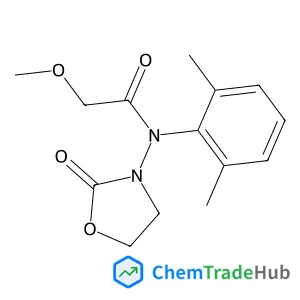
N-(2,6-Dimethylphenyl)-2-methoxy-N-(2-oxo-1,3-oxazolidin-3-yl)acetamide
CAS番号:
77732-09-3
分子式:
C14H18N2O4
おすすめサプライヤー




免責事項
このページに表示される学術雑誌情報は、参考および研究目的のみを目的としています。当社は雑誌出版社とは提携しておらず、投稿の取り扱いも行っておりません。出版に関するお問い合わせは、各雑誌出版社に直接ご連絡ください。
表示されている情報に誤りがある場合は、support@chemtradehub.com までご連絡ください。迅速に確認し、対応いたします。