












A multifunctional Mg2Si monolayer with negative Poisson's ratio and ultrahigh thermoelectric performance at room temperature
文献情報
出版日
2023-11-28
DOI
10.1039/D3TA06260K
インパクトファクター
12.732
著者
Xin Yu, Jiafei Pang, Jingning Zuo, Xiaoyu Kuang, Cheng Lu
原文を見る
要旨
Flexible thermoelectric materials exhibit robust fracture resistance, rendering them highly promising for applications in wearable thermoelectric devices. Here, we design an environmentally friendly two-dimensional (2D) magnesium–silicon monolayer with negative Poisson's ratio and high thermoelectric conversion efficiency by CALYPSO package and first-principles calculations. The calculations indicate that the stable 2D Mg2Si monolayer is a semiconductor with in-plane negative Poisson's ratio of −0.364. The thermoelectric figure of merit (ZT) values of the p-type doped Mg2Si monolayer in the x direction are 2.51 at room temperature and 3.92 at 500 K, exceeding the threshold value of 2.0 for conventional thermoelectric materials. The remarkable thermoelectric performance of the Mg2Si monolayer is attributed to the presence of resonant bonds between magnesium and silicon atoms, as well as the strong coupling between acoustic and optical phonon modes, leading to pronounced phonon anharmonicity. In addition, the four-phonon scattering process also effectively reduces the lattice thermal conductivity. And since a portion of phonon mean free paths are lower than the Ioffe–Regel limit, a two-channel model is considered for calculating the lattice thermal conductivity. These findings offer valuable insights into comprehending the diverse structural, thermoelectric, and mechanical properties of the Mg2Si monolayer, and provide an avenue for the exploration and development of wearable thermoelectric devices.
関連文献
Strong-pump strong-probe spectroscopy: effects of higher excited electronic states
Maxim F. Gelin, Dassia Egorova, Wolfgang Domcke
2013-03-22
Paper
DOI: 10.1039/C3CP44454F
Faceting preferences for AuN and PdN nanoclusters with high-symmetry motifs
Z. Y. Li, Roy L. Johnston
2013-04-15
Paper
DOI: 10.1039/C3CP50978H
Photoinduced electron transfer of platinum(ii) bipyridine diacetylides linked by triphenylamine- and naphthaleneimide-derivatives and their application to photoelectric conversion systems
Yuma Matsumoto, Mai Tsubamoto, Ryoji Sugimura, Masatoshi Kozaki, Kenshi Kimoto, Munetaka Iwamura, Koichi Nozaki, Naoki Senju, Chiasa Uragami, Yohei Muramatsu, Akinori Konno
2013-02-28
Paper
DOI: 10.1039/C3CP50182E
A time resolved high energy X-ray diffraction study of cooling liquid SiO2
C. J. Benmore, M. C. Wilding, S. K. Tumber
2013-04-05
Paper
DOI: 10.1039/C3CP44347G
Atomic pair distribution functions analysis of disordered low-Z materials
V. Petkov, Y. Ren, S. Kabekkodu, D. Murphy
2012-12-13
Paper
DOI: 10.1039/C2CP43378H
Influence of the Ce–Zr promoter on Pd behaviour under dynamic CO/NO cycling conditions: a structural and chemical approach
Anna Kubacka, Ana Iglesias-Juez, M. Di Michiel, Mark A. Newton, Marcos Fernández-García
2013-03-18
Paper
DOI: 10.1039/C3CP44293D
Molecular dynamics investigation of the disordered crystal structure of hexagonal LiBH4
Keith Refson
2013-01-29
Paper
DOI: 10.1039/C3CP44520H
Assessment of density functional methods with correct asymptotic behavior
Chen-Wei Tsai, Yu-Chuan Su, Guan-De Li
2013-03-28
Paper
DOI: 10.1039/C3CP50441G
Oxidation stages of Ni electrodes in solid oxidefuel cell environments
Farid El Gabaly, Kevin F. McCarty, Hendrik Bluhm, Anthony H. McDaniel
2013-04-18
Paper
DOI: 10.1039/C3CP50366F
NMR self-diffusion study of a phosphonium bis(mandelato)borate ionic liquid
Faiz Ullah Shah, Mamoun Taher
2013-04-19
Paper
DOI: 10.1039/C3CP51132D
こちらもおすすめ
化合物よくある質問
2-氟-4-イオドベンzo酸エチルエステルを取り扱う際の実験室安全事項は何ですか?
2-氟-4-イオドベンzo酸エチルエステルは有機溶媒を用いた反応であり、ドラフトチャンバーでの操作が必要です。漏洩時にはSDS参照の安全措置を講じ、PPE(防護...
205750-82-9Benzoic acid, 2-fluo...
化合物よくある質問
血根碱の主な用途は何ですか?
血根碱は主に医薬分野で利用され、抗炎症や抗がん剤としての潜在的な効果が研究されています。また、化学研究や薬物開発において、新しい薬剤設計の参考となる化合物として...
2447-54-313-Methyl[1,3]benzod...
化合物よくある質問
Methyl 3-methoxythiophene-2-carboxylateの主な用途は何ですか?
Methyl 3-メトキシスチフェン-2-カルボン酸メチルエステルは、薬品合成、染料製造、以及合成中間体としての用途が広がっています。
62353-75-7Methyl 3-methoxythio...
化合物よくある質問
丹磺酰-L-亮氨酸はどのように保存すればよいですか?
丹磺酰-L-亮氨酸は乾燥した場所で、直射日光から保護し、低温(室温以下)で保存してください。密閉容器に入れて保管することをおすすめします。
1100-22-7N-{[5-(Dimethylamino...
化合物よくある質問
5-(苄氧基)ピラミジン-4-アミンの代替品はありますか?
5-(苄氧基)ピラミジン-4-アミンの代替品として、6-メトキシピラミジンや5-フェニルピラミジンなどが挙げられます。これらの化合物は、5-(苄氧基)ピラミジン...
92289-50-45-benzyloxypyrimidin...
化合物よくある質問
8-ヒドロキシノルデコペントアセートの物理化学的性質は何ですか?
8-ヒドロキシノルデコペントアセートはCAS番号84807-87-4の化合物で、分子量は750.02 uです。これは油溶性で、水に溶けにくい特徴があります。反応...
84807-87-4(5Z,8Z,11Z,13E,15S)-...
化合物よくある質問
tert-ブチル(エス)-1-ヒドロキシペンタ-4-エン-2-イルカルバamateの主な用途は何ですか?
tert-ブチル(エス)-1-ヒドロキシペンタ-4-エン-2-イルカルバamateは主に医薬品の合成材料や分析化学の試薬として使用されます。
116613-81-12-Methyl-2-propanyl ...
化合物よくある質問
ブコール-L-2-フローヨルブリンについて適切な法規ガイドラインは何ですか?
ブコール-L-2-フローヨルブリン(CAS番号: 1196107-73-9)は、GHS(グローバルハザードアサessmentシステム)に基づく危害分類と表示が求...
1196107-73-92-Bromo-13,13-dimeth...
化合物よくある質問
6-ブロモ-N-環丙基-2-ピリジニニメタンの市場動向や研究トレンドはどうですか
6-ブロモ-N-環丙基-2-ピリジニニメタンは、薬理学研究や合成化学に使用される化合物であり、特に抗ウイルス薬や抗がん薬の開発に注目されています。市場では、薬物...
959237-20-86-Bromo-N-cyclopropy...
化合物よくある質問
RS-AMPÀはどのように保存すればよいですか?
RS-AMPÀは、遮光容器に保存し、室温(15〜25℃)で保管することが推奨されます。高湿や熱は物質を劣化させるため、湿度は50%以下に保つことが重要です。また...
74341-63-2(RS)-AMPA
掲載誌
Journal of Materials Chemistry A

CiteScore:
19.5
自己引用率:
4.7%
年間論文数:
2211
Journal of Materials Chemistry A, B & C cover high quality studies across all fields of materials chemistry. The journals focus on those theoretical or experimental studies that report new understanding, applications, properties and synthesis of materials. The journals have a strong history of publishing quality reports of interest to interdisciplinary communities and providing an efficient and rigorous service through peer review and publication. The journals are led by an international team of Editors-in-Chief and Associate Editors who are all active researchers in their fields. Journal of Materials Chemistry A, B & C are separated by the intended application of the material studied. Broadly, applications in energy and sustainability are of interest to Journal of Materials Chemistry A, applications in biology and medicine are of interest to Journal of Materials Chemistry B, and applications in optical, magnetic and electronic devices are of interest to Journal of Materials Chemistry C. More than one Journal of Materials Chemistry journal may be suitable for certain fields and researchers are encouraged to submit their paper to the journal that they feel best fits for their particular article. Example topic areas within the scope of Journal of Materials Chemistry A are listed below. This list is neither exhaustive nor exclusive. Artificial photosynthesis Batteries Carbon dioxide conversion Catalysis Fuel cells Gas capture/separation/storage Green/sustainable materials Hydrogen generation Hydrogen storage Photocatalysis Photovoltaics Self-cleaning materials Self-healing materials Sensors Supercapacitors Thermoelectrics Water splitting Water treatment
おすすめ化合物
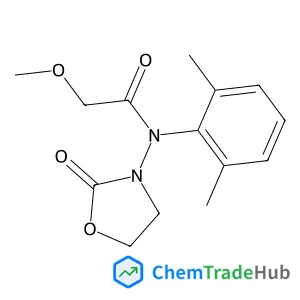
N-(2,6-Dimethylphenyl)-2-methoxy-N-(2-oxo-1,3-oxazolidin-3-yl)acetamide
CAS番号:
77732-09-3
分子式:
C14H18N2O4
おすすめサプライヤー



免責事項
このページに表示される学術雑誌情報は、参考および研究目的のみを目的としています。当社は雑誌出版社とは提携しておらず、投稿の取り扱いも行っておりません。出版に関するお問い合わせは、各雑誌出版社に直接ご連絡ください。
表示されている情報に誤りがある場合は、support@chemtradehub.com までご連絡ください。迅速に確認し、対応いたします。