












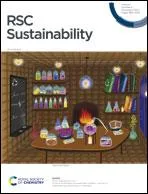
N-doped graphene nanosheets-based optical nano switch for the selective detection of guanine and Pb2+
文献情報
出版日
2023-10-17
DOI
10.1039/D3SU00328K
インパクトファクター
0
著者
Gouri Sankar Das, Manish Srivastava, Kumud Malika Tripathi
原文を見る
要旨
The development of biosensors for the selective detection of Pb2+ and guanine is critical for the elucidation of lead toxicity and human health monitoring. In this research, blue-green luminous water-soluble nitrogen-doped graphene nanosheets (ws-NGNSs) were synthesized from biomass as an optical sensor for guanine and Pb2+ in aqueous media. A facile hydrothermal approach followed by mild oxidation was used for the synthesis of ws-NGNSs, where rotten pear was used as the carbon source and urea was used as the nitrogen source. The ws-NGNSs emitted intense fluorescence at a maximum excitation/emission wavelength of 340/425 nm. The addition of Pb2+ effectively quenched the blue-green emission of ws-NGNSs with prominent selectivity. The selectivity is attributed to the synergic effects of heteroatom doping, surface functional groups, and surface-active sites. Further, ws-NGNSs/Pb2+ was used as a promising fluorescent probe for the selective recognition of guanine. The addition of guanine induced the fluorescence “turn on” effect. Therefore, ws-NGNSs with excellent fluorescence properties can be used as efficient fluorescence “on-off-on” nano-switches for the selective detection and differentiation of Pb2+ and guanine with limits of detection of 8 μM and 0.2 μM, respectively. The possible sensing mechanism is explained using fluorescence and UV-vis spectroscopy. Water-soluble NGNSs have a solid foundation for the fabrication of optical sensors for biomedical and environmental applications.
関連文献
Vertical flow assays based on core–shell SERS nanotags for multiplex prostate cancer biomarker detection
Chengxin Luan
2019-05-13
Paper
DOI: 10.1039/C9AN00733D
Development of pyrene-stacked carbon nanotube-based hybrid: measurement of NO3− ions using fluorescence spectroscopy
Beant Kaur Billing, Mayank, Prabhat K. Agnihotri, Narinder Singh
2018-05-29
Paper
DOI: 10.1039/C8AN00286J
Fluorescence hyperspectral imaging for live monitoring of multiple spheroids in microfluidic chips
Mathieu Masse, Mathias Strupler
2018-07-12
Paper
DOI: 10.1039/C8AN00536B
Volatile organic compound signature from co-culture of lung epithelial cell line with Pseudomonas aeruginosa
Hugo Knobel, Hans Weda, Lieuwe D. Bos, Tamara M. E. Nijsen, Royston Goodacre
2018-06-01
Paper
DOI: 10.1039/C8AN00759D
Hot off the press
Robert A. Hill, Marie Claire Parker
2003-07-09
Hot off the Press Article
DOI: 10.1039/B307118A
こちらもおすすめ
化合物よくある質問
環戊烷-1,3-二甲酸甲酯はどのように合成されますか?
環戊烷-1,3-二甲酸甲酯は、環戊烷と塩酸によるヒンデンブルク反応を経由して合成されます。この反応では、環戊烷が塩酸と作用し、1,3-ジカルボキシ基が導入されま...
2435-36-1Dimethyl 1,3-cyclope...
化合物よくある質問
4-メトキシ-1,2,3-スチアゼ-3,5-ジオンとは何ですか?
4-メトキシ-1,2,3-スチアゼ-3,5-ジオンは、CAS番号107843-77-6の化合物で、(E)-ベンジル3-(3,4-ジヒドロキシフェニル) acry...
107843-77-6(E)-Benzyl 3-(3,4-di...
化合物よくある質問
プロスタグランジンA2について「に適用される法規ガイドラインは何ですか?'
プロスタグランジンA2 (CAS番号: 41691-92-3) は、化学物質の安全管理に関する規制として、GHS (危険物質の国際的ハザード分類・ラベル付けシス...
41691-92-316,16-DIMETHYL PROST...
化合物よくある質問
4-アミノ-1-ナフタレン sulfonic 酸についての物理化学的性質は何ですか?
4-アミノ-1-ナフタレン sulfonic 酸のCAS番号は84-86-6です。この化合物は結晶性で、分子量は212.15 g/molです。アルコールや水など...
84-86-64-Amino-1-naphthalen...
化合物よくある質問
N-GlcNAc-生物素を取り扱う際の実験室安全事項は何ですか?
N-GlcNAc-生物素は吸収性があり、皮膚や目への接触を避けることが重要です。PPE(個体保護具)は使用し、ドラフトチャンバーは必要に応じて使用します。漏洩時...
1272755-69-72-Acetamido-2-deoxy-...
化合物よくある質問
3-アミノメチルフローラノピペリジン-1-カルボニル酸テルブチルエステルとは何ですか?
CAS番号1209781-11-2の3-アミノメチルフローラノピペリジン-1-カルボニル酸テルブチルエステルは、有機化合物の一種で、化学式はC10H17FNO3...
1209781-11-22-Methyl-2-propanyl ...
化合物よくある質問
6-溴-1-甲基-1H-ベンゾ[d][1,2,3]三氮唑はどのように合成されますか?
6- bromo-1-methyl-1H-benzotriazoleは、ブロモフリオリンと1-メチル-1H-ベンゾ[d][1,2,3]三氮唑の反応により合成され...
944718-32-56-Bromo-1-methyl-1H-...
化合物よくある質問
4-硫代尿苷はどのように合成されますか?
4-硫代尿苷は、尿素とD-リボシルヒドロキシアルデヒドを用いてスルホン化反応を経て合成されます。通常は塩酸ヒドロキシチオニルスルホン酸などの触媒を使用し、選択性...
6741-73-71-(4-thio-beta-D-rib...
化合物よくある質問
ブレインナトリユリックペプチド32ラットとは何ですか?
ブレインナトリユリックペプチド32ラット(CAS番号: 133448-20-1)は、心臓で作られるホルモンの一つで、心不全の診断や予後評価に使用されます。
133448-20-1Brain Natriuretic Pe...
化合物よくある質問
1-(3-氮杂啶)-4-羟基哌啶双盐酸盐の物理化学的性質は何ですか?
CAS番号810680-60-5の1-(3-氮杂啶)-4-羟基哌啶双盐酸盐は、白色の結晶性粉末である。分子量は360.84 g/molで、水に溶けやすい。反応活...
810680-60-51-(3-Azetidinyl)-4-p...
掲載誌
おすすめ化合物
![N-[(1S,2R,4S)-2-Amino-4-(dimethylcarbamoyl)cyclohexyl]-N'-(5-chloro-2-pyridinyl)ethanediamide structure](https://static.chemtradehub.com/structs/480/480452-37-7-0898.webp "N-[(1S,2R,4S)-2-Amino-4-(dimethylcarbamoyl)cyclohexyl]-N'-(5-chloro-2-pyridinyl)ethanediamide structure")
おすすめサプライヤー






免責事項
このページに表示される学術雑誌情報は、参考および研究目的のみを目的としています。当社は雑誌出版社とは提携しておらず、投稿の取り扱いも行っておりません。出版に関するお問い合わせは、各雑誌出版社に直接ご連絡ください。
表示されている情報に誤りがある場合は、support@chemtradehub.com までご連絡ください。迅速に確認し、対応いたします。