












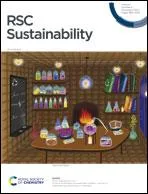
The effects of lignin source and extraction on the composition and properties of biorefined depolymerization products
文献情報
出版日
2023-10-27
DOI
10.1039/D3SU00262D
インパクトファクター
0
著者
Natalia Obrzut, Rob Hickmott, Lily Shure, Kimberly A. Gray
原文を見る
要旨
We explore the efficacy of depolymerization as a function of lignin source and extraction method under the conditions of our previously described biorefinery. Biomass source (i.e. herbaceous, softwood, and hardwood) influences the total available lignin and structural features such as the ratio of monomers (S/G) and the percentage of β-O-4 linkage. The method of extraction (i.e. Milled Wood (mild), Organosolv (medium), and Klason (harsh)) determines levels of solubilization, preservation of the intrinsic lignin structure, and distribution and properties of products. Herbaceous lignin extracted by the Organosolv process is best suited for depolymerization in our biorefinery and shows the greatest extent of solubilization (∼100% over 7 days), the highest yields of phenolics and flavonoids, and the most and smallest lignin nanoparticles. Additionally, this depolymerized product mixture has the highest antioxidant capacity. Only the harsh, Klason method successfully isolates lignin, through carbohydrate conversion, from all three sources, but the herbaceous and hardwood sources are depolymerized to a lesser extent than by the Organosolv method. With low density of labile bonds, softwood lignin is not effectively depolymerized under these conditions. Although modifying intrinsic lignin structure the least, Milled Wood lignin does not efficiently extract lignin from any of the biomass, and the extracted lignin is low in purity inhibiting further processing. These results further detail the promise of herbaceous Organosolv lignin as a renewable feedstock to high value products in a distributed-scale biorefinery.
関連文献
Cyclodehydrogenation of di- and tetra(benzimidazol-2-yl)benzenes to give model heteroaromatic discotic systems
Weicheng Wu, Andrew. C. Grimsdale, Klaus Müllen
2003-04-07
Communication
DOI: 10.1039/B301512M
Influence of substrate on self-assembled photonic crystal
Sachiko I. Matsushita
2004-02-09
Communication
DOI: 10.1039/B313410E
Synthesis and characterization of a benzene-centered, phthalocyanine hexamer
Giovanni Bottari, Tomás Torres
2004-10-14
Communication
DOI: 10.1039/B411960F
Chemistry of materials under extreme high pressure-high-temperature conditions
2003-03-27
Focus
DOI: 10.1039/B300963G
Reduction of nitroaromatics to arylnitrenium ions by vinyl halide cations
Hao Chen, Xubin Zheng, Pengxiang Yang, R. Graham Cooks
2004-02-12
Communication
DOI: 10.1039/B314713D
Highly efficient bromination of aromatic compounds using 3-methylimidazolium tribromide as reagent/solvent
Cinzia Chiappe, Elsa Leandri, Daniela Pieraccini
2004-09-30
Communication
DOI: 10.1039/B410796A
Poly(9,9′-spirobifluorene-manganese porphyrin): a new catalytic material for oxidation of alkenes by iodobenzene diacetate and iodosylbenzene
Cyril Poriel, Yann Ferrand, Paul le Maux, Joëlle Raul-Berthelot, Gerard Simonneaux
2003-04-02
Communication
DOI: 10.1039/B301717F
Doubly N-fused meso-aryl substituted hexaphyrins(1.1.1.1.1.1)
Masaaki Suzuki, Ryuichiro Taniguchi
2004-10-06
Communication
DOI: 10.1039/B410011E
Total synthesis of (+)-belactosin A
Alan Armstrong, James N. Scutt
2004-01-27
Communication
DOI: 10.1039/B316142K
A novel catalyst with high activity for polyhydric alcohol oxidation: nanosilver/zeolite film
Jiang Shen, Wei Shan, Yahong Zhang, Junming Du, Hualong Xu, Kangnian Fan, Wei Shen, Yi Tang
2004-11-15
Communication
DOI: 10.1039/B412986E
こちらもおすすめ
化合物よくある質問
環戊烷-1,3-二甲酸甲酯はどのように合成されますか?
環戊烷-1,3-二甲酸甲酯は、環戊烷と塩酸によるヒンデンブルク反応を経由して合成されます。この反応では、環戊烷が塩酸と作用し、1,3-ジカルボキシ基が導入されま...
2435-36-1Dimethyl 1,3-cyclope...
化合物よくある質問
4-メトキシ-1,2,3-スチアゼ-3,5-ジオンとは何ですか?
4-メトキシ-1,2,3-スチアゼ-3,5-ジオンは、CAS番号107843-77-6の化合物で、(E)-ベンジル3-(3,4-ジヒドロキシフェニル) acry...
107843-77-6(E)-Benzyl 3-(3,4-di...
化合物よくある質問
プロスタグランジンA2について「に適用される法規ガイドラインは何ですか?'
プロスタグランジンA2 (CAS番号: 41691-92-3) は、化学物質の安全管理に関する規制として、GHS (危険物質の国際的ハザード分類・ラベル付けシス...
41691-92-316,16-DIMETHYL PROST...
化合物よくある質問
4-アミノ-1-ナフタレン sulfonic 酸についての物理化学的性質は何ですか?
4-アミノ-1-ナフタレン sulfonic 酸のCAS番号は84-86-6です。この化合物は結晶性で、分子量は212.15 g/molです。アルコールや水など...
84-86-64-Amino-1-naphthalen...
化合物よくある質問
N-GlcNAc-生物素を取り扱う際の実験室安全事項は何ですか?
N-GlcNAc-生物素は吸収性があり、皮膚や目への接触を避けることが重要です。PPE(個体保護具)は使用し、ドラフトチャンバーは必要に応じて使用します。漏洩時...
1272755-69-72-Acetamido-2-deoxy-...
化合物よくある質問
3-アミノメチルフローラノピペリジン-1-カルボニル酸テルブチルエステルとは何ですか?
CAS番号1209781-11-2の3-アミノメチルフローラノピペリジン-1-カルボニル酸テルブチルエステルは、有機化合物の一種で、化学式はC10H17FNO3...
1209781-11-22-Methyl-2-propanyl ...
化合物よくある質問
6-溴-1-甲基-1H-ベンゾ[d][1,2,3]三氮唑はどのように合成されますか?
6- bromo-1-methyl-1H-benzotriazoleは、ブロモフリオリンと1-メチル-1H-ベンゾ[d][1,2,3]三氮唑の反応により合成され...
944718-32-56-Bromo-1-methyl-1H-...
化合物よくある質問
4-硫代尿苷はどのように合成されますか?
4-硫代尿苷は、尿素とD-リボシルヒドロキシアルデヒドを用いてスルホン化反応を経て合成されます。通常は塩酸ヒドロキシチオニルスルホン酸などの触媒を使用し、選択性...
6741-73-71-(4-thio-beta-D-rib...
化合物よくある質問
ブレインナトリユリックペプチド32ラットとは何ですか?
ブレインナトリユリックペプチド32ラット(CAS番号: 133448-20-1)は、心臓で作られるホルモンの一つで、心不全の診断や予後評価に使用されます。
133448-20-1Brain Natriuretic Pe...
化合物よくある質問
1-(3-氮杂啶)-4-羟基哌啶双盐酸盐の物理化学的性質は何ですか?
CAS番号810680-60-5の1-(3-氮杂啶)-4-羟基哌啶双盐酸盐は、白色の結晶性粉末である。分子量は360.84 g/molで、水に溶けやすい。反応活...
810680-60-51-(3-Azetidinyl)-4-p...
掲載誌
おすすめ化合物
おすすめサプライヤー







免責事項
このページに表示される学術雑誌情報は、参考および研究目的のみを目的としています。当社は雑誌出版社とは提携しておらず、投稿の取り扱いも行っておりません。出版に関するお問い合わせは、各雑誌出版社に直接ご連絡ください。
表示されている情報に誤りがある場合は、support@chemtradehub.com までご連絡ください。迅速に確認し、対応いたします。