


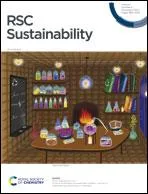
Exploration of bis(pentafluorophenyl)borinic acid as an electronically saturated, bench-top stable Lewis acid catalyst
文献情報
出版日
2023-08-03
DOI
10.1039/D3SU00222E
インパクトファクター
0
著者
Taylor P. L. Cosby, Christopher B. Caputo
原文を見る
要旨
In efforts to develop air- and moisture-stable Lewis acid “frustrated Lewis pair” catalysts, we explored the catalytic reactivity of 9-(bis(perfluorophenyl)boraneyl)-9H-carbazole (1) towards the hydrosilylation of carbonyls. The stability of 1 was followed using nuclear magnetic resonance (NMR) spectroscopy. It was found that 1 cleanly decomposed via hydrolysis to bis(pentafluorophenyl)borinic acid (2). The borinic acid 2 was shown to be stable under ambient atmospheric conditions for upwards of 3 months in the solid-state and 2 weeks dissolved in solution. The Lewis acidity of 2 was evaluated and similarly reactivity towards hydrosilylation was observed. The use of an air-stable, inexpensive, and more sustainable silane, poly(methylhydrosiloxane) (PMHS), affords the reduction of aldehydes to alcohols under atmospheric conditions using 2, emphasizing 2 as a more sustainable, bench-top stable Lewis acid catalyst.
おすすめジャーナル

Journal of Peptide Science

Russian Journal of Coordination Chemistry

Russian Journal of Applied Chemistry

Crystallography Reports

Current Opinion in Solid State & Materials Science

Russian Chemical Bulletin

Current Opinion in Colloid & Interface Science

Russian Journal of General Chemistry

Russian Journal of Organic Chemistry

Organic Process Research & Development
関連文献
1,2,3-Triazole-strapped calix[4]pyrrole: a new membrane transporter for chloride
Matthew G. Fisher, Philip A. Gale, Jennifer R. Hiscock, Michael B. Hursthouse, Mark E. Light, Franz P. Schmidtchen, Christine C. Tong
2009-04-07
Communication
DOI: 10.1039/B904089G
Cyclohexaneoxidation on a novel Ti70Zr10Co20catalyst containing quasicrystal
Baozhong Liu, Shuxia Cai, Fengyu Zhao
2009-05-06
Communication
DOI: 10.1039/B905324G
Hydrogen-bonded dimer stacking induced emission of aminobenzoic acid compounds
Tianlei Zhou, Feng Li, Yan Fan, Weifeng Song, Xiaoyue Mu, Hongyu Zhang, Yue Wang
2009-05-01
Communication
DOI: 10.1039/B900476A
A new PEG-1000-based dicationic ionic liquid exhibiting temperature-dependent phase behavior with toluene and its application in one-pot synthesis of benzopyrans
Huizhen Zhi, Chunxu Lü, Qiang Zhang, Jun Luo
2009-04-06
Communication
DOI: 10.1039/B822481A
Functionalization of fluorous thin films via “click” chemistry
Catherine M. Santos, Amit Kumar, Wen Zhang, Chengzhi Cai
2009-04-09
Communication
DOI: 10.1039/B821148E
The effects of hydrogen bonds on metal-mediated O2activation and related processes
Ryan L. Shook, A. S. Borovik
2008-10-01
Feature Article
DOI: 10.1039/B810957E
Crystal structure determination of the elusive paracetamol Form III
Marc-Antoine Perrin, Marcus A. Neumann, Hagit Elmaleh, Lionel Zaske
2009-04-27
Communication
DOI: 10.1039/B822882E
こちらもおすすめ
化合物よくある質問
6-苄基-6,7-二氢-5H-吡咯并3,4-b吡啶とは何ですか?
6-苄基-6,7-二氢-5H-吡咯并3,4-b吡啶は、CAS番号109966-30-5の化合物です。これは、6-ベンジル基を持つ6,7-二氢-5H-吡咯並みの化...
109966-30-56-Benzyl-6,7-dihydro...
化合物よくある質問
半硫酸奎宁单水水合物はどのように保存すればよいですか?
半硫酸奎宁单水水合物は、乾燥した涼しい場所に保管し、直射日光や湿気を避ける必要があります。保存温度は常温(15〜25℃)が適切で、湿度は40%以下を維持すること...
6119-70-6Quinine sulfate hydr...
化合物よくある質問
D-核糖-5-リン酸二ナトリウムとは何ですか?
D-核糖-5-リン酸二ナトリウムは、CAS番号18265-46-8を有する化合物で、D-核糖の5位付加部位にリン酸基が結合した化合物です。この化合物は、水溶性で...
18265-46-8Disodium (2R,3R,4R)-...
2257-52-5Isopropylhydrazine
化合物よくある質問
3-乙酰基-4-羟基喹啉-2(1H)-酮はどのように合成されますか?
3-乙酰基-4-羟基喹啉-2(1H)-酮は、ハイドロキノンと酢酸アセトイルアミドのアミド化反応により合成されます。この反応は塩基触媒を用いて行われ、選択性は良好...
26138-64-73-Acetyl-4-hydroxyqu...
2280037-51-44-Amino-1-(3-bipheny...
化合物よくある質問
5-溴-4-甲基-1H-吲唑とは何ですか?
5-溴-4-甲基-1H-吲唑は、CAS番号1082041-34-6の化学物質で、化学式はC10H9BrNです。この化合物は淡黄色の結晶性粉末で、吸湿性があります...
1082041-34-65-Bromo-4-methyl-1H-...
化合物よくある質問
3-(4メトキシフェニル)オキテナン-3カーボイル酸の代替品はありますか?
3-(4メトキシフェニル)オキテナン-3カーボイル酸の代替品は、その用途により異なりますが、例えば4-(メトキシフェニル)オキテナン-3カーボイル酸や、他のオキ...
1416323-25-53-(4-Methoxyphenyl)-...
化合物よくある質問
3-イリドオキシピロロ[2,3-b]ピリジン-5-カルボキシlic酸は安全ですか?
3-イリドオキシピロロ[2,3-b]ピリジン-5-カルボキシlic酸は危険な化合物ではありませんが、適切な手袋や保護眼鏡の使用を推奨します。誤って摂取または接触...
1060816-80-93-Iodo-1H-pyrrolo[2,...
化合物よくある質問
3-氟-4- iodobenolを取り扱う際の実験室安全事項は何ですか?
3-氟-4- iodobenolは可燃性を有し、強力な反応性を持つため、取り扱いには注意が必要です。PPE(個人保護具)の着用、ドラフトチャンバーの使用、漏洩時...
122927-84-83-Fluoro-4-iodopheno...
掲載誌
おすすめ化合物
![1-Benzyl-1,7-diazaspiro[4.4]nonane dihydrochloride structure](https://static.chemtradehub.com/structs/115/1159822-71-5-0320.webp "1-Benzyl-1,7-diazaspiro[4.4]nonane dihydrochloride structure")
おすすめサプライヤー




免責事項
このページに表示される学術雑誌情報は、参考および研究目的のみを目的としています。当社は雑誌出版社とは提携しておらず、投稿の取り扱いも行っておりません。出版に関するお問い合わせは、各雑誌出版社に直接ご連絡ください。
表示されている情報に誤りがある場合は、support@chemtradehub.com までご連絡ください。迅速に確認し、対応いたします。