


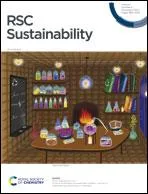
Recent advances in radical polymerization of bio-based monomers in aqueous dispersed media
文献情報
出版日
2023-05-09
DOI
10.1039/D3SU00097D
インパクトファクター
0
著者
Vincent Ladmiral, Sylvain Caillol, Patrick Lacroix-Desmazes
原文を見る
要旨
This review describes the recent research and development progress in the radical polymerization of bio-based monomers in aqueous dispersed media. The previous review on this subject was published in 2019 by S. Molina-Gutiérrez and coworkers (Green Chem., 2019, 21, 36). This topic is constantly evolving and improving because of the need for greener solutions to replace petroleum-derived monomers and more sustainable procedures to generate aqueous dispersions of polymers. For these reasons, we chose not only to update the previous review, but also to emphasize opportunities and constraints and to present considerations about green chemistry to outline the revolution that is arising.
おすすめジャーナル

Saudi Pharmaceutical Journal

Chemistry Education Research and Practice

Russian Journal of Coordination Chemistry

Journal of Natural Medicines

Russian Chemical Bulletin

Organic Process Research & Development

Russian Journal of Organic Chemistry

Russian Journal of General Chemistry

Current Opinion in Solid State & Materials Science

Russian Journal of Bioorganic Chemistry
関連文献
Super-helices self-assembled from a binary system of amphiphilic polypeptideblock copolymers and polypeptide homopolymers
Chunhua Cai, Jiaping Lin, Tao Chen, Xiao-Song Wang, Shaoliang Lin
2009-03-27
Communication
DOI: 10.1039/B823367E
Facile and predictable synthesis of dual mesoporous–mesosize nanostructures through thermally-driven self-assembly of nanodroplets
Pedro Tartaj
2009-04-20
Communication
DOI: 10.1039/B901785B
Asymmetric tandem Michael addition–ylide olefination reaction for the synthesis of optically active cyclohexa-1,3-diene derivatives
Long-Wu Ye, Shou-Bing Wang, Qing-Gang Wang, Xiu-Li Sun, Yong Tang, Yong-Gui Zhou
2009-04-15
Communication
DOI: 10.1039/B900048H
Functionalization of fluorous thin films via “click” chemistry
Catherine M. Santos, Amit Kumar, Wen Zhang, Chengzhi Cai
2009-04-09
Communication
DOI: 10.1039/B821148E
The design, synthesis and evaluation of hypoxia-activated pro-oligonucleotides
Chunyan Tan, Puqin Cai, Peizhuo Zhang, Yufen Zhao
2009-04-23
Communication
DOI: 10.1039/B903331A
A new PEG-1000-based dicationic ionic liquid exhibiting temperature-dependent phase behavior with toluene and its application in one-pot synthesis of benzopyrans
Huizhen Zhi, Chunxu Lü, Qiang Zhang, Jun Luo
2009-04-06
Communication
DOI: 10.1039/B822481A
Facile controlled preparation of gold nanoparticles with amphiphilicthiacalix[4]arene as reductant and stabilizer
Chunlai Tu, Guolin Li, Yunfeng Shi, Xin Yu, Yi Jiang, Qi Zhu, Jiamiao Liang, Yuan Gao, Deyue Yan, Jian Sun
2009-04-29
Communication
DOI: 10.1039/B902033K
Internally referenced analysis of charge-transfer reactions in a new ferrocenyl bithiophenic conducting polymer through cyclic voltammetry
Chuang Peng, Xiaohang Zhou, George Z. Chen, Fabrice Moggia, Frédéric Fages, Hugues Brisset, Jean Roncali
2008-11-13
Communication
DOI: 10.1039/B817101G
Conformationally controlled, thymine-based α-nucleopeptides
Marco Crisma, Cristina Peggion, Alberto Bianco, Fernando Formaggio
2009-04-30
Communication
DOI: 10.1039/B822789F
こちらもおすすめ
化合物よくある質問
6-苄基-6,7-二氢-5H-吡咯并3,4-b吡啶とは何ですか?
6-苄基-6,7-二氢-5H-吡咯并3,4-b吡啶は、CAS番号109966-30-5の化合物です。これは、6-ベンジル基を持つ6,7-二氢-5H-吡咯並みの化...
109966-30-56-Benzyl-6,7-dihydro...
化合物よくある質問
半硫酸奎宁单水水合物はどのように保存すればよいですか?
半硫酸奎宁单水水合物は、乾燥した涼しい場所に保管し、直射日光や湿気を避ける必要があります。保存温度は常温(15〜25℃)が適切で、湿度は40%以下を維持すること...
6119-70-6Quinine sulfate hydr...
化合物よくある質問
D-核糖-5-リン酸二ナトリウムとは何ですか?
D-核糖-5-リン酸二ナトリウムは、CAS番号18265-46-8を有する化合物で、D-核糖の5位付加部位にリン酸基が結合した化合物です。この化合物は、水溶性で...
18265-46-8Disodium (2R,3R,4R)-...
2257-52-5Isopropylhydrazine
化合物よくある質問
3-乙酰基-4-羟基喹啉-2(1H)-酮はどのように合成されますか?
3-乙酰基-4-羟基喹啉-2(1H)-酮は、ハイドロキノンと酢酸アセトイルアミドのアミド化反応により合成されます。この反応は塩基触媒を用いて行われ、選択性は良好...
26138-64-73-Acetyl-4-hydroxyqu...
2280037-51-44-Amino-1-(3-bipheny...
化合物よくある質問
5-溴-4-甲基-1H-吲唑とは何ですか?
5-溴-4-甲基-1H-吲唑は、CAS番号1082041-34-6の化学物質で、化学式はC10H9BrNです。この化合物は淡黄色の結晶性粉末で、吸湿性があります...
1082041-34-65-Bromo-4-methyl-1H-...
化合物よくある質問
3-(4メトキシフェニル)オキテナン-3カーボイル酸の代替品はありますか?
3-(4メトキシフェニル)オキテナン-3カーボイル酸の代替品は、その用途により異なりますが、例えば4-(メトキシフェニル)オキテナン-3カーボイル酸や、他のオキ...
1416323-25-53-(4-Methoxyphenyl)-...
化合物よくある質問
3-イリドオキシピロロ[2,3-b]ピリジン-5-カルボキシlic酸は安全ですか?
3-イリドオキシピロロ[2,3-b]ピリジン-5-カルボキシlic酸は危険な化合物ではありませんが、適切な手袋や保護眼鏡の使用を推奨します。誤って摂取または接触...
1060816-80-93-Iodo-1H-pyrrolo[2,...
化合物よくある質問
3-氟-4- iodobenolを取り扱う際の実験室安全事項は何ですか?
3-氟-4- iodobenolは可燃性を有し、強力な反応性を持つため、取り扱いには注意が必要です。PPE(個人保護具)の着用、ドラフトチャンバーの使用、漏洩時...
122927-84-83-Fluoro-4-iodopheno...
掲載誌
おすすめ化合物
![trans-2-{[(Tert-butoxy)carbonyl]amino}cyclobutane-1-carboxylic acid structure](https://static.chemtradehub.com/structs/951/951173-25-4-27cd.webp "trans-2-{[(Tert-butoxy)carbonyl]amino}cyclobutane-1-carboxylic acid structure")
おすすめサプライヤー




免責事項
このページに表示される学術雑誌情報は、参考および研究目的のみを目的としています。当社は雑誌出版社とは提携しておらず、投稿の取り扱いも行っておりません。出版に関するお問い合わせは、各雑誌出版社に直接ご連絡ください。
表示されている情報に誤りがある場合は、support@chemtradehub.com までご連絡ください。迅速に確認し、対応いたします。