













Cylindrical brushes with ionized side chains: Scaling theory revisited
文献情報
出版日
2023-10-26
DOI
10.1039/D3SM00727H
インパクトファクター
3.679
著者
Ekaterina B. Zhulina
原文を見る
要旨
We revisit the classic scaling model of a cylindrical polyelectrolyte (PE) brush focusing on molecular brushes with stiff backbones and dispersions of polymer-decorated nanorods. Based on the blob representation we demonstrate that similarly to the case of planar PE brushes, separation of intra- and intermolecular repulsions between charges leads to novel scaling regimes for cylindrical PE brushes in salt-added solution and a sharper decrease in its thickness versus salt concentration dependence. These theoretical predictions may inspire further comprehensive experimental research and computer simulations of synthetic and biopolyelectrolyte cylindrical brushes.
関連文献
A unified diabatic description for electron transfer reactions, isomerization reactions, proton transfer reactions, and aromaticity
Ross H. McKenzie
2015-07-08
Paper
DOI: 10.1039/C5CP02236C
Effects of halogen doping on nanocarbon catalysts synthesized by a solution plasma process for the oxygen reduction reaction
Yuta Wada, Satoshi Chiba, Sou Kumagai, Hoonseung Lee, Ai Serizawa, Oi Lun Li, Gasidit Panomsuwan
2016-07-08
Paper
DOI: 10.1039/C6CP03579E
Computational simulation and interpretation of the low-lying excited electronic states and electronic spectrum of thioanisole
Shaohong L. Li, Xuefei Xu, Donald G. Truhlar
2015-06-05
Paper
DOI: 10.1039/C5CP02461G
Step dynamics and oxide formation during CO oxidation over a vicinal Pd surface
Mikhail Shipilin, Johan Gustafson, Chu Zhang, Lindsay Richard Merte, Edvin Lundgren
2016-01-20
Paper
DOI: 10.1039/C5CP07488F
Facile synthesis of S, N co-doped carbon dots and investigation of their photoluminescence properties
Yue Zhang, Junhui He
2015-07-16
Paper
DOI: 10.1039/C5CP03498A
Facile synthesis of SnO2 nanocrystals anchored onto graphene nanosheets as anode materials for lithium-ion batteries
Yanjun Zhang, Li Jiang, Chunru Wang
2015-07-08
Communication
DOI: 10.1039/C5CP03305E
Excited state structural evolution during charge-transfer reactions in betaine-30
W. Ruchira Silva, Renee R. Frontiera
2016-01-04
Paper
DOI: 10.1039/C5CP06195D
Facile hydrothermal synthesis of NiMoO4@CoMoO4 hierarchical nanospheres for supercapacitor applications
2015-07-13
Paper
DOI: 10.1039/C5CP03331D
Self-healing dynamic bond-based rubbers: understanding the mechanisms in ionomeric elastomer model systems
N. Hohlbein, A. Shaaban, A. R. Bras, W. Pyckhout-Hintzen, A. M. Schmidt
2015-07-03
Paper
DOI: 10.1039/C5CP00620A
こちらもおすすめ
化合物よくある質問
1-{3-[5-(エチルカルボンイル)-2,4-ジメチル-1H-ピロロール-3-基]プロパニル}ピペリジン-4-カルボン酸について、適用される法規ガイドラインは何ですか?
この化合物はCAS番号1142209-81-1であり、GHS分類では corrosive (腐食性物質) と classified (分類物質) として指定され...
1142209-81-11-{3-[5-(Ethoxycarbo...
化合物よくある質問
2,2-二氟-1,3-ベンゾジオキサン-5-カルボキシlic酸とは何ですか?
2,2-二氟-1,3-ベンゾジオキサン-5-カルボキシlic酸は、CAS番号656-46-2の化合物で、化学式はC8H4F2O4です。この化合物は白色の結晶性粉...
656-46-22,2-Difluoro-1,3-ben...
化合物よくある質問
8-氯-4-色原酮の代替品はありますか?
8-氯-4-色原酮(CAS番号: 49701-11-3)の代替品には、他の色原酮類似物や、構造が似ている化合物があります。例えば、8-メチル-4-色原酮や、他の...
49701-11-38-Chloro-2,3-dihydro...
化合物よくある質問
エチル6,6-ジメチル-4,5,6,7-テトラヒドロ-1H-インドアゼー-3-カルボキシレートとは何ですか?
エチル6,6-ジメチル-4,5,6,7-テトラヒドロ-1H-インドアゼー-3-カルボキシレートは、CAS番号1233243-56-5を有する化合物です。これは有...
1233243-56-5Ethyl 6,6-dimethyl-4...
化合物よくある質問
4-叔丁基-6-氯-嘧啶に適用される法規ガイドラインは何ですか?
4-叔丁基-6-氯-嘧啶はCAS番号3435-24-3で、GHS分類では毒性物質とみなし、GHSの危険性分類が適用されます。REACH規則では登録が必要で、Eu...
3435-24-34-Tert-butyl-6-chlor...
化合物よくある質問
維库溴铵杂质Bはどのように合成されますか?
維库溴铵杂质Bは、アンドロステンデンから始まり、一連の合成反応、包括的な選択性と高い収率で合成されます。具体的には、ブロミド化、酸化、ジマーゼ反応、アミド化など...
50587-95-6(2beta,3alpha,5alpha...
化合物よくある質問
2-(4-氟苄基)-吡咯烷の物理化学的性質は何ですか?
CAS番号350017-04-8の2-(4-氟苄基)-吡咯烷は、結晶性の白色粉末です。分子量は199.17 g/molで、水に溶けにくいです。化学反応では比較的...
350017-04-82-(4-Fluorobenzyl)py...
化合物よくある質問
3-喹啉甲醛(2-チロール-8-エチル)は安全ですか?
3-喹啉甲醛(2-チロール-8-エチル)は一定の毒性を持つため、取扱には注意が必要です。使用する際は適切な防護具を着用し、密閉容器で保管・搬送し、直接的な接触を...
335196-05-92-Chloro-8-ethyl-3-q...
化合物よくある質問
エチル3-(ヒドロキシメチル)-1H-ピロール-2-カルボキシレートはどのように保存すればよいですか?
エチル3-(ヒドロキシメチル)-1H-ピロール-2-カルボキシレートは、室温(25℃)以下で保存し、直射日光を避け、乾燥した環境で保管することが推奨されます。ま...
75448-69-0Ethyl 3-(hydroxymeth...
119410-05-88-Chloro-11-(4-piper...
掲載誌
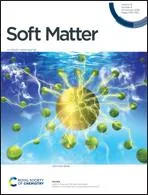
Soft Matter
CiteScore:
6
自己引用率:
10.3%
年間論文数:
856
Soft Matter provides a unique forum for the communication of significant advances in interdisciplinary soft matter research. There is a particular focus on the interface between chemistry, physics, materials science, biology and chemical engineering. Research may report new soft materials or phenomena, encompass their design, synthesis, and use in new applications; or provide fundamental insight and observations on their behaviour. Experimental, theoretical and computational soft matter approaches are encouraged. The scope of Soft Matter covers the following. Soft matter assemblies, including colloids, granular matter, liquid crystals, gels & networks, polymers, hybrid materials, active matter and further examples Soft nanotechnology, soft robotics and devices Synthesis, self-assembly and directed assembly Biological aspects of soft matter including proteins, biopolymers, cells and tissues Surfaces, interfaces and interactions Phase behaviour, coacervation and rheological behaviour Sustainable soft materials including recycling, circular economy and end of life Mechanistic insights and modelling
おすすめ化合物



おすすめサプライヤー







免責事項
このページに表示される学術雑誌情報は、参考および研究目的のみを目的としています。当社は雑誌出版社とは提携しておらず、投稿の取り扱いも行っておりません。出版に関するお問い合わせは、各雑誌出版社に直接ご連絡ください。
表示されている情報に誤りがある場合は、support@chemtradehub.com までご連絡ください。迅速に確認し、対応いたします。