












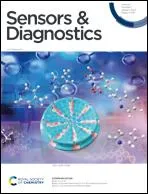

Recent advances in DNA-based electrogenerated chemiluminescence biosensors
文献情報
出版日
2023-03-14
DOI
10.1039/D3SD00027C
インパクトファクター
0
著者
Jingfeng Zhu
原文を見る
要旨
Electrogenerated chemiluminescence (also called electrochemiluminescence and abbreviated as ECL) has witnessed significant development in fields ranging from biological analysis to clinical diagnosis due to its outstanding advantages such as high sensitivity, wide detection range, and low background signal. DNA, a class of biopolymers with programmable self-assembly and molecular recognition functions, is a significant tool in the field of ECL bioanalysis. Benefiting from the unique structures and excellent properties of DNA, DNA-based ECL biosensors have aroused increasing attention. In this review, we summarize and classify the signal output mode of DNA-based ECL biosensors and introduce the different methods for the immobilization of DNA probes on electrodes. In addition, we discuss the recent progress and applications of DNA-based ECL biosensors, including the detection of nucleic acids, proteins, and small biomolecules. Finally, we present a brief summary and prospects in this field.
関連文献
Radiation chemistry of solid acetone in the interstellar medium – a new dimension to an old problem
2017-11-07
Paper
DOI: 10.1039/C7CP06431D
Strain-induced modulations of electronic structure and electron–phonon coupling in dense H3S
Chang Liu, Hang Zhai, Ying Sun, Weiguang Gong, Yan Yan, Quan Li, Weitao Zheng
2018-01-29
Paper
DOI: 10.1039/C8CP00205C
Osmotic contribution to the flow-driven tube formation of copper–phosphate and copper–silicate chemical gardens
Evelin Rauscher, Gábor Schuszter, Bíborka Bohner, Ágota Tóth, Dezső Horváth
2018-01-23
Paper
DOI: 10.1039/C7CP08282G
Modulation of electronic and magnetic properties of edge hydrogenated armchair phosphorene nanoribbons by transition metal adsorption
Yong-Chao Rao, Peng Zhang, Shun-Fang Li, Xiang-Mei Duan, Su-Huai Wei
2018-04-13
Paper
DOI: 10.1039/C8CP00880A
Aerogen bonds formed between AeOF2 (Ae = Kr, Xe) and diazines: comparisons between σ-hole and π-hole complexes
Wiktor Zierkiewicz, Mariusz Michalczyk, Steve Scheiner
2018-01-10
Paper
DOI: 10.1039/C7CP08048D
2-Chloromalonaldehyde, a model system of resonance-assisted hydrogen bonding: vibrational investigation
Michèle Chevalier, Justinas Ceponkus, Germán A. Rojas-Lorenzo, Claudine Crépin
2018-04-16
Paper
DOI: 10.1039/C7CP06481K
Mediating both valence and conduction bands of TiO2 by anionic dopants for visible- and infrared-light photocatalysis
Tingwei Chen, Guokui Liu, Fan Jin, Min Wei, Jin Feng, Yuchen Ma
2018-04-04
Paper
DOI: 10.1039/C8CP00895G
Liquid worm-like and proto-micelles: water solubilization in amphiphile–oil solutions
Baofu Qiao, Kenneth C. Littrell, Ross J. Ellis
2018-04-10
Paper
DOI: 10.1039/C8CP00600H
An organoferroelasticity driven by molecular conformational change
Sajjad Husain Mir, Satoshi Takamizawa
2017-12-04
Communication
DOI: 10.1039/C7CP07206F
An experimental and theoretical study of adenine adsorption on Au(111)
Robert G. Acres, Xun Cheng, Sofiia Bercha, Tomáš Skála, Vladimír Matolín, Ye Xu, Kevin C. Prince, Nataliya Tsud
2018-01-19
Paper
DOI: 10.1039/C7CP08102B
こちらもおすすめ
化合物よくある質問
2-ヒドロキシ-5-ニトロベンジンブロモイドの代替品はありますか?
2-ヒドロキシ-5-ニトロベンジンブロモイドは特定の化学反応に適しているため、代替品は限られています。しかし、同様の構造を持つ2-ヒドロキシ-4-ニトロベンジン...
772-33-82-(Bromomethyl)-4-ni...
化合物よくある質問
N-(2-ブロモフェニル)-1-チロール-3-オキソ-3-(ピペリジニル)プロペン-2-イル)ベンゼンアミドを取り扱う際の実験室安全事項は何ですか?
N-(2-ブロモフェニル)-1-チロール-3-オキソ-3-(ピペリジニル)プロペン-2-イル)ベンゼンアミドは有毒で、皮膚や粘膜に刺激を与える可能性があります。...
1800044-77-2N-[(1Z)-1-(2-Bromoph...
化合物よくある質問
1,3プロパンジオール,2-[2-(2アミノ-6クロロ-9Hピリミジン-9-イル)エチル-1,1,2,2-D4]-2,3-ジアセタートの市場動向や研究トレンドはどうですか?
この化合物は、新規治療薬の開発に注目されています。市場では、その有効性と安全性が評価され、研究分野では、分子生物学と医薬化学の新たな発見が期待されています。
1020718-81-31,3-Propanediol, 2-[...
579-44-2Ethanone, 2-hydroxy-...
化合物よくある質問
Succinimidyl-alanyl-phenylalanyl-prolyl-phenylalanine 4-nitroanilide はどの業界で使用されていますか?
Succinimidyl-alanyl-phenylalanyl-prolyl-phenylalanine 4-nitroanilide は主に医薬品開発やポ...
128802-73-3succinimidyl-alanyl-...
化合物よくある質問
メチル6-アミノ-5-クロロピリジン-2-カーボイル酸について、適用される法規ガイドラインは何ですか?
メチル6-アミノ-5-クロロピリジン-2-カーボイル酸(CAS番号: 1256794-05-4)の使用には、GHS( Globally Harmonized S...
1256794-05-4Methyl 6-amino-5-chl...
化合物よくある質問
エチル4-(シクロ Pentagonyl)アミノ-2-メチル硫化基ピリミジン-5-カルボキシレートを取り扱う際の実験室安全事項は何ですか?
取り扱いには、耐薬品性の容器を使用し、通気性の良い場所で操作することを推奨します。漏れ時は、SDS(安全データシート)を参照して適切な措置を取ること。手洗いと洗...
211245-62-4ethyl 4-(cyclopentyl...
化合物よくある質問
(S)-3-ベンZYルピペリジン塩酸塩とは何ですか?
(S)-3-ベンZYルピペリジン塩酸塩は、CAS番号1258940-00-9で表される化合物です。これは、(S)-3-苯基哌啶的盐酸盐であり、主に医薬品の原料と...
1258940-00-9(S)-3-Phenylpiperidi...
化合物よくある質問
3,5-二甲基金剛胺の主な用途は何ですか?
3,5-二甲基金剛胺は、主に医薬品の原料として使用され、また抗うつ薬や抗アルツハイマー薬の開発に利用されます。さらに、化粧品や食品添加物の製造でも重要な役割を果...
19988-45-52-(2,3-Dihydroxyphen...
化合物よくある質問
ビス(4-メチル-2-ペンチル)フェニルカルボン酸エステルの代替品はありますか?
ビス(4-メチル-2-ペンチル)フェニルカルボン酸エステル (CAS番号: 1398066-13-1) の代替品には、ビス(2-エチルヘキシル)フェノールカルボ...
1398066-13-1Bis(4-methyl-2-penty...
掲載誌
おすすめ化合物
![5-Methyl-4,5,6,7-tetrahydropyrazolo[1,5-a]pyrazin-2-amine structure](https://static.chemtradehub.com/structs/122/1227210-33-4-8d64.webp "5-Methyl-4,5,6,7-tetrahydropyrazolo[1,5-a]pyrazin-2-amine structure")
![1-[3-(4-Morpholinylsulfonyl)phenyl]methanamine structure](https://static.chemtradehub.com/structs/933/933989-32-3-51af.webp "1-[3-(4-Morpholinylsulfonyl)phenyl]methanamine structure")
おすすめサプライヤー




免責事項
このページに表示される学術雑誌情報は、参考および研究目的のみを目的としています。当社は雑誌出版社とは提携しておらず、投稿の取り扱いも行っておりません。出版に関するお問い合わせは、各雑誌出版社に直接ご連絡ください。
表示されている情報に誤りがある場合は、support@chemtradehub.com までご連絡ください。迅速に確認し、対応いたします。