












Facile synthesis of 1,2-aminoalcohols via α-C–H aminoalkylation of alcohols by photoinduced hydrogen-atom transfer catalysis
文献情報
出版日
2023-11-16
DOI
10.1039/D3SC05305A
インパクトファクター
9.825
著者
Joaquim Caner, Akira Matsumoto
原文を見る
要旨
1,2-Aminoalcohols are common motifs found in a wide range of natural products and pharmaceutical compounds. Here we report a photocatalytic method for the direct conversion of readily available aliphatic alcohols into synthetically valuable 1,2-aminoalcohols. A dual catalytic system consisting of an acridinium photoredox catalyst and a cationic hydrogen-atom transfer (HAT) catalyst based on 1,4-diazabicyclo[2.2.2]octane (DABCO) enables an efficient and site-selective HAT from the α-C–H bonds of unprotected primary and secondary alcohols. The subsequent radical addition to a newly designed chiral N-sulfinyl α-iminoester afforded various 1,2-aminoalcohols, including enantiomerically enriched ones, under mild photochemical conditions with high atom and step economy.
関連文献
Electrochemical oxidation of double-stranded polybisnorbornenes containing linearly aligned ferrocene linkers
Cheng-Lan Lin, Hui-Chun Yang, Nai-Ti Lin, I-Jui Hsu, Yu Wang, Tien-Yau Luh
2008-07-30
Communication
DOI: 10.1039/B808958B
Hydrous zinc halide-catalyzed aminosulfonation of hydrocarbons
Biswajit Kalita, Angus A. Lamar, Kenneth M. Nicholas
2008-08-05
Communication
DOI: 10.1039/B805783D
Diol-substituted boron complexes of dipyrrolyl diketones as anion receptors and covalently linked ‘pivotal’ dimers
Yasunobu Fujii, Yuta Mihashi
2008-07-16
Communication
DOI: 10.1039/B806361C
Energetics of conformational conversion between 1,1,2-trichloroethane polymorphs
Maciej Bujak, Marcin Podsiadło, Andrzej Katrusiak
2008-07-22
Communication
DOI: 10.1039/B807372D
An organopalladium chromogenic chemodosimeter for the selective naked-eye detection of Hg2+ and MeHg+ in water–ethanol 1 : 1 mixture
O. del Campo, A. Carbayo, J. V. Cuevas, A. Muñoz, G. García-Herbosa, D. Moreno, E. Ballesteros, S. Basurto, T. Gómez, T. Torroba
2008-08-05
Communication
DOI: 10.1039/B807670G
An electrochemical sensor for 3,4-dihydroxyphenylacetic acid with carbon nanotubes as electronic transducer and synthetic cyclophane as recognition element
Jie Yan, Yucheng Zhou, Ping Yu, Lei Su, Lanqun Mao, Deqing Zhang, Daoben Zhu
2008-07-17
Communication
DOI: 10.1039/B805958F
Activatable imaging probes with amplified fluorescent signals
Seulki Lee, Kyeongsoon Park, Kwangmeyung Kim, Kuiwon Choi, Ick Chan Kwon
2008-07-25
Feature Article
DOI: 10.1039/B806854M
State-resolved UV photofragmentation spectrum of the metal dication complex [Zn(pyridine)4]2+
Guohua Wu, Caroline Norris, Hamish Stewart, Hazel Cox, Anthony J. Stace
2008-07-11
Communication
DOI: 10.1039/B806469E
Ni(ii)-catalyzed enantioselective Nazarov cyclizations
Irene Walz, Antonio Togni
2008-07-17
Communication
DOI: 10.1039/B806870D
Model systems for flavoenzyme activity: intramolecular self-assembly of a flavin derivative viahydrogen bonding and aromatic interactions
Stuart T. Caldwell, Graeme Cooke, Shanika G. Hewage, Suhil Mabruk, Gouher Rabani, Vincent Rotello, Brian O. Smith, Chandramouleeswaran Subramani, Patrice Woisel
2008-08-01
Communication
DOI: 10.1039/B809762C
こちらもおすすめ
化合物よくある質問
2-ブロモ-9,9-ジフェニル-9H-フルオレンの主な用途は何ですか?
2-溴-9,9-二苯基芴は、医薬品、工業材料、有機合成の研究分野で応用されます。特に、レーザー材料や機能性ポリマーの合成に使用されることがあります。また、蛍光色...
474918-32-62-Bromo-9,9-diphenyl...
化合物よくある質問
四氯化铱の市場動向や研究トレンドはどうですか?
四氯化铱の市場は研究開発分野で注目されており、特にナノ技術や金属有機框架(MOFs)の分野での需要が増加傾向にあります。価格は安定しており、中国や韓国での生産が...
207399-11-9Tetrachloroiridium h...
882-06-44-Nitrocinnamic acid
化合物よくある質問
1-(4-溴-3-氟苯基)-2-氯乙酮を含む廃棄物はどのように処理すべきですか?
1-(4-溴-3-氟苯基)-2-氯乙酮 (CAS番号: 1260857-14-4) の廃棄物は専門的な廃棄処理が必要です。まず、廃棄物は密閉された容器に収集し、...
1260857-14-41-(4-Bromo-3-fluorop...
化合物よくある質問
苦参酚Kとは何ですか?
苦参酚Kは、CAS番号101236-49-1を持つ化合物で、主に天然由来の生薬から抽出されます。この化合物は、抗炎症作用や抗癌作用を持つことが報告されています。
101236-49-1Kushenol K
化合物よくある質問
POTASSIUM (1-(TERTBUTOXYCARBONYL)AZETIDIN-3-YL)TRIFLUOROBORATE を含む廃棄物はどのように処理すべきですか?
POTASSIUM (1-(TERTBUTOXYCARBONYL)AZETIDIN-3-YL)TRIFLUOROBORATE を含む廃棄物は、まず安全なエント...
1430219-73-0Potassium (1-(tert-b...
化合物よくある質問
4-庚基-4’-联苯羧酸の市場動向や研究トレンドはどうですか?
4-庚基-4’-聯苯羧酸は、特殊化学品や合成化学の分野で用いられる化学物質ですが、市場動向としては、研究開発の進展とともに需要が増加しています。また、環境配慮型...
58573-94-74'-Heptyl-4-biphenyl...
化合物よくある質問
6-ブロモ-3-メトキシ-1-フェニル-1H-インドゾールを含む廃棄物はどのように処理すべきですか?
6-ブロモ-3-メトキシ-1-フェニル-1H-インドゾールを含む廃棄物は、適切な化学廃棄処理が必要です。通常、廃棄物は密閉容器に収集され、専門の廃棄処理業者に引...
1332527-03-36-Bromo-3-methoxy-1-...
化合物よくある質問
4,4-二甲基-2-吡咯烷酮はどの業界で使用されていますか?
4,4-二甲基-2-吡咯烷酮は医薬、ポリマー、センサー、半導体などの業界で広く使用されています。特に溶媒としての性能が高く評価されています。
66899-02-34,4-dimethylpyrrolid...
51312-42-6Sodium Phosphotungst...
掲載誌
Chemical Science
CiteScore:
14.4
自己引用率:
3.9%
年間論文数:
1413
Our journal has a wide-ranging scope which covers the full breadth of the chemical sciences. The research we publish contains the sorts of novel ideas, challenging questions and progressive thinking that bring undiscovered breakthroughs within reach. Your paper could focus on a single area, or cross many. It could be beyond the accepted bounds of the chemical sciences. It might address an immediate challenge, contribute to a future breakthrough or be wholly conceptual. We’re a team from every field of the chemical sciences, and know from experience that breakthroughs that drive the solutions to global challenges can come from anywhere, at any time. You could even start an entirely new area of research. Too bold? Too progressive? No such thing
おすすめ化合物
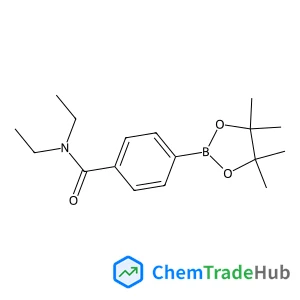
N,N-Diethyl-4-(4,4,5,5-tetramethyl-1,3,2-dioxaborolan-2-yl)benzamide
CAS番号:
325142-99-2
分子式:
C17H26BNO3
![tert-Butyl N-[(2-chloropyridin-4-yl)methyl]carbamate structure](https://static.chemtradehub.com/structs/916/916210-27-0-9f95.webp "tert-Butyl N-[(2-chloropyridin-4-yl)methyl]carbamate structure")
おすすめサプライヤー






免責事項
このページに表示される学術雑誌情報は、参考および研究目的のみを目的としています。当社は雑誌出版社とは提携しておらず、投稿の取り扱いも行っておりません。出版に関するお問い合わせは、各雑誌出版社に直接ご連絡ください。
表示されている情報に誤りがある場合は、support@chemtradehub.com までご連絡ください。迅速に確認し、対応いたします。