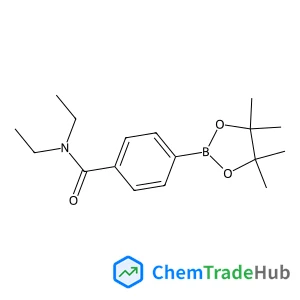
N,N-Diethyl-4-(4,4,5,5-tetramethyl-1,3,2-dioxaborolan-2-yl)benzamide
CAS番号:
325142-99-2
分子式:
C17H26BNO3
Xianzhu Luo, Cuiling Zhang, Chenyang Yue, Yuelin Jiang, Fei Yang, Yuezhong Xian
Ischemia–reperfusion-induced cardiomyocyte mortality constitutes a prominent contributor to global morbidity and mortality. However, early diagnosis and preventive treatment of cardiac I/R injury remains a challenge. Given the close relationship between ferroptosis and I/R injury, monitoring their pathological processes holds promise for advancing early diagnosis and treatment of the disease. Herein, we report a near-infrared (NIR) light-activated dual-responsive nanoprobe (UCNP@mSiO2@SP-NP-NAP) for controllable detection of hydrogen polysulfide (H2Sn) and sulfur dioxide (SO2) during ferroptosis-related myocardial I/R injury. The nanoprobe's responsive sites could be activated by NIR and Vis light modulation, reversibly alternating for at least 5 cycles. We employed the nanoprobe to monitor the fluctuation levels of H2Sn and SO2 in H9C2 cardiomyocytes and mice, revealing that H2Sn and SO2 levels were up-regulated during I/R. The NIR light-activated dual-responsive nanoprobe could be a powerful tool for myocardial I/R injury diagnosis. Moreover, we also found that inhibiting the initiation of the ferroptosis process contributed to attenuating cardiac I/R injury, which indicated great potential for treating I/R injury.
DOI: 10.1039/B807629D
Saad Makhseed, Jacob Samuel
DOI: 10.1039/B805656K
Cheng-Lan Lin, Hui-Chun Yang, Nai-Ti Lin, I-Jui Hsu, Yu Wang, Tien-Yau Luh
DOI: 10.1039/B808958B
Xueguang Wang, Hajime Kawanami, Nazrul M. Islam, Maya Chattergee, Toshirou Yokoyama, Yutaka Ikushima
DOI: 10.1039/B808201D
Hua Wei, Cui-yun Yu, Cong Chang, Chang-yun Quan, Shao-bo Mo, Si-xue Cheng, Xian-zheng Zhang, Ren-xi Zhuo
DOI: 10.1039/B811553B
Zhe Li, Yonggang Ke, Chenxiang Lin, Hao Yan, Yan Liu
DOI: 10.1039/B807933A
Anthony J. Kirby, Bruno S. Souza, Michelle Medeiros, Jacks P. Priebe, Alex M. Manfredi, Faruk Nome
DOI: 10.1039/B810408E
Catherine Bonnier, Warren E. Piers, Masood Parvez, Ted S. Sorensen
DOI: 10.1039/B808739C
Guohua Wu, Caroline Norris, Hamish Stewart, Hazel Cox, Anthony J. Stace
DOI: 10.1039/B806469E
Jared Skey, Rachel K. O’Reilly
DOI: 10.1039/B804260H
2-溴-9,9-二苯基芴は、医薬品、工業材料、有機合成の研究分野で応用されます。特に、レーザー材料や機能性ポリマーの合成に使用されることがあります。また、蛍光色...
四氯化铱の市場は研究開発分野で注目されており、特にナノ技術や金属有機框架(MOFs)の分野での需要が増加傾向にあります。価格は安定しており、中国や韓国での生産が...
1-(4-溴-3-氟苯基)-2-氯乙酮 (CAS番号: 1260857-14-4) の廃棄物は専門的な廃棄処理が必要です。まず、廃棄物は密閉された容器に収集し、...
苦参酚Kは、CAS番号101236-49-1を持つ化合物で、主に天然由来の生薬から抽出されます。この化合物は、抗炎症作用や抗癌作用を持つことが報告されています。
POTASSIUM (1-(TERTBUTOXYCARBONYL)AZETIDIN-3-YL)TRIFLUOROBORATE を含む廃棄物は、まず安全なエント...
4-庚基-4’-聯苯羧酸は、特殊化学品や合成化学の分野で用いられる化学物質ですが、市場動向としては、研究開発の進展とともに需要が増加しています。また、環境配慮型...
6-ブロモ-3-メトキシ-1-フェニル-1H-インドゾールを含む廃棄物は、適切な化学廃棄処理が必要です。通常、廃棄物は密閉容器に収集され、専門の廃棄処理業者に引...
4,4-二甲基-2-吡咯烷酮は医薬、ポリマー、センサー、半導体などの業界で広く使用されています。特に溶媒としての性能が高く評価されています。
Our journal has a wide-ranging scope which covers the full breadth of the chemical sciences. The research we publish contains the sorts of novel ideas, challenging questions and progressive thinking that bring undiscovered breakthroughs within reach. Your paper could focus on a single area, or cross many. It could be beyond the accepted bounds of the chemical sciences. It might address an immediate challenge, contribute to a future breakthrough or be wholly conceptual. We’re a team from every field of the chemical sciences, and know from experience that breakthroughs that drive the solutions to global challenges can come from anywhere, at any time. You could even start an entirely new area of research. Too bold? Too progressive? No such thing