












From non-conductive MOF to proton-conducting metal-HOFs: a new class of reversible transformations induced by solvent-free mechanochemistry
文献情報
出版日
2023-11-27
DOI
10.1039/D3SC04401G
インパクトファクター
9.825
著者
Marcin Oszajca, Dariusz Matoga
原文を見る
要旨
Proton-conducting materials play an important role as solid electrolytes in electrochemical devices for energy storage and conversion, including proton exchange membrane fuel cells. Metal–organic frameworks (MOFs), covalent-organic frameworks (COFs) and more recently hydrogen-bonded organic frameworks (HOFs) have emerged as useful crystalline platforms for proton transport that provide high conductivity and enable insight into conduction pathways. Here, we present two new HOFs with high conductivity, reaching 2 × 10⁻² S cm−1 at 60 °C and 75% relative humidity, obtained in reactions that represent a new class of reversible transformations of solids. The reactions are induced by solvent-free mechanochemistry and involve breaking of coordination linkages in a MOF and formation of extended hydrogen-bonded networks of metal-HOFs (MHOFs). This unprecedented class of MOF-to-MHOF transformations has been demonstrated using a non-conductive MOF (JUK-1) and formamidinium or methylammonium thiocyanates as solid reactants. Structural details of the solid-state reactions are revealed by powder X-ray diffraction and Rietveld refinements for the MHOF products. None of the attempts using conventional methods were successful in obtaining the MHOFs, emphasizing a unique role of mechanochemical stimuli in the reactivity of supramolecular polymer solids, including crystalline MOFs and HOFs. The reversible nature of non-covalent interactions in such materials may be utilized for the development of healable polymer systems.
関連文献
Ni(ii)-catalyzed enantioselective Nazarov cyclizations
Irene Walz, Antonio Togni
2008-07-17
Communication
DOI: 10.1039/B806870D
Hydroxylamine as an oxygen nucleophile. Chemical evidence from its reaction with a phosphate triester
Anthony J. Kirby, Bruno S. Souza, Michelle Medeiros, Jacks P. Priebe, Alex M. Manfredi, Faruk Nome
2008-08-13
Communication
DOI: 10.1039/B810408E
B–H Activation by frustrated Lewis pairs: borenium or boryl phosphonium cation?
Meghan A. Dureen, A. Lough, Thomas M. Gilbert, Douglas W. Stephan
2008-07-16
Communication
DOI: 10.1039/B808348G
[60]Fullerene-based liquid crystals acting as acid-sensitive fluorescent probes‡
Laura Pérez, Julie Lenoble, Joaquín Barberá, Pilar de la Cruz, Robert Deschenaux, Fernando Langa
2008-08-22
Communication
DOI: 10.1039/B808730J
Binary stacks of [CuC6F5]4 with arenes
Ami Doshi, Krishnan Venkatasubbaiah, Arnold L. Rheingold, Frieder Jäkle
2008-07-25
Communication
DOI: 10.1039/B807128D
In tube determination of the absolute configuration of α- and β-hydroxy acids by NMR via chiral BINOL borates
Félix Freire, Emilio Quiñoá, Ricardo Riguera
2008-07-14
Communication
DOI: 10.1039/B806529B
Highly stable dendritic trityl radicals as oxygen and pH probe
Yangping Liu, Jay L. Zweier
2008-08-15
Communication
DOI: 10.1039/B807406B
Silica-supported catalysts for ring-closing metathesis: effects of linker group and microenvironment on recyclability
Jaehong Lim, Su Seong Lee, Jackie Y. Ying
2008-07-17
Communication
DOI: 10.1039/B803663B
Translocation of copper within the cavity of cryptands: reversible fluorescence signaling
Kalyan K. Sadhu, Parimal K. Bharadwaj
2008-07-23
Communication
DOI: 10.1039/B806426A
Lewis base-catalyzed conjugate reduction and reductive aldol reaction of α,β-unsaturated ketones using trichlorosilane
Masaharu Sugiura, Norimasa Sato, Shunsuke Kotani, Makoto Nakajima
2008-07-17
Communication
DOI: 10.1039/B807529H
こちらもおすすめ
化合物よくある質問
2-ブロモ-9,9-ジフェニル-9H-フルオレンの主な用途は何ですか?
2-溴-9,9-二苯基芴は、医薬品、工業材料、有機合成の研究分野で応用されます。特に、レーザー材料や機能性ポリマーの合成に使用されることがあります。また、蛍光色...
474918-32-62-Bromo-9,9-diphenyl...
化合物よくある質問
四氯化铱の市場動向や研究トレンドはどうですか?
四氯化铱の市場は研究開発分野で注目されており、特にナノ技術や金属有機框架(MOFs)の分野での需要が増加傾向にあります。価格は安定しており、中国や韓国での生産が...
207399-11-9Tetrachloroiridium h...
882-06-44-Nitrocinnamic acid
化合物よくある質問
1-(4-溴-3-氟苯基)-2-氯乙酮を含む廃棄物はどのように処理すべきですか?
1-(4-溴-3-氟苯基)-2-氯乙酮 (CAS番号: 1260857-14-4) の廃棄物は専門的な廃棄処理が必要です。まず、廃棄物は密閉された容器に収集し、...
1260857-14-41-(4-Bromo-3-fluorop...
化合物よくある質問
苦参酚Kとは何ですか?
苦参酚Kは、CAS番号101236-49-1を持つ化合物で、主に天然由来の生薬から抽出されます。この化合物は、抗炎症作用や抗癌作用を持つことが報告されています。
101236-49-1Kushenol K
化合物よくある質問
POTASSIUM (1-(TERTBUTOXYCARBONYL)AZETIDIN-3-YL)TRIFLUOROBORATE を含む廃棄物はどのように処理すべきですか?
POTASSIUM (1-(TERTBUTOXYCARBONYL)AZETIDIN-3-YL)TRIFLUOROBORATE を含む廃棄物は、まず安全なエント...
1430219-73-0Potassium (1-(tert-b...
化合物よくある質問
4-庚基-4’-联苯羧酸の市場動向や研究トレンドはどうですか?
4-庚基-4’-聯苯羧酸は、特殊化学品や合成化学の分野で用いられる化学物質ですが、市場動向としては、研究開発の進展とともに需要が増加しています。また、環境配慮型...
58573-94-74'-Heptyl-4-biphenyl...
化合物よくある質問
6-ブロモ-3-メトキシ-1-フェニル-1H-インドゾールを含む廃棄物はどのように処理すべきですか?
6-ブロモ-3-メトキシ-1-フェニル-1H-インドゾールを含む廃棄物は、適切な化学廃棄処理が必要です。通常、廃棄物は密閉容器に収集され、専門の廃棄処理業者に引...
1332527-03-36-Bromo-3-methoxy-1-...
化合物よくある質問
4,4-二甲基-2-吡咯烷酮はどの業界で使用されていますか?
4,4-二甲基-2-吡咯烷酮は医薬、ポリマー、センサー、半導体などの業界で広く使用されています。特に溶媒としての性能が高く評価されています。
66899-02-34,4-dimethylpyrrolid...
51312-42-6Sodium Phosphotungst...
掲載誌
Chemical Science
CiteScore:
14.4
自己引用率:
3.9%
年間論文数:
1413
Our journal has a wide-ranging scope which covers the full breadth of the chemical sciences. The research we publish contains the sorts of novel ideas, challenging questions and progressive thinking that bring undiscovered breakthroughs within reach. Your paper could focus on a single area, or cross many. It could be beyond the accepted bounds of the chemical sciences. It might address an immediate challenge, contribute to a future breakthrough or be wholly conceptual. We’re a team from every field of the chemical sciences, and know from experience that breakthroughs that drive the solutions to global challenges can come from anywhere, at any time. You could even start an entirely new area of research. Too bold? Too progressive? No such thing
おすすめ化合物
![tert-Butyl N-[(2-chloropyridin-4-yl)methyl]carbamate structure](https://static.chemtradehub.com/structs/916/916210-27-0-9f95.webp "tert-Butyl N-[(2-chloropyridin-4-yl)methyl]carbamate structure")
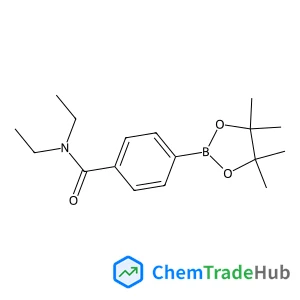
N,N-Diethyl-4-(4,4,5,5-tetramethyl-1,3,2-dioxaborolan-2-yl)benzamide
CAS番号:
325142-99-2
分子式:
C17H26BNO3
![2,6-Bis({(2R)-2-[hydroxy(diphenyl)methyl]-1-pyrrolidinyl}methyl)-4-methylphenol structure](https://static.chemtradehub.com/structs/877/877395-58-9-70bf.webp "2,6-Bis({(2R)-2-[hydroxy(diphenyl)methyl]-1-pyrrolidinyl}methyl)-4-methylphenol structure")
おすすめサプライヤー






免責事項
このページに表示される学術雑誌情報は、参考および研究目的のみを目的としています。当社は雑誌出版社とは提携しておらず、投稿の取り扱いも行っておりません。出版に関するお問い合わせは、各雑誌出版社に直接ご連絡ください。
表示されている情報に誤りがある場合は、support@chemtradehub.com までご連絡ください。迅速に確認し、対応いたします。