


Decorrelated singlet and triplet exciton delocalization in acetylene-bridged Zn-porphyrin dimers
文献情報
出版日
2023-12-19
DOI
10.1039/D3SC03327A
インパクトファクター
9.825
著者
Hasini Medagedara, Mandefro Y. Teferi, Sachithra T. Wanasinghe, Wade Burson, Shahad Kizi, Bradly Zaslona, Kristy L. Mardis, Jens Niklas, Oleg G. Poluektov, Aaron S. Rury
原文を見る
要旨
The controlled delocalization of molecular excitons remains an important goal towards the application of organic chromophores in processes ranging from light-initiated chemical transformations to classical and quantum information processing. In this study, we present a methodology to couple optical and magnetic spectroscopic techniques and assess the delocalization of singlet and triplet excitons in model molecular chromophores. By comparing the steady-state and time-resolved optical spectra of Zn-porphyrin monomers and weakly coupled dimers, we show that we can use the identity of substituents bound at specific positions of the macromolecules' rings to control the inter-ring delocalization of singlet excitons stemming from their B states through acetylene bridges. While broadened steady-state absorption spectra suggest the presence of delocalized B state excitons in mesityl-substituted Zn-tetraphenyl porphyrin dimers (Zn2U-D), we confirm this conclusion by measuring an enhanced ultrafast non-radiative relaxation from these inter-ring excitonic states to lower lying electronic states relative to their monomer. In contrast to the delocalized nature of singlet excitons, we use time-resolved EPR and ENDOR spectroscopies to show that the triplet states of the Zn-porphyrin dimers remain localized on one of the two macrocyclic sub-units. We use the analysis of EPR and ENDOR measurements on unmetallated model porphyrin monomers and dimers to support this conclusion. The results of DFT calculations also support the interpretation of localized triplet states. These results demonstrate researchers cannot conclude triplet excitons delocalize in macromolecular based on the presence of spatially extended singlet excitons, which can help in the design of chromophores for application in spin conversion and information processing technologies.
おすすめジャーナル

Russian Journal of General Chemistry

Nature Medicine

Organic Process Research & Development

Chemical Communications

Russian Journal of Bioorganic Chemistry

Chemistry Education Research and Practice

Journal of Peptide Science

Acta Materialia

Russian Journal of Organic Chemistry

Current Opinion in Solid State & Materials Science
関連文献
Actinide embedded nearly planar gold superatoms: structural properties and applications in surface-enhanced Raman scattering (SERS)
Jiehong Lei
2018-10-11
Paper
DOI: 10.1039/C8CP05350B
Control of TiN oxidation upon atomic layer deposition of oxides
E. O. Filatova, S. S. Sakhonenkov, A. S. Konashuk, V. V. Afanas’ev
2018-10-22
Paper
DOI: 10.1039/C8CP06076B
Self-assembled structure and dynamics of imidazolium-based protic salts in water solution
R. Vijayaraghavan, Douglas R. MacFarlane
2019-01-08
Paper
DOI: 10.1039/C8CP07254J
Molecular dynamics study on ions and water confined in the nanometer channel of Friedel's salt: structure, dynamics and interfacial interaction
Penggang Wang, Yuting Jia, Tao Li, Dongshuai Hou, Qi Zheng
2018-09-25
Paper
DOI: 10.1039/C8CP02450B
Isotope effect on hydrogen bond symmetrization in hydrogen and deuterium fluoride crystals by molecular dynamics simulation
Hichem Dammak, Fabien Brieuc, Grégory Geneste, Marc Torrent, Marc Hayoun
2019-01-21
Paper
DOI: 10.1039/C8CP06949B
Quantifying the influence of the ion cloud on SAXS profiles of charged proteins
Miloš T. Ivanović, Linda K. Bruetzel, Roman Shevchuk, Jan Lipfert, Jochen S. Hub
2018-10-02
Paper
DOI: 10.1039/C8CP03080D
Using microgels to control the morphology and optoelectronic properties of hybrid organic–inorganic perovskite films
Chotiros Dokkhan, Muhamad Z. Mokhtar, Qian Chen, Brian R. Saunders, Nigel W. Hodson, Bruce Hamilton
2018-10-05
Paper
DOI: 10.1039/C8CP05148H
Precise estimation of transfer free energies for ionic species between similar media
Carmen Esposito, Andreas Vitalis
2018-10-17
Paper
DOI: 10.1039/C8CP05331F
Mapping the dynamics of methanol and xenon co-adsorption in SWNTs by in situ continuous-flow hyperpolarized 129Xe NMR
Shutao Xu, Xin Li, Cheng Sun, Anmin Zheng, Weiping Zhang, Xiuwen Han, Xianchun Liu, Xinhe Bao
2019-01-15
Paper
DOI: 10.1039/C8CP07238H
Twisted scroll wave dynamics: partially pinned waves in excitable chemical media
Porramain Porjai, Malee Sutthiopad, Kritsana Khaothong, Metinee Phantu, Nakorn Kumchaiseemak, Jiraporn Luengviriya, Kenneth Showalter, Chaiya Luengviriya
2019-01-16
Paper
DOI: 10.1039/C8CP06948D
こちらもおすすめ
化合物よくある質問
間溴苯甲酰腈の市場動向や研究トレンドはどうですか?
間 brom 苯甲酰腈は、合成化学や薬物化学において重要な Intermediate として使用されています。市場動向としては、その合成性と機能性により、研究開...
24999-51-7(3-Bromophenyl)(oxo)...
287966-62-5Desulfo Glucoraphani...
化合物よくある質問
Methyl 2-amino-5-(trifluoromethyl)benzoateに適用される法規ガイドラインは何ですか?
CAS番号117324-58-0の塩酸メチル2アミノ-5-トリフルオロメチルベンゼートは、GHS分類により腐食性物質と判定されます。REACH規則では、製造、販...
117324-58-0Methyl 2-amino-5-(tr...
化合物よくある質問
3-ブロモ-1,3,4,5-四水化-2H-1-ベンザアゼピン-2-オンは安全ですか?
毒性があるため、適切な安全対策が必須です。皮膚や粘膜への刺激性が強く、吸入や誤飲により健康被害を引き起こす可能性があります。取扱時にはガスマスクや手袋、眼鏡を使...
86499-96-93-Bromo-1,3,4,5-tetr...
化合物よくある質問
三氟甲基ピリジン-2-甲アミン塩酸塩は安全ですか?
三氟甲基ピリジン-2-甲アミン塩酸塩は安全性に注意が必要です。毒性は低レベルですが、直接的接触や吸入は避けるべきです。適切な手袋や防塵マスクを着用し、密閉された...
871826-12-9(5-(Trifluoromethyl)...
化合物よくある質問
1-エチル-4-(4-硝基フェニル)ピペリジンは安全ですか?
1-エチル-4-(4-硝基フェニル)ピペリジンは有毒であり、取扱には注意が必要です。保管や作業中に手袋を着用し、目や皮膚に接触しないように注意する必要があります...
115619-00-61-Ethyl-4-(4-nitroph...
化合物よくある質問
1,1-ジメトキシプロパン-2-オンは安全ですか?
1,1-ジメトキシプロパン-2-オンは一般的に低毒性ですが、皮膚や目への刺激性があるため、取扱いには注意が必要です。蒸気や液体の吸入には有害な可能性があり、適切...
6342-56-91,1-dimethoxypropan-...
化合物よくある質問
コバルト(II) 3,3'-{[(1S,2S)-1,2-ジメチルフENCYCLICALE-1,2-エチエンジイル]ビス[ニトロリルメチルイリデン]}ビス[4-オキソ-2-ペンテン-2-olate]について「に適用される法規ガイドラインは何ですか?
この化合物はCAS番号259259-80-8に対応しています。GHS分類では、毒性、燃焼性、反応性、炎症性を考慮に入れ、適切な危険性分類が行われます。REACH...
259259-80-8Cobalt(2+) (2E,2'E)-...
化合物よくある質問
「カーバミル酸, N-[8-[[2-[[2-(2,6-ジオキソ-3-ピペリジニル)-2,3-ジオキソ-1,3-ジヒドロ-1H-イソイソインドール-4-イルオキシ]アセチル]アミノ]オクチル]-1,1-ジメチレチルエステル」はどのように保存すればよいですか?
この化合物は、冷却庫で-20℃の温度、乾燥した容器に保管し、直日光から保護する必要があります。湿度の高い環境や高温は避けてください。
1950635-34-32-Methyl-2-propanyl ...
1433975-21-3FMoc-D-4-Aph(tBu-CbM...
掲載誌
Chemical Science
CiteScore:
14.4
自己引用率:
3.9%
年間論文数:
1413
Our journal has a wide-ranging scope which covers the full breadth of the chemical sciences. The research we publish contains the sorts of novel ideas, challenging questions and progressive thinking that bring undiscovered breakthroughs within reach. Your paper could focus on a single area, or cross many. It could be beyond the accepted bounds of the chemical sciences. It might address an immediate challenge, contribute to a future breakthrough or be wholly conceptual. We’re a team from every field of the chemical sciences, and know from experience that breakthroughs that drive the solutions to global challenges can come from anywhere, at any time. You could even start an entirely new area of research. Too bold? Too progressive? No such thing
おすすめ化合物
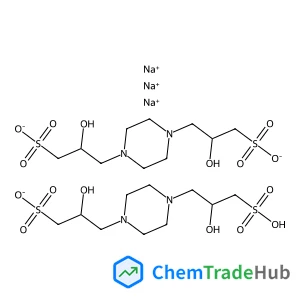
3,3'-(Piperazine-1,4-diyl)bis(2-hydroxypropane-1-sulfonic acid) Sodium Salt
CAS番号:
108321-08-0
分子式:
C20H41N4Na3O16S4
おすすめサプライヤー



免責事項
このページに表示される学術雑誌情報は、参考および研究目的のみを目的としています。当社は雑誌出版社とは提携しておらず、投稿の取り扱いも行っておりません。出版に関するお問い合わせは、各雑誌出版社に直接ご連絡ください。
表示されている情報に誤りがある場合は、support@chemtradehub.com までご連絡ください。迅速に確認し、対応いたします。