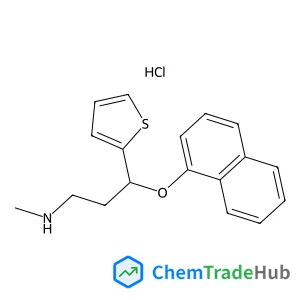
N-Methyl-3-(1-naphthyloxy)-3-(2-thienyl)-1-propanamine hydrochloride (1:1)
CAS番号:
1188266-11-6
分子式:
C18H20ClNOS
Zaira Ruiz-Bernal, M. Ángeles Lillo-Ródenas, M. Carmen Román-Martínez
Ru/C catalysts for the transformation of levulinic acid into gamma-valerolactone have been prepared using carbon materials with different textural and chemical properties, and morphology. In the mild reaction conditions used (70 °C, 15 bar H2, 1 h), all the reduced catalysts are active and selective, with similar behavior independently of the support's properties. Surprisingly, the un-reduced (as prepared) catalysts show also catalytic activity, which varies (from moderate to high) with the carbon support type, indicating that an in situ (under reaction) reduction process takes place. The catalysts prepared with the supports of lower surface chemistry are almost as active as their reduced counterparts, whereas those prepared with rich surface chemistry supports are noticeably less active, but become activated in consecutive runs. The size of the developed Ru particles depends on the reduction conditions (i.e., reduction treatment at 250 °C or reaction conditions) and is highly influenced by the support's surface chemistry, which determines the metal–support interaction.

Journal of Organometallic Chemistry

Molecular Pharmacology

Proceedings of the National Academy of Sciences of the United States of America

European Journal of Wood and Wood Products

Helvetica Chimica Acta

Planta Medica

Russian Chemical Reviews

Journal of Heterocyclic Chemistry

Nature

Pure and Applied Chemistry
DOI: 10.1039/C3CP50578B
Ying Dai, Baibiao Huang, Timo Jacob
DOI: 10.1039/C3CP51078F
Z. Y. Li, Roy L. Johnston
DOI: 10.1039/C3CP50978H
Z. Valy Vardeny
DOI: 10.1039/C3CP50639H
Mark Wilson, Chris J. Benmore, J. K. R. Weber, Paul F. McMillan
DOI: 10.1039/C3CP51209F
Javier Catalán
DOI: 10.1039/C3CP44627A
Paola D'Angelo, Valentina Migliorati, Riccardo Spezia, Simone De Panfilis, Ingmar Persson, Andrea Zitolo
DOI: 10.1039/C3CP50842K
Jing-Hua Guo, Yoshiyuki Miyamoto
DOI: 10.1039/C3CP50492A
Johannes Auerswald, Bernd Engels, Ingo Fischer, Thiemo Gerbich, Jörg Herterich, Anke Krueger, Melanie Lang, Hans-Christian Schmitt, Christof Schon, Christof Walter
DOI: 10.1039/C3CP44271C
Gabriel J. Cuello, Shinji Kohara, Chris J. Benmore, David L. Price, Eugene Bychkov
DOI: 10.1039/C3CP50536G
3-イチチルビフェニルは、ビフェニルとイチプロピオニトリルを回収率約90%で反応させて合成されます。触媒は通常、亜リチウムホウ素を用います。
8-溴-5-三氟甲基喹啉は、5-トリフルオロメチル-2-メチル-1,3-ベンゼンジオールをブロモエタノールと反応させて生成します。この反応は塩基性条件下で行われ...
ジメチル4-(4,4,5,5-テトラメチル-1,3,2-ドioxaborolan-2-基)-2,6-ピリジンジカルボイル酸フェニルアミニドの代替品としては、4-...
N-(3,5-ヘキサクロロ-4-ピリドインイル)-8-メチオキシ-5-キノリンカーボン酸の市場動向は、主に産業用途での需要により影響を受けます。研究トレンドとし...
イソステアロイルグリセリルは一般的に安全性が高いとされていますが、過度な使用や個人差により皮�owsん炎などの反応が起こる可能性があります。使用前に医師に相談す...
1-(二苯甲基)-3,3-二氟-氮杂环丁烷の市場動向は、医薬品や合成化学の研究分野で注目を集めています。新興研究は、該当化合物の合成改良と生体内での作用メカニズ...
3-チオフェンスチオールのCAS番号は7774-73-4です。結晶性の白色粉末で、分子量は122.17です。この化合物は水に微溶解し、エタノールやジクロロメタン...
2-Methyl-2-propanyl (2S)-2-(aminomethyl)-1-piperidinecarboxylateは一定の安全性基準を満たしていま...
CAS番号1316822-90-8の化合物は安全性に関しては評価が不足していますが、一般的には生物学的に活性な物質であり、取り扱いには適切な安全防護措置が必要で...
Tert-butyl 2-(2-羟基乙基)哌嗪-1-羧酸は、冷暗所で保存し、直射日光から遠ざけてください。容器は密閉し、高湿度や高温を避けて保管してください。

Reaction Chemistry & Engineering is an interdisciplinary journal reporting cutting-edge research focused on enhancing the understanding and efficiency of reactions. Reaction engineering leverages the interface where fundamental molecular chemistry meets chemical engineering and technology. Challenges in chemistry can be overcome by the application of new technologies, while engineers may find improved solutions for process development from the latest developments in reaction chemistry. Reaction Chemistry & Engineering is a unique forum for researchers whose interests span the broad areas of chemical engineering and chemical sciences to come together in solving problems of importance to wider society. All papers should be written to be approachable by readers across the engineering and chemical sciences. Papers that consider multiple scales, from the laboratory up to and including plant scale, are particularly encouraged.

![N-{[(2-Methyl-2-propanyl)oxy]carbonyl}-L-methionylglycine structure](https://static.chemtradehub.com/structs/234/23446-03-9-e1e5.webp "N-{[(2-Methyl-2-propanyl)oxy]carbonyl}-L-methionylglycine structure")