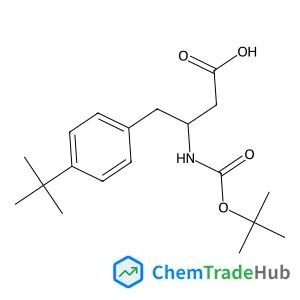
(S)-3-((tert-Butoxycarbonyl)amino)-4-(4-(tert-butyl)phenyl)butanoic acid
CAS番号:
403661-85-8
分子式:
C19H29NO4
Xiao Wan, Jiaxin Lin, Junjie Bai, Jingjing Li, Kaifeng Wang, Zhiyu Cao, Minggang Li, Xiaoguang Bao, Xiaobing Wan
Current strategies for activating amides primarily focus on secondary or tertiary amides. However, the activation of primary amides, the simplest form of amides, remains a significant challenge. In this study, we propose a novel approach that involves generating and intercepting RCONCl2in situ to activate primary amides under mild conditions. This method allows for hydrolysis and esterification of primary amides without the use of strong Lewis acid or transition-metal catalysts typically used in amide activation. We demonstrate the synthetic potential of this approach through late-stage modifications on complex molecules, tolerance toward over 20 heterocycles, and scalability. Mechanistic experiments and DFT calculations suggest that the formation of RCONCl2 and subsequent nucleophilic attack with hydrogen bonding assistance play crucial roles in this transformation.
Chitrarekha Dewangan, Sandeep Kumawat, Tarun Bhatt, Kishore Natte
DOI: 10.1039/D3CC05173K
Fei Tao, Qian Han, Peng Yang
DOI: 10.1039/D3CC90386A
Jixing Li, Ming Fang, Maoyan Liao, Hongling Xie, Xiu-Qin Dong, Jianwei Sun, Hai Huang
DOI: 10.1039/D3CC04355J
Yujing He, Jing Hu, Yunfei Tian
DOI: 10.1039/D3CC05121H
Muyun Xu, Xinrui Ma, Jessica E. Pigga, He Zhang, Shuli Wang, Weiling Zhao, Huaifu Deng, Anna M. Wu, Rihe Liu, Zhanhong Wu, Joseph M. Fox, Zibo Li
DOI: 10.1039/D3CC04212J
Ali Douaki, Annina Stuber, Julian Hengsteler, Dmitry Momotenko, David M. Rogers, Walter Rocchia, Jonathan D. Hirst, Nako Nakatsuka
DOI: 10.1039/D3CC04334G
Samuel J. Horsewill, Chengyang Cao, Noah Dabney, Eric S. Yang, Stephen Faulkner, Daniel J. Scott
DOI: 10.1039/D3CC04375D
3-イチチルビフェニルは、ビフェニルとイチプロピオニトリルを回収率約90%で反応させて合成されます。触媒は通常、亜リチウムホウ素を用います。
8-溴-5-三氟甲基喹啉は、5-トリフルオロメチル-2-メチル-1,3-ベンゼンジオールをブロモエタノールと反応させて生成します。この反応は塩基性条件下で行われ...
ジメチル4-(4,4,5,5-テトラメチル-1,3,2-ドioxaborolan-2-基)-2,6-ピリジンジカルボイル酸フェニルアミニドの代替品としては、4-...
N-(3,5-ヘキサクロロ-4-ピリドインイル)-8-メチオキシ-5-キノリンカーボン酸の市場動向は、主に産業用途での需要により影響を受けます。研究トレンドとし...
イソステアロイルグリセリルは一般的に安全性が高いとされていますが、過度な使用や個人差により皮�owsん炎などの反応が起こる可能性があります。使用前に医師に相談す...
1-(二苯甲基)-3,3-二氟-氮杂环丁烷の市場動向は、医薬品や合成化学の研究分野で注目を集めています。新興研究は、該当化合物の合成改良と生体内での作用メカニズ...
3-チオフェンスチオールのCAS番号は7774-73-4です。結晶性の白色粉末で、分子量は122.17です。この化合物は水に微溶解し、エタノールやジクロロメタン...
2-Methyl-2-propanyl (2S)-2-(aminomethyl)-1-piperidinecarboxylateは一定の安全性基準を満たしていま...
CAS番号1316822-90-8の化合物は安全性に関しては評価が不足していますが、一般的には生物学的に活性な物質であり、取り扱いには適切な安全防護措置が必要で...
Tert-butyl 2-(2-羟基乙基)哌嗪-1-羧酸は、冷暗所で保存し、直射日光から遠ざけてください。容器は密閉し、高湿度や高温を避けて保管してください。

Organic Chemistry Frontiers publishes high-quality research from across organic chemistry. Emphases are placed on studies that make significant contributions to the field of organic chemistry by reporting either new or significantly improved protocols or methodologies. Topics include, but are not limited to the following: Organic synthesis Development of synthetic methodologies Catalysis Natural products Functional organic materials Supramolecular and macromolecular chemistry Physical and computational organic chemistry