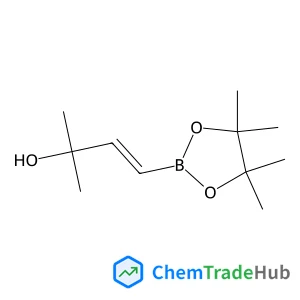
(E)-2-methyl-4-(4,4,5,5-tetramethyl-1,3,2-dioxaborolan-2-yl)but-3-en-2-ol
CAS番号:
581802-26-8
分子式:
C11H21BO3
Jing-Hong Li, Jun-Xian Chen, Rui-Biao Lin, Xiao-Ming Chen
The separation of gaseous hydrocarbons is involved in many important industrial processes for manufacturing chemicals, polymers, plastics, and fuels, and is performed through cryogenic distillation, which is heavily energy-intensive. Adsorption-based gas separation technology by using adsorbent materials can potentially fulfill a much energy-efficient gas separation. As a new generation of adsorbent materials, metal–organic frameworks (MOFs) have been demonstrated to have great potential in addressing important gas separations of hydrocarbons. In this review, we outline the uniqueness of MOF adsorbents for their separation application for gaseous hydrocarbons. A variety of microporous MOFs have been developed for separating gaseous hydrocarbons, which have been achieved by fine-tuning their pore sizes for high molecular sieving effects and/or immobilizing binding sites on their pore surfaces for their specific recognition of small molecules. Herein, we highlight recent important progress in this very important topic, focusing on the purification of ethylene, propylene, and butadiene.

Current Opinion in Colloid & Interface Science

Russian Journal of General Chemistry

Saudi Pharmaceutical Journal

Russian Journal of Organic Chemistry

Drug Discovery Today

Organic Process Research & Development

Russian Journal of Applied Chemistry

Acta Materialia

Nature Medicine

Russian Journal of Coordination Chemistry
Preeti Dagar, Nandan Ghorai, Manisha Bungla, Hirendra N. Ghosh
DOI: 10.1039/D3CP90230G
Kuldeep Singh Negi, Nilimesh Das, Tanmoy Khan, Pratik Sen
DOI: 10.1039/D3CP03357K
Ghulam Hasnain Tariq, Ghulam Asghar, M. Shahzad Shifa, M. Anis-Ur-Rehman, Sana Ullah, Zulfiqar Ali Shah, Ahmed M. Tawfeek, Farooq Sher
DOI: 10.1039/D3CP04332K
Hao Wang, Yuan Li, Jiao Han, Caishun Zhang, Honghao Wang, Daosheng Liu, Xiaoning Hou, Lei Zhang, Zhixian Gao
DOI: 10.1039/D3CP03885H
Jia-Ben Song, Yun-Hao Zhang, Yu-Feng Li, Jia-Cheng Zhang, Xu Liang, Zhen-Dong Sha
DOI: 10.1039/D3CP04280D
6- bromo-1-cyclopropyl-1H-benzimidazoleは、抗炎症、抗ウイルス作用を持つことが報告されており、新薬開発の研究対象として注目...
取り扱う際には、防護眼鏡と手袋を使用し、ドラフトチャンバー内で操作することを推奨します。漏洩時には適切な手順で処理し、安全データシートを常に参照してください。
2,2’-ジメチル-3,3’-ビピリジンは、ピリジンと2-メチルアクリルアミドを有機合成反応で合成します。この反応では、ピリジンと2-メチルアクリルアミドを含有...
6-甲基ピリジン-2-ボリック酸は、合成化学、医薬品合成、以及研究用途などに広く使用され、特に組換えDNA技術や分子生物学の研究において重要な役割を果たします。
(R)-3-(1-甲基-2-氧環己基)プロpano酸メチルは一定の安全性がありますが、直接的な皮膚接触や吸入は避けるべきです。使用する際は適切な個々の安全データ...
ketorolacは、密封して遮光容器に保管し、直射日光や高温を避けて保存してください。温度は常温で保存し、湿度をなるべく低く保つことが推奨されます。
L-2,3-二氨基丙酸二盐酸盐は腐食性が強く、皮膚や粘膜に刺激を与える可能性があります。取り扱う際は、防塵マスク、ゴーグル、手袋を使用し、適切な排気設備を使用し...
2-(4-溴ピリジン-2-基)乙腈のCAS番号は312325-73-8です。主に結晶形態で存在し、分子量は159.01 g/molです。この化合物は水に溶けやす...
この化合物は毒性は低いですが、直接的な接触や吸入に注意が必要です。PPE(個人防護具)を着用し、ドラフトチャンバーを使用して操作することを推奨します。また、漏洩...
3-(1-氧代-1,3-二氢-2H-2-异吲哚)丙酸は、薬理学研究や医薬品製造において広く用いられる化合物です。また、工業的な用途でも一部の化学反応の触媒や助剤...